Playing long balls into empty space since 2012.

Wednesday, 23 March 2022

Well, it’s in the paper!

Newspaper records of soccer and Rugby League in Newcastle in the 1920s


This research idea is based on the hypothesis that soccer in Australia achieved a level of popularity and growth in the 1920s that is often overlooked. In some areas of Australia, particularly Newcastle, the game may indeed have been the dominant code for well over a decade, if not even longer.


Guided by this assumption, I searched Trove to ascertain the extent to which soccer achieved substantial recognition in a variety of local media. My first search was ‘soccer’ in the Newcastle Morning Herald, which was a present term in over 4500 items (articles, lists and advertising) in the newspaper during the 1920s. During the same period ‘Rugby League’ was present in 2400 items. A similar comparison in the Illawarra mercury revealed 1470 soccer items as against 693 for Rugby League. The Brisbane Telegraph revealed numbers that were roughly equal (over 9000 each) during that decade. Surprisingly, the Ipswich newspaper recorded 4000 Rugby League items to soccer’s 3000–the 1927 split seemingly having a retarding influence on soccer numbers at the end of the decade. Despite the Ipswich result, this data largely aligned with my original assertion that soccer was a dominant code in Newcastle and elsewhere in the 1920s. The Brisbane and Ipswich figures indicate a code that is equally dominant with Rugby League. 


A number of questions arise from these observations. 


  1. How useful are the search terms?

  2. Do the Trove searches find substantial and relevant items?

  3. How reliable is the newspaper content?

  4. What is the correlation between newspaper content and cultural reality?


  1. Are the terms ‘soccer’ and ‘Rugby League’ useful catch-all terms in the newspapers? Are they inclusive enough to capture all relevant items while excluding irrelevancies. Will they capture enough of the data to make the statistics accurate? My sense is that they are adequate; however, I need to pay attention to alternate terms: ‘BA rules’, ‘Association football’ for soccer, and ‘league football’ for Rugby League. Though again, I suspect these factors are not enough to skew the data.

  2. Can I trust that the Trove searches find substantial items? Or do a great proportion of them represent incidental references? A brief perusal of the hits suggests that most items have a direct and substantial reference to the game under search. It seems that in the Newcastle papers, lists and advertising make up approximately one third of the total items. For soccer, the Newcastle Sun includes 3500 articles, 1200 lists, 600 advertisements while for Rugby League the figures are 2100 articles, 520 lists, 330 advertisements. A similar spread exists in the Herald. The Maitland Daily Mercury yields for soccer: 1000 articles, 276 lists, 83 advertisements; and for Rugby League 1350 articles, 241 lists, 153 advertisements. In the Maitland figures, lists and advertising make up approximately a quarter of the total items.

    Sporting representation in three Newcastle region newspapers in the 1920s

Newspaper

sport

articles

lists

ads

total

Newcastle Morning Herald

soccer

3082

898

536

4516


Rugby League

1654

287

442

2383

Newcastle Sun

soccer

3500

1200

600

5300


Rugby League

2100

520

330

2950

The Maitland Daily Mercury

soccer

1000

276

83

1359


Rugby League

1350

241

153

1744


  1. Are the newspapers chosen representative of actual numbers or do their editorial policies hold a distorting bias? For example, the Newcastle Sun during the period had over 5000 items that referred to soccer and 3000 that referred to Rugby League–a similar difference to the Herald. The Maitland Daily Mercury, however, had more references to Rugby League over soccer (1750 to 1350). This latter figure may represent a regional preference for Rugby League or it may itself represent bias towards Rugby League. My sense is that the Newcastle Morning Herald and the Newcastle Sun as the main newspapers of Newcastle at that time are likely representative. Because the Sun contains most items relating to each code I will provisionally establish it as the more significant reporter for the whole region. 


  1. Can a correlation be assumed between representation in the newspaper and 1) what is actually happening in a sports culture and 2) the extent to which a regional culture accepts a game as its own? This is a general/theoretical question that applies to all locales and cultures that are represented by a newspaper.


Notes for later work

  • Cumberland Argus: soccer 2000 Rugby League half that

  • Sydney Morning Herald: rugby combined 9000 soccer 1500

  • Referee newspaper: RL 300

Thursday, 8 July 2021

100 Years Ago Today, July 8 1921

Queensland Times (Ipswich), Wednesday 6 July 1921, page 6


LINKS WITH THE PAST. 

Compiled from files of the "Queensland Times," of 25 years ago, 1896.

British Association Football--Ipswich Rovers trounced the Bundanba Rangers by 1 goal to nil, P. Levesey refereeing; and the Brisbane Thistles were beaten, on the Pineapple ground South Brisbane, by the Second Bush Rats by 4 goals to 3. 


Armidale Chronicle, Wednesday 6 July 1921, page 3


SOCCER Armidale City met the renowned Cessnock team (Newcastle) on Saturday last, giving one of the finest exhibitions of football played at home this season, the home team leading by one goal to nil ten minutes from time. Constant practice told its tale, and Newcastle led by three goals to one on the final whistle. The teams were:—

Armidale City.—A. Woodcock, W. Gill, A. Ridley, C. Lesnic F. W. Mil ner (capl.), Dr. Austin, W. Leach, R. Woodcock, .1. M'Avoy, and II. Bishop.

Newcastle.—G. Wells, G. Williams, Li. Buskins, G. Nixon, G. Runncx (cap tain), D. Harden, C.'Williams, G. Roe, •T. Shang, D. Leonard, and II. Wil liams.

Mr. O. V. Williams (President) kicked off for the City, commencing the game al 3.15 p.m. McAvoy securing passed to Bishop, who centred, G. Williams eofending aldy. Play was transferred into the City territory, a combined movement by Newcastle ending in Shang shooting wide. Con tinued pressure by them resulted in their ciTorls meeting with no success, owing to ihe high standard of the lo cal defence, Milncr, Handley, and C. Lcsnic showing out conspicuously. Milner relieving, sent lo Woodcock, lo McAvoy, to Bishop, who drove a high dropping sliot into goal, which was well cleared by Wells. Play was transferred lo mid-field, where even play look place. Rennex securing, again transferred play into the City's territory, but once again the home defence prevailed, Gill and Ridley proving their stumbling block. Bach side look up the attack, Ihe wing men showing cleverness, their centreing being all that could lie wished, hut weakness of the inside men spoilt their efforts. Half-time arrived with no scores. \

On resuming, Newcastle kept up Ihe attack for ten minutes, Milncr re lieving the pressure, sending to Lesnie, to Austin, who, travelling down the wing, centred, and Bishop' securing, opened the scoring with a fast, low drive, giving Wells no possible chance. Even play from the kick-ofT followed, Newcastle having the better - of the exchanges, but could not break through the homo defence. Auslin, Lesnie, and R. Woodcock broke away

occasionally,'hut they found lloskins

and Rennex hard to beat. A move ment starling from Nixon, to Williams, Lo Roe, lo Lennard, In E. Williams, who centred, and Woodcock, owing to Hie slippery state of the ball, could not hold it, ended in Shang rushing the ball through, equalising for ' New castle. Willi five minutes to go, New castle attacked in earnest, and once again, owing to a misunderstanding be tween (he local hack and goalie, Roe touched the hall past Ihe latter, secur ing the lead 2—1. Willi three minutes to go, Newcastle scored again, Ren

ucx securing, and passing to Nixon, to Roe, to C. Williams, who, travelling at top speed, beat Milner and Ridley, sending in a lovely siiol to the riglil side of the goal, high up, giving A. Woodcock no chance, rfliu. !ly after the whistle hlew, leaving Newcastle the winners hy lliree goals to one.

Newcastle were deserving of their victory, their combination, especially the forwards, being worthy of high est praise in the second half. Up, ten minutes from time, Armidale appeared lo he certain winners, but constant playing by the Newcastle team stood them at the finish. No individual play can be quoted of the Newcastleites, combination being their premier excellence.

For Armidale, Rishop's goal was a scorcher, and Handley was the best on field in the defence. R. Woodcock did not play up to his reputation, but G. Uesnie played his best game of the season. Milner, Gill, and Ridley play ed up-to their usual good standard, but A. Woodcock was extremely un fortunate in two goals being scored against liini owing to the slippery na ture of the ground. Dr. Austin play ed an excellent game, whilst his condi tion lasted, hut his final efforts were inclined to lie weak.

Visitors Entertained.

After the match the Armidale players had dinner with the visiting team, and entertained them later at a smoke concert at the Albion Hotel.

The Mayor (Ald. A. Purkiss) presided, and gave the toast of "The King." The Mayor extended a hearty welcome to the visiting team. Soccer, he said, was in its infancy in Armidale, and he did not know much about the game, being more conversant with Rugby. Nevertheless there must be something in Soccer to bring visitors all the way from Cessnock to give Armidale a game. He hoped their slay in Armidale would be a pleasant one.

Mr. F. W. Milner proposed the health of "The Cessnock Soccer Club." The locals were highly delighted and intensely gratified when they heard the Cessnock Club intended to pay a visit to Armidale, simply to give a helping hand to "Soccer" in the country districts. Thcy had travelled at their own expense to push things along in Armidale. No doubt Soccer was making big strides in New South Wales. A lot of Soccer was being played in and around Sydney, and it had got a footing in the country districts. It was being played in Glen Innes, Tenterfield, and the Kentucky Soldiers' Settlement had also a good team. The ladies were taking the game up. He felt sure Soccer was here to stay.

Mr. H. Stevenson replied. Cessnock had been playing Soccer for a number of years. He knew he was expressing the best wishes of the visiting players when he hoped Armidale would develop into a champion Soccer team. He hoped an effort would be made to get the game into the schools, for the boys of to-day were young enough to make the Soccer players of the future.

Mr. G. Renncx proposed the toast of the Armidale Soccer Club." He, too, would impress the Armidale players with the necessity of getting the school boys to play the game. Cessnock's experience' had been that the schools had taken the game up seriously, and many of their seniors had learnt it in the schools. He had played both the Union and the League game, but for a scientific display they were not to lie compared to Soccer.

Mr. O. V. Williams (President) replied on behalf' of the Armidale Soccer Club. He was delighted that the visitors had came along. There had been some talk of postponing the game owing to the wet weather, but, after considering the whole matter, il was decided to let the visitors make the journey. They felt they had met a real good lot of sports, for they had played a nice, clean game, and he thought both sides had enjoyed it. He looked forward to taking an Armidale team to Cessnock, and he was sure the local men would give them a good game.

During the evening songs were sung by Messrs. W. Gill, P. Woodcock, J. Gardner, .1. Giles, S. Nixon, T. Bishop, S. and C. Leslie, and a recitation given by Mr. F. W. Milner.

On Monday morning the visitors were the guests of the Mayor, who look them for a motor trip round Armidale.

Mr. G. Stevenson, on behalf of the visitors, expressed their indebtedness In the Armidale people for all their kindness.


Armidale Chronicle, Saturday 9 July 1921, page 7


Armidale City played a return match with the renowned Cessnock team (Newcastle) on Monday last, reversing their defeat of Saturday last. The home team proved victorious by two goals to one. Both teams made a couple of alterations to the sides which played on Saturday. For Armidale, Cameron, S. Lesnie, and Herron replaced Leach, Handley, and Dr. Austin (absent, owing to injuries); for Newcastle, G. Rennex and G. Wells were replaced by S. Williams and D. Pendergast. Mr. Hanks refereed.

Mr. O. V. Williams (President of the local Club) again kicked off, towards the grandstand. S. Williams cleared. Darwell secured, and passed to E. Williams, who made progress to the City's goal. Gill relieved with a powerful kick, and play was transferred to mid-field. Even play followed until Milner, trapping the ball, passed to R. Woodcock, to Herron, to Cameron, who beat his opponents in line style, finishing up his run by centreing accurately, and McAvoy shooting within inches of the post. From the goalkick, E. Williams secured, and, travelling down the wing at top speed, C. Williams missed by yards with his shot at goal. Cameron once more got possession, and, beating the opposition, centred accurately from the corner flag, where bishop, following up, had an easy task in opening the scoring. Both E. and C. Williams, for Newcastle, showed great pace, the former time and again beating S. Lesnie, and leaving him behind. From a good kick by Ridley, Milner passed to R. Woodcock, who sent in a terrific shot from thirty yards out, only to see the

ball hit the goal post and bounce back into play. Give-and-take play followed afterwards, but neither side could add to the score. Both defences proved superior to the attack. Half-time arrived with Armidale leading by one goal to nil.

On resuming, Armidale took up the attack, and for the first ten minutes overwhelmed the visitors' defence, at tempts being made by R. Woodcock, Milner, Cameron, Bishop, and McAvoy, but Wells proved an adept at dealing with them. Newcastle then took up the offensive, and powerful shots by E. and C. Williams found A. Woodcock on the alert. One save in particular was a masterpiece, Woodcock turning the ball around the goal-post when a score seemed a certainty. Not to be denied, Newcastle continued to press, and C. Williams, securing the ball in mid-field, made a magnificent

individual run, beating Milner, Ridley, and Gill, and sending in a terrific

shot, gave Woodcock no possible chance, making the scores one goal each. This acted as a tonic to the local team, who tightened up their attack, and several attempts were made to secure the lead again. A shot by Bishop had hard luck to miss by inches. The home forwards were outplaying the visitors, their combination being the best seen this season. Long passing was a feature of the play about this time, and on occasions it found the Newcastleites standing still,

owing to the suddenness of transfer of play from one wing to the other. One of these long passes ended in Armidale securing the lead. Milner passed to McAvoy, to Bishop, who, noticing the right wing unmarked, whipped the ball across to Cameron, to Herron, who sent in a perfect centre, and R. Woodcock jumping up, met the ball and headed it through into the top right-hand corner of the net—as pretty a goal as one could wish to see. From this onwards Armidale kept up the pressure, but the visitors defended stubbornly, and no further score was added. The final whistle found Armidlie pressing, and the home team ran out winners by two goals to one.

The combination by the local team displayed in the second half was the best produced this season. The long passing game completely beat the visitors' defence, when indulged in. This is a practice the local men should remember. Ridley was unfortunate in receiving a heavy blow in the face during the early part of the game, which affected his play in the first half. Gill was most reliable, playing his soundest game of the season. C. Lesnie and F. W. Milner were beyond comparison, their tackling and clearing being a sight to see. Cameron was a bone of strength in the forwards. The locals are lucky in having secured such a player. R. Woodcock and McAvoy showed up prominently, but should keep up closer to goal when the wing men centre the ball. They give the opposition too many opportunities to clear. Newcastle adopted the same tactics as on Saturday, E. and C. Williams, on their respective wings, showing brilliance, but the inside men did not support them too well. Hoskins experienced bad luck in having his wrist sprained ten minutes before time. He played a sterling

game.

Meeting of Committee.

On the day's play Armidale deserved their victory, and were extremely unfortunate to lose on Saturday.

The Club held its weekly meeting on Tuesday last. Mr. F. W. Milner occupied the chair, and there was a good attendance. It was decided to invite West Wallsend to Armidale at an early date. It was also pleasing to note that the High School had decided to adopt the Soccer code, in view of which the Club is donating a football. On Wednesday, two elevens from the High School participated in a friendly game, which the boys greatly enjoyed. It was decided that should the other schools wish to play Soccer, a member would be in attendance at any time to teach them the rules of the game. After the football meeting the Dance Committee got busy, and completed arrangements for the Soccer dance, which is fixed to take palce on July 12th.


Sun (Sydney), Wednesday 6 July 1921, page 4


SOCCER

GIRLS IN TRAINING

Chewing Gum and Giggles

"What are the red flags for?" asked a big strapping girl, attired in a bathing costume, white shoes and stockings, and gold armlets, at the Wentworth Oval last night. "Them's the goals, silly," said an other girl, not quite so big, but similarly attired. 

Last night the Sydney Ladies' Soccer Club, held its first try-out with the ball, and a varied assortment of styles in femininity and fashion turned up with enthusiasm. After half an hour on the field they learned to kick the ball in something like the way that it should be kicked— a few stubbed toes soon taught the lesson. There were tall and hefty girls, short und wiry girls, and girls betwixt and, between. Mostly they were clad in bathing costumes, and as it was rather a chilly night the new footballers would have been glad to play even chasings in order to keep warm. A few girls wore shorts and shirts, and one affected a smart black bow-tie at the collar of her silk shirt. A few Woollen jumpers were worn on top of bloomers, and handkerchiefs or bathing cups kept troublesome tresses within bounds. The railings became wardrobes, and here and there a coat or a mackintosh or a fur coat was hooked on top of the fence. 

REPAIRs WHILE YOU WAIT 

It would seem that girls nowadays are not possessed of good stout shoes, for the Soccer ladies wore slightly light slices with Louis heels. Sensible ones wore boots or sandshoes, but they were in the minority. Before the game was over heels were left in the mud, and later on in the dressing-room there went up a cry: "Has anybody got a hammer?" The Indispensable man produced the necessary Implement and oornrrt reed nailiig shoes and licels to gether, amid chqers. nd all the while the chewing went on— the jaws moved round with un canny precision, and no matter where you looked you could not escape that hcri .ble move men'. Even the ripple of giggles and delightful feminine shrieks of excitement did not stop the eternal chewing. On the field the girls were eagerness itself and while waiting for sides to be picked some jawed ill over the oval, some turned Catherine wheels, some walked on their hands. The ground was not only damp, It was wet, and the girls who turned somersaults soon looked as If they had been In a Rugby scrum. "When the game commenced in earnest tl e fun commenced also. An occasional thin "Hee-a-o-ugh!" was answered by t burly "Hu-o-o-ugh!' from the other side of the paling fence. Women must be beginning to feel the delightful triumph of doing some, king during which mop can be kept on the wrong side of tho fence. THE INDISPENSABLE HAIRPIN Just as the game was starting one of the backs wanted a hairpin, and the centre-forward offered to run to the dressing room, but an 'obliging In side hg.lf came to the rescue. Then the whistle blow, and the ball was off. It was chased across the field and back again, to the accompaniment of laughter and screams, with a few go'od kicks to balance things. In a critical moment' there was a yell, "Where's the back?" bqt. the 'back was chasing up somewhere In the rear. Then the game concentrated round one goal post, and there were plaintive walls from the darkness at the other end of tho field, "Eh, aren't we playing too? We're getting cold." More spills and kicks, and the ball' came back again to a goal. | GOSSIP- OH There- wero cheers and an Interlude for gossip, or the adjustment of shoe laces and the rubbing of sore places. Then a lull came — the chatter stopped, but the chewing continued — and a voice roared, "What's wrong? Kam-buk wanted?"' That was enough. The game started again with renewed vigor and increased Blcill. A second goal was scored by the samo side, and the opponents' zeal wus challenged. "Bull In the centre!" cried one of the Instructors again, and the girls took their places for the last game.- Thoy chased and kicked, put out their arms to grab the ball — ("Keep yer arms down!" yelled the referee) — slithered on tho grass, lost the handkerchiefs off their hair, shrieked with excitement or set their (faces In grim determination, and by dint of good luck and good play the losing side retrieved some of Its reputation by scoring a goal. "Yah, yer needn't be so skittish. We got two, so's "alright!" cried a mem ber of the winning team, as everybody plcked,up their belongings, collected rings and bangles and ear-rings fron\ tho pockets of an obliging man, and returned to the dreBsing-room. The sounds of massage, slapped flesh, and shower baths were mingled with the hummed tune of "By Jingo, Oh, by Gee!" as two girls — still. In bathing costume and bare feet — essayed a one-stop. When Miss Alexander (tho pre sident) arrived she asked the girls If the" wero enthusiastic enough to como along to practice next Tuesday. "Too right, we will!" was the ringing chorus. And after the first night's practice the Soccer players shaped so well that some good games should be seen in tho near future. If enthusiasm helps any, tho Sydney Soccer .Ladles' Cldb will certainly mako good. At tho ond of play last night a meet ing was held, and Miss Beth Keogh was elected secretary In place of Miss Flnl-gan. Miss M. Keogh was elected to tho management committee.

Telegraph (Brisbane), Thursday 7 July 1921, page 4


SOCCER FOOTBALL

FINAL STAGES OF PREMIERSHIP PADDINGTON GIRLS FORM A CLUB

By "RIGHT HALF."

A Soccer football club for girls has been formed at Paddington. It is named the Latrobe Ladies Football Club. It has already 14 playing members, and practice is in full awing. A lady connected with the club writes to Mr. William Betts, the well known physical culture instructor, who is convening a meeting to be held in the Brisbane Gymnasium on Friday evening, at 7.30 o'clock, as follows: "In to-night's (Monday) 'Telegraph,' I saw where the first definite move in the direction of forming women's football clubs was being made. I am pleased to state that we formed a ladies' Soccer football club on Tuesday last. We have 14 playing members already. I am sorry your meeting is to be held on Friday night, as our members are then holding an evening, Still I shall be very pleased to have an interview with you on the matter." 


Toowoomba Chronicle, Friday 8 July 1921, page 7


GIRL FOOTBALLERS.

https://trove.nla.gov.au/newspaper/article/253706481


Table Talk (Melbourne), Thursday 7 July 1921, page 38


The Australian Cricketers in England

A LETTER FROM EDGAR MAYNE.


"We arrived in England last Friday and were invited to see the Cup Final at Chelsea. Seventy-two thousand people paid for admission, and then they to close the gates, turning thousands away. The "gate" was £13,000. The King and Duke of York were present and went out and shook hands with the players before the game started, although it was raining. After the match was over the King presented the "cup" to the captain of the winning team and a medal to each of the players. It was the first game of soccer I have seen, and although the conditions were very bad owing to the rain, the players struck me as being wonderfully clever. It is really football, as the players are not allowed to handle the ball, and I think it is faster than our Australian game. It was wonderful to see the vast crowd sitting out in the rain, and I didn't think there were as many caps in the world as I saw on Saturday.


Dockerty Cup replay

N&D 1 Melbourne Thistle 0

League I

Albert Park 1 St Kilda 1

Windsor 4 Preston 1 (game abandoned)

League II

Welsh Utd 2 St David's 1

Thistle A 7 Preston A 1

Sunday, 27 June 2021

100 Years Ago Today, 1 July 1921

 Daily Standard (Brisbane), Thursday 30 June 1921, page 4


Six young ladies In Toowoomba are endeavoring to form a Soccer football team, and the nurses at the Toowoomba and Willowburn Hospitals are being invited to down swabs and thermometers once or twice a week and join in. There should be a great trade in hair-pads when the darlings of the Downs set to work at Soccer, for there is a lot of head work in the British game. The reporters will have to be very circumspect in their criticisms of the game; that is if they are males, for only a lady knows how another lady feels.


Sun (Sydney), Friday 1 July 1921, page 2


WOMEN TO PLAY SOCCER

ASSOCIATION FORMED

A meeting was held under the auspices of the Metropolitan (Soccer) Football Association, at the Sports Club, Hunter-street, last night, to consider the formation of a Women's Soccer Football Association. There were over 30 ladies present. Mr. W. Lincoln, president of M.F.A., presided, and other officials present were Messrs. G. K. Martin (hon. secretary), Mr. F. West (president M.J.F.A.), and K. Jones, F. Langford, W. McAllister, C. Robinson, W. Chapman, and E. Drew. The ladies watched the proceedings with interest, and were keen for the formation of an association. Some of them had played in Canada, New Zealand, Great Britain, and Melbourne. It was decided to form an association, to be called the Sydney Ladies' Soccer F.A. The following wore elected to the necessary positions: — President, Miss M. Alexander; hon. secretary, Miss D. Finigan; hon. treasurer, Mrs. S. Reed; management committee, Miss M. Thomas, M. Charters, B. Keogh, Z. Maine, and M. Bush. The ladies were given an invitation to attend two first-class Soccer football matches at, Wentworth Park Oval to-morrow. The first management committee meeting of the new organisation will be held next Monday at the Sports Club, and the first practice match will take place at Wentworth Park Oval on Tuesday night.


Week (Brisbane), Friday 1 July 1921, page 18


SOCCER FOOTBALL.

FORMATION OF WOMEN'S CLUBS

By "RIGHT HALF."

Quite a craze has set in in Sydney for the formation of women football clubs, and Brisbane has become infected with the idea through the Soccer code. Women play Soccer in Great Britain, and in France, in which countries the game is considered the most suitable for those women who want to play football. Both the Sydney and Brisbane Soccer Associations are alive to this fact, and in the former place a move has already been made in the direction of running women's clubs. The Queensland body considered the matter at its meeting this week. In the meantime, correspondence is invited from those girls who are interested in the formation of such clubs.

In England last season, the French women Soccer footballers defeated an English team by 2 goals to 1. A huge crowd witnessed the game. I remember reading a description of the match—or, at least, a description of the girls who. played in it. The writer was too much hypnotised by "bare knees, adorned by the most fascinating of dimples" to write much about the match itself. He described one French player as "the prettiest little thing who ever strayed off the cover of a magazine on to a football ground." Some kid! as the American would say. The football critic did not stop there. "She is the smallest member of the team." he wrote, "but has a figure like a more solid Venus di Medici." Ye gods!

What a crowd a few such players would attract at the 'Gabba.

The question has been raised whether or not the Australian girls are of a sufficient physique to play football. I was talking the matter over with an official of the Q.F.A. the other day and he pointed out that the Brisbane girl was not so big, strong, and well developed as the Lancashire girls. The English XI, which played France, it might be mentioned, was comprised mostly of girls from the factories of Lancashire, but although they were a heavier combination than the French women. they failed to win. This, of course, goes to prove that it is not always weight that counts in Soccer. Science is almost variably the deciding factor. The French team was drawn from the magasins and offices of Paris—long, thin girls; short, nuggety girls; big, lumpy girls; and dainty, shapely-girls.

Why, the smallest member of the French team Mdlle. Rigal, the girl with the "fascinating dimples," was the trickiest player on the field. Surely, in face of this, no one can deny that the material for women Soccer, teams is available in Brisbane.

"Miriam" (Kangaroo Point), as though anticipating my thoughts on the above subject, writes under yesterday's date, as follows: "I have been a constant visitor this season to the 'Gabba, and while watching the games there I have often thought what great fun it would be if the contestants were women instead of men. I notice that attempts are being made in New South Wales to form football clubs for women, but the only game of the different codes that appeals to me and most members of my sex, is Soccer. I should be glad if you would publish this letter in

your Soccer notes on Thursday-  if only Messrs. Kendal, Hildreth, and Co. make a move in the matter, I am sure you will find that quite a number of girls will come forward. Several of my friends have already made up their minds in the matter.

TOOWOOMBA WOMEN TO PLAY.

Word has been received in Brisbane that a movement is on foot to start women Soccer clubs in Toowoomba. The secretary of the B.F.A. in the Downs city states that several girls have approached him in the matter. An invitation has been issued by the executive to other members of the fair sex. who wish to play Soccer, to send in their names. It is hoped to form two clubs, almost immediately.


Beaudesert Times, Friday 1 July 1921, page 6

Tuesday, 22 June 2021

100 Years Ago Today. 27 June 1921


Daily Standard (Brisbane), Friday 24 June 1921, page 7


FOOTBALL; SOCCER

(By "WANDERER.")

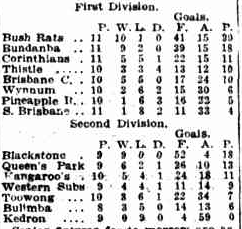
The positions of the senior clubs up to an including games played on June 18 are as follows:-

….

The match of the day will be played at Bundanba. Bush Rats are leading Bundanba in the competition by two points, and the team that wins this game will probably take the premiership. Bundanba, who, like the. majority of the Ipswich teams, are hard to beat on their own ground, may win. Wynnum, who are at home to South Brisbane, should annex two points.

Tristram Bros, have presented a handsome shield to the Q.F.A. for competition. The competition will be run on the knock-out principle, and the draw for the first round to be played on July 9 resulted as follows:

Western Suburbs v Queen's Park, Bush Rats v Pineapple Rover, Toowong v Kangaroos, Thistle v Blackstone, Bulimba v Corinthians, Wynnum n Kedron, Brisbane City bye. 


Newcastle Morning Herald and Miner’ Advocate, Monday 27 June 1921, page 6


WESTON

Among a large number of letters and telegrams of sympathy received by Nurse Pearce on the occasion of the death of her son were those from Weston Town Bank, CessnockBank, Methodists Ladies Church Aid, Weston L.O.L, Weston Prodestant Federation and Hebburn Colliery Survey Staff. Floral tributes were received from Deputies and Shot-firers, Weston Soccer Club, Weston Rugby League, Weston Town Band, Wenton Band Ladies' Committee, Cessnock Band, Hebburn Survey Staff, Mr D. Roach, Lance and Lizzie Charlton, Weston L.O.L, Elsie Marsh, Mr. and Mrs. Langford, Mr. and Mrs. Ridley, Mr. and Mrs. Hadfield, Mr. and Mrs. Hector, Mr. and Mrs. Fairfall, Mr. Roderick and family, Nurse Hawkins, Nellie and Joe Ruddley, Charlie, Harry and Bert Wrighton. The Rev. D. Weatherall, referred to the fine manly qualities of the deceased, the outstanding feature of his life being his devotion to his widowed mother. He was an enthusiastic Soccer footballer and played his last game on June 11 for Weston. 


The Week (Brisbane), Friday 8 July 1921


DEATH OF MR. EDWINM ALDRED

By “RIGHT HALF”

Soccer devotes in Brisbane will regret to learn that Mr. Edwin (Teddy) Aldred, who before he went to Sydney in 1913 played for Bulimba, is dead. Before coming to Queensland from England, the deceased had played with Leeds City II. He played with Bulimba for several years, and in 1913 he accompanied the Mayor of Brisbane’s (Ald. C. M. Jenkinson) team to New South Wales, when he played a wonderful game, and was partly responsible for the Queenslanders turning the tables on New South Wales for the first time in some years. He did not then return Brisbane, and afterwards qualified for Northern Suburbs, Sydney, and afterwards transferred to the Sydney District Club. When war came he enlisted and fought with the A.I.F. until the declaration of peace. He reappeared in Sydney over a week ago as goalie for Campsie against Pyrmont. According to “Referee” he remarked after the game that he “felt as fit as any fiddle and hoped to return to his usual form within the next few weeks”, but died the following Monday. While the Queenslanders were in Sydney recently, Mr. Aldred acted as their trainer. His death comes as a great shoch to his friends in the Bulimba Club and the interstate players who met him recently. 

(Note: Aldred died on June 20th and obituaries were published that week. This report, which came a fortnight later, is the most clear summary of his career. It should be noted the despite references to Aldred playing for Bulimba for a number of years, there is no reference to him in connection to Australian soccer before 1913 with Bulimba, the interstate games and his move south. He played in 1914, and had most recently been seen in 1919. According to Birth, Deaths and Marriages, he died at the age of 47.) 


Women’s Soccer Rumblings. 

Darling Downs Gazette, Thursday 23 June 1921

________________________________________

LADY FOOTBALLERS IN TOOWOOMBA

The secretary of the British Football Association advises that he has been approached by several young ladies regarding ladies playing soccer in Toowoomba. Now that the Soccer Association has taken over the Show Grounds it is felt quite sure that this sport can be enjoyed by the sporting fair sex. The secretary will be pleased to hear from any young ladies who would like a game as a trial, which could be arranged in private if required. Perhaps, write the secretary, several could ladies could get a couple of teams together when a match could be arranged any time that they wish. The secretary’s address is Mr W. Lyon, “Moree” Mary Street, Toowoomba. 


Northern Star (Lismore), Monday 27 June 1921 


WOMEN PLAYNG SOCCER

SYDNEY, Sunday.—A women's soccer team has been formed at Balgownie, South Coast, and has arranged to play a team of women from Woonona.


The Telegraph (Brisbane), Thursday 23 June 1921 

________________________________________

SOCCER FOOTBALL.

FORMATION OF WOMEN'S CLUBS.

Q.F.A. EXECUTIVE TO DISCUSS MATTER.

By "RIGHT HALF."

Quite a craze has set In In Sydney for the formation of women football clubs, and Brisbane has become infected with the idea through the Soccer code. Women play Soccer in Great Britain, and In France, in which countries the game is considered the most suitable for those women who want to play football.

Both the Sydney and Brisbane Soccer Associations are alive to this fact, and in the former place a move has already been made in the direction of forming women's clubs. The Queensland body is to consider the matter at its meeting next week. In the meantime, correspondence is invited from those girls who are interested in the formation of such clubs.

In England last season, the French women Soccer footballers defeated an English team by 2 goals to 1. A huge crowd witnessed the game. I remember reading a description of the match —or, at least a description of the girls who played in it. The writer was too much hypnotised by "bare knees, adorned by the most fascinating of dimples" to write much about the match itself. He described one French player as - "the prettiest little thing who over strayed off the cover of a magazine on to a football ground." Some kid! as the American would say. The football critic did not stop there, "She is the smallest member of the team," he wrote, "but has a figure like a more solid Venus di Medici." Ye gods! What crowd a few such players would attract at the 'Gabba.

* * *

The question has been asked whether or not the Australian girls are of a sufficient physique to play football. I was talking the matter over with an official of the Q.F.A. the other day, and he pointed out that the average Brisbane girl was not so big, strong, and well developed as the Lancashire girls. The English XI, which played France, it might be mentioned, was comprised mostly of girls from the factories of Lancashire, but although they were a heavier combination than the French women, they failed to win. This, of course, goes to prove that it is not always weight that counts in Soccer. Science is almost invariably the deciding factor. The French team was drawn from the magasins and offices of Paris — long, thin girls; short, nuggety girls; big, lumpy girls ; and dainty, shapely girls. Why, the smallest member of the French team, Mdlle Rigal, the girl with the "fascinating dimples,", was the trickiest player on the field. Surely, in face of this, no one can deny that the material for women Soccer teams is available in Brisbane.

* * *

"Mirian" (Kangaroo. Point), as though anticipating my thoughts on the above subject, writes under yesterday's date, as follows: "I have been" a constant visitor this season, to the 'Gabba, and while watching the games there I have often thought what great fun it would be if the contestants were women instead of men. I notice that attempts are being made in New South Wales to form football clubs for women, but the only game of the different codos that appeals to me and most members of my sex, is Soccer. I should be glad if you would, publish this letter in your Soccer notes on Thursday. If only Messrs. Kendal, Hildreth, and Co., make a move in the matter, I am sure you will find that quite a number of girls will come forward.  Several of my friends have already made their minds in the matter."


Thursday, 3 June 2021

The Trials of George Macaulay

These are three amazing documents sent to me by Val Finlayson. They are form letters (neither personalised nor signed) sent by Harry Bingham inviting George Macaulay to: 

  1. Be selected for an England v Scotland game in 1930 (George was in fact Irish and did not play in the game);
  2. Be available for the Division 1 team to play against the Division 2 team later in the same year. George was in fact selected and helped to create a goal in the first minute of play;
  3. Play in the Victorian team for the Interstate Carnival in Sydney in 1932. The letter also contains travel instructions.
They are remarkable because they give us some insight into bureaucratic and selection practices of the VSFA in the early 1930s. More to come.


But they do more than this. They also give us a picture of the way transport was organised and the extent to which they players were required to supply material that would be provided for them in today's elite level soccer. 

The 'man in Grey' is a curious notion. Apparently (thanks Mav and Adam Muyt) it refers to  a booth at Spenser St Station that was set up to answer traveller's queries and seems to have been a regular meeting point.

100 Years Ago Today 3 June 1921

Queensland Times (Ipswich), Wednesday 1 June 1921, page 4


COLLIERY EMPLOYEES' SPORTS. 

The Queensland Colliery Employees' Sports Club,;in accordance with the usual custom, will hold a sports carnival on the Bundanba racecourse, on Friday next (King's Birthday). The committee has been working energetically during the past few weeks, and the arrangements are now about completed. A good day's sport is assured, Judging by the number of entries which have been received for the various events, and if the function is patronised as largely as the committee expects, a record success should compensate the promoters for the trouble they have gone to in making the preparations. Pedestrian and horse events are set down for decision and not the least of the attrac tions will be the junior inter-city soccer match, one of the events of the season so far as local patrons of this form of sport are concerned; This match will begin at 3.15 p.m. and should, in itself, be a big "draw" to the Q.C.I.U. carnival


Daily Mail (Brisbane), Friday 3 June 1921, page 7


ankle deep in mud.

queenslanders plight;

(Bv a Special Correspondent.)

SYDNEY, Thursday.— After having subsisted for two days upon cups of tea and refreshment-room pies, about a hundred hungry Queenslanders stopped off the mail train at Central station in the early hours of this morning. The ladies wore a most dejected air. All their Queen-street finery had been ruined by the rain and mud of Ben Lomond. One lady lost a pair of expensive suede shoes, and tramped off the platform in her husband's house slippers. The troubles of the passengers who left Brisbane at 8 o'clock on Tuesday morning began at Glen Inncs, where a railway official informed them that owing to land slide the mail could not pass. The Train was shunted into a siding. In several carriages the lights were inoperative, and the passengers could not see to undress in the crowded carriages. The Queensland soccer team kept up its spirits by singing "Do I Want, to See My Mother Any more?" and "Take Me Back to Brisbane." Before the day broke crowds of sleepy passengers besieged the refreshment rooms in search of tea and toast, and it was still dark when the train moved out of Glen Innes for Ben Lomond, a few miles away. Just before Ben Lomond was reached the order "all get out" was given. Rain had fallen all night, and when the passengers lowered themselves from the mail train on to the permanent way they found themselves in a sorry plight. Anklc-deep in mud, they were called upon to transport their luggage about a quarter of a mile to the relief train. To do this the men had to clamber up an almost perpendicular height, as the track was impossible be' tween the train and the railway bank. Many persons had had falls in the mud, but the majority took their reverses in good spirit. Eventually the passengers and luggage were lined up in the vicinity of the engine, which was partially buried, and the relief train got away from Ben Lomond for Sydney about 9 o'clock amid cheers.


Lest we ennoble the soccer players too much: this https://trove.nla.gov.au/newspaper/article/253206276?searchTerm=soccer


Herald (Melbourne), Wednesday 8 June 1921, page 7


football for women

CLAIMS OF RUGBY URGED

SYDNEY, Wednesday.

Considerable controversy In tho newspapers is going on concerning the proposal to establish women's Rugby football clubs In Sydney.

Many people are opposed to the scheme, and medical men have given the opinion that the strain of the game will affect the girls In later life.

Miss Ella Gormlcy, one of the physical culture experts of the Education Department, is opposed to Rugby being played by the girls. She said that in the American universities the girls played "soccer" (Association football), but that was a different game from Rugby. She fancied that this craze for football among Sydney girls was due to tho photographs of the French and English women's football teams and the news of their matches, but she thought the Sydney girls over looked the fact that the game these teams played was "soccer" and not Rugby. She thought that there were plenty of games in which girls could indulge without taking up Rugby football.

Age, Monday 6 June 1921, page 9


Soccer


Windsor 6? goals, St Kilda - 2 goals 

Other results:— 

League I

  • Preston 9, Footscray Thistle ,0;
  • Melbourne Thistle 2 (Robertson, Grant), Spotswood 1 (Shrives).
  • N. and D. 1 (Lennox) Albert Park 0.

League II

  • Welsh United 4, Preston A 0; 
  • Thistle A 4, St. David's 0; 
  • St Kilda A 9, Windsor A 2; 
  • Brunswick 6, Yarra Falls 0.


If we have time: 
https://trove.nla.gov.au/newspaper/article/242499227

Monday, 31 May 2021

Soccer is Ordinary

A letter from George's Mother

Val Finlayson has sent me a copy of a letter written by her Grandmother and George Macaulay's mother to her son Sam. It contains evidence of a soccer culture in Melbourne that shines a light on how 'ordinary' soccer was for those families involved in the game. 

The letter was written on the evening of Wednesday 17 May, 1933, while the Footscray Thistle "soccer committee" were meeting  in the Macaulay residence at 17 Napier St Footscray. Mrs Macaulay discusses some family news before writing: 

Geo went to Wonthaggi on Sat, it was a pouring wet day here, it was also bad up there. Charlie Shiels went with them. Preston won, they left Won, at 10 O'Clock & was home at two in the morning. The roads were greasy & besides there was sleet falling however they got home without an accident.


While while not particularly earth shattering the letter nevertheless contains some important information.

  • We can assume perhaps that the Macaulay residence at 17 Napier St was a regular venue for Footscray Thistle SC committee meetings.
  • Why George Macaulay goes to Wonthaggi when his own team is playing St Kilda is an interesting question. Was he dropped? Injured? Rested?
  • He and some other men (Charlie Shiels included) were interested enough in the game to travel to Wonthaggi to see Preston beat Wonthaggi Magpies 8-1 - that's State League I level commitment! The apparent danger of the 4-hour return journey only adds to the sense of commitment.
  • George's mother sees nothing out of the ordinary is such behaviour.
  • We know Preston won well despite the conditions.
  • We also learn that a brother had 5 teeth pulled out that day and was having trouble finding work -- but that's by the by.
  • Sleet?

So, not earth shattering, but also promising. Information exists in family archives about the ordinary culture of Victorian soccer in the 1930s. I am so grateful to Val Finlayson (with whose permission the letter is published above) for once again providing me with inspirational family artifacts that perhaps reveal more about the history of soccer than a family holding them might imagine.

Sunday, 30 May 2021

Mapping Footscray's Soccer History

It's growng. Slowly.

My knowledge of Footscray soccer history has grown from zero to really not very much in a year. But 'not very much' is perhaps about as much as anyone else knows. The people who should know: Footscray historians and soccer historians have left it in either the "well I'll be buggered, who'da thunk" box or the "too hard basket". John Lack's history of Footscray, for example, fails to mention the game at all, and the Footscray Historical Society (FHS) had little idea until very recently. To be fair they have welcomed me with open arms and have been particularly supportive, supplying a number of vital leads explored below.

Yet for nearly a 20 year period, bewteen 1914  and the mid 1930s, Footscray, in the form of Northumberland & Durhams and Footscray Thistle, can be fairly described as a driving force of Victorian soccer, one or the other being there at the business end of most senior competitions. The lack of knowledge about the two clubs is not surprising but it remains an annoyance.

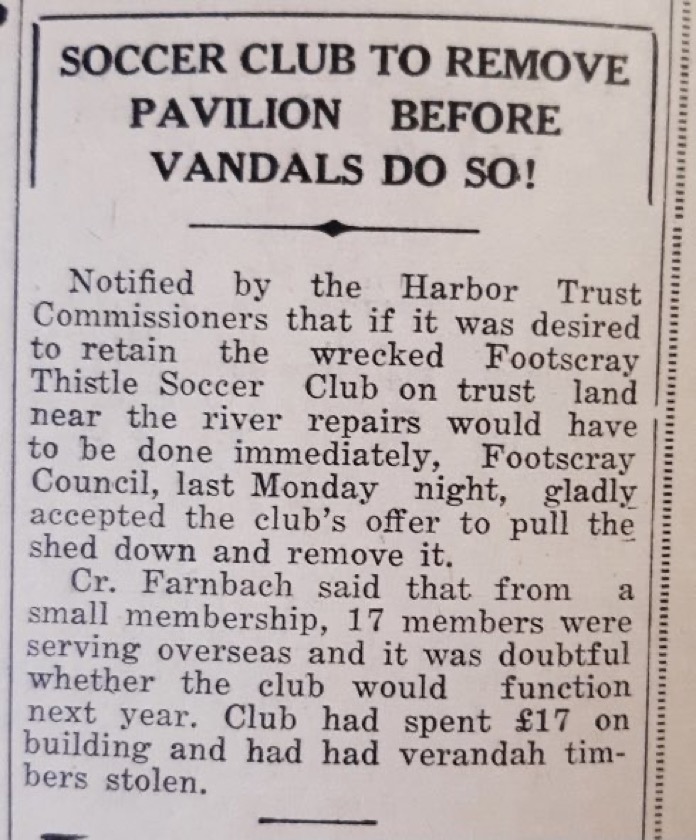
Footscray Advertiser July 1940
From my first engagement with the FHS I obtained 5 photographs of the Footscray Thistle team, discussed here. This led to a meeting with Val Finlayson, daughter of George Macaulay, one of Thistle's prominent players between 1927 and 1939. More recently 'Barbara from FHS' found this little article (right) in the Footscray Advertiser from July 1940. An inordinately sad piece, it described the literal and symbolic moment Footscray Thistle was ended as a club. The vandals didn't destroy the club because it was already on the way out but they helped to precipitate a somewhat pathetic ending to Melbourne's first soccer Super Club.

The advantage of the article is that it located the place of the club's final moment. Some digging in Trove revealed that in 1939 the club's 'new ground' was sited at the 'foot of Napier St', 'next to the Swing bridge'. It was also clear that the club had planted a number of trees (with the Council's approval) near the ground in 1939. The important question was which side of Napier St. The north (pink) or the south (blue).

On Saturday morning 29 May I undertook to try to find and video clues as to the ground's location, producing this 6 minute mini doco on twitter, typically inspiring #sokkahtwitter to chip in. While the general consensus seemed to be that the Southern side was most likely, we could not be sure. Discovering the below aerial shot looking west seems to have solved the puzzle. It places the ground squarely on the south side. The large road in the right foreground which crosses the river is Napier St and the patch of ground to its left seems the only possible space for a soccer ground.

c1939 Footscray looking West, ID: 1528, 
an image owned by the Footscray Historical society

A crop of the above image at the corner of Napier and Moreland Strees.

Well, that's 1939-40 knocked over. The harder job is to work backwards and map them all. We know from documents provided by Val Nicholson, that in 1935-36 the club definitely played out of Yarraville Cricket Club's ground on Williamstown Road. It is likely they also played there all the years from 1932 until 1938. Earlier they played at Yarraville Gardens, and sometimes on Ammunition Flat and a number of other grounds the names of which are rendered unclear in newspaper reports

I'm confident we can get there and map the places Footscray Thistle (and Northumberland & Durhams) called home.