About 12 seconds of Melbourne soccer footage I found somewhere. No idea where or when the game is being played. Help!
Tuesday, 4 August 2015
Mysterious Melbourne Match

Victorian Soccer Fixtures and Results 1890
The teams in 1890 were
Saturday 12 April
Saturday 31 May
Saturday 26 July
Saturday 13 September
- South Melbourne
- Carlton
- Rovers
- Wanderers
Saturday 12 April
Players 3 Spectators 1 at Middle ParkSaturday 10 May
Rovers v Carlton at Middle Park
Rovers: Newton, Hill. T. Clarke, Boden, Law, Plummer, Muirhead, Clarke, Bisiker, Lamb, Middleton.Carlton: Liddiard, Tunnicliff, Irvine, M'Kenzie, F. Beeson, H. Beeson, Bathgate, Nicholson.
Carlton v. Wanderers (George and George Cup) at Middle Park.
Carlton: Wilson, Spence, Amson, Tunnicliff, Donaldson, Beeson (2), Bathgate, Nicholson, M'Kenzie, Purnell and Irvine.
Rovers v South Melbourne at Middle Park
Rovers: W. Newton; T. Hill. T. H. Clarke, F. Bodes, R. Law, Middleton, Plummer, F. Ross, D.Lamb, W Bisiker, E. Springall.
South Melbourne: M'Gregor, Grove, Princep, Armour, Hartley, Johnstone, Caven, Bowdler, M'Pherson, Ross, Salmon, Spence, Gibson and Mann.
Saturday 7 June
Rovers 3 v South Melbourne 2
Melbourne Rovers: Tipper, Law, Clarke, Hill, Boden, Springall, Princeps, Bisiker, Bowland, Wivell, Clarke,
South Melbourne: M'Gregor, Ross. Macpherson, Grooves, Spence, Johnstone, Mann, Hartley, Bowdler, Caven. Balmore, Gibson, Armour,
Referee— M'Kenzie.
Saturday 21 June
South Melbourne v Wanderers (George and George Cup) at rear of E.M.C.G.Saturday 5 July
South Melbourne 4 Carlton 0 (George and George Cup) at Middle Park
Saturday 12 July
Wanderers v Rovers (George and George's cup) at Middle ParkWanderers: Goal, Wolfe; Backs, Boase, Millar; half backs. Maxwell, Thomas. Heape; forwards. Maxwell, M'Donald. Fraser, Thomas, Henderson; emergencies. Stenton. Thomas, Isherwood.
Rovers: Goal, Peters: backs, Hill, Clarke: half backs, Clarke, Law, Tipper; forwards, Prinseps, Wivell, Poland, Bisiker, Springall ; emergencies, Poland, Plummer, Middleton.South Melbourne v CarltonSouth Melbourne: M'Gregor. M'Pherson, Ridgeway, Salmon, Tunnicliffe, Spence, Ross, Johnstone, Paton, Hartley and Mann.
Carlton: Wilson, Spence, Amson, Donaldson, Holmes. Nicholson, Bathgate, Beeeson, M'Kenzie, Parnell and Irvine.
Saturday 26 July
South Melbourne 3 Rovers 1 (George and George Cup) at Middle ParkSaturday 9 August
Carlton 3 South Melbourne 0 (George and George Cup) at Middle ParkWanderers 6 Rovers 1 (George and George Cup) at Middle Park
Saturday 6 September
South Melbourne 5 Carlton 5 (Beaney Cup) at Middle Park
Carlton: Goal, Wilson; backs, Spence and Hunt; half backs, Donaldson, F. Beeson and Walker ; forwards, Bathgate. H. Beeson, M'Kenzie Nicholson and Irvine.South Melbourne: Goal, Salmon. backs, M'Pherson and Wridgway; half backs, Paton, Tunnicliff and Ross: forwards, Mann, Hartley, Johnston, Murray and Gibb.
South Melbourne v Carlton (Beaney Cup) at Middle Park
Monday, 3 August 2015
Multicultural Round, or "Spot the Wog"
This article appeared first in the Age as "A multicultural AFL? Not quite" 13 July 2013. A year on and it was just as fresh. I tweak it on and off as the AFLdiversity site releases its new figures. The latests figures suggest the game is becoming even more monocultural.
Someone needs to call the AFL out on this one. As if we don’t have enough ‘noble work’ rounds already, we are this week lumbered with the most ludicrously framed of them all, Multicultural Round. The only round more silly would be the one that celebrated the game’s great Barrys.
Now I’m not against the idea of celebrating cultural diversity in any arena. More power to those who want to remind us that we live in a diverse and multicultural society. Yet, no matter how many celebrations of Anzac, Aboriginality, women's round, heritage round, whatever round, a great number of the game's supporters seem entirely opposed to these ideas. The booing of Adam Goodes is only the surface of the intolerance that seems to flow through Australian rules football. Ultimately the game is xenophobic. Moreover, that fear of the outsider is something of which it is perversely proud.
If this were not the case and anyone in the AFL bothered to think deeply for even a moment about the motivations of the Multicultural Round they would run a mile.
 |
| Are these the face of multicultural AFL footy: a Wallaby and a bloke they don't understand? |
Unfortunately, the AFL does not have all that much to celebrate in terms of its cultural diversity – yet. While the AFL Diversity website claims that “Australian football has the extraordinary power to bring people together regardless of their background,” the proof of the pudding is just not there. For example, the AFL concedes that of the 811 listed AFL players, only 24 were born overseas (9 to Australian parents), just 3 per cent. This can be compared with the general Australian population in which over 27 per cent were born overseas. (The AFL claims this figure is only 20 per cent.)
Perhaps it could be argued that AFL figures are not representative of the game of Australian rules as a whole. This may be the case but would then be an indictment of the development pathways available for the non-Australian born. Moreover, footy has had many years to integrate the overseas born as elite players and has failed to do so. It's not as if substantial numbers of migrants have only just recently popped up on our shores. Since 1970 the non-Australian born have represented over 20 per cent of the Australian population. The lowest figure since 1890 is about 10 per cent in the immediate post-Second-World-war years.
The AFL claims a higher figure in relation to those of a “Multicultural background”. About 12% (down from 14% in 2014 and 15% in 2013) of listed players fit the AFL’s Multicultural criteria of having at least one parent born overseas. So the AFL falls down here as well, with over 45 per cent of the Australian population fitting this criterion. In 2016 A total of 113 players (14%) were from a multicultural background (i.e. having at least one parent born overseas) and 20 players (2.5%) were born overseas among those listed in the AFL in 2016." [I will rewrite this section once the 2017 figures come out.]
When we look more closely at the AFL's figures, further problems appear. The AFL Diversity website lists 99 'Multicultural players (down from 112 in 2014, 121 in 2013 and 118 in 2012), carefully noting their parents' country of origin. Of the 99, over one-half have one parent from Anglophone countries, mainly Britain, Ireland and New Zealand. The evidence suggests that only 7 of the 811 listed players are from non-Anglophone families. Steele Sidebottom, born in Australia to an Australian father and English mother does not strike me as a significant embodiment of cultural diversity. And the idea that Heath Grundy’s Kiwi mother makes him somehow ‘multicultural’ borders on the perverse. From the list of past multicultural players: Dermot Brereton? The man so sensitive to diversity that he told Adam Goodes to HTFU. Really?
Bizarrely, this definition would allow most of the game’s Anglo-Australian founders to be described as Multicultural and eligible for selection in the all-time Multicultural Australian rules team.
Yet this construction of multicultural identity is not universally applied in the AFL’s thinking. Fourth generation Australian Ron Barrasi is included in an historical list of Multicultural players. There’s a tokenism here that cares more about the woggy surname than it does about the realities and differences of Italian-Australian culture. It’s all just a bit silly.
Actually it isn’t just silly. It’s also pernicious. The problem with all of this lies in the construction of a ‘Multicultural’ identity as opposed to another (true blue?) identity. The diversity gurus at the AFL seem to think that in breaking Australian society into two categories (insiders and outsiders, native-born and migrants, or Australians and multiculturals?) they are doing us a favour when in fact they are replicating the kind of Hansonite stereotypes that gave us Cronulla. When Eddie McGuire makes stupid comments about the “Felafel Land” of Western Sydney or Kevin Sheedy reveals his ignorance in talking about the immigration department supplying supporters for the Western Sydney Wanderers, they articulate the AFL’s failure to understand the social fissures encouraged by this false division between ‘real’ and ‘wannabee’ Aussies.
The bottom line is that in a multicultural society we are ALL multicultural. We all have ethnic and cultural baggage that sets us up in relation to the fluid process that we call multicultural Australia. We are all in it together and none of the imported cultures deserve the priority that is the privilege of the truly indigenous.
The AFL is to be congratulated for recognising and using its great social clout for good in relation to any number of issues. The way the AFL has supported indigenous players in their struggle to be recognised as powerful and legitimate contributors to the game is one of our great sport stories of recent times. It should also be supported for acknowledging that it is not a particularly diverse sport and taking steps to correct that.
But I’ll be buggered if I am going to pat them on the back for playing catch-up football in relation to the vital issue of cultural diversity. Let me know when the siren sounds on this game because I reckon we have a while to go. Meanwhile I’m off to a game this weekend that, for all its faults - and despite the FFA's attempts to limit the appearance and reality of diversity - is so culturally diverse that to play “Spot the Wog” would be redundant. I’ll leave that to the AFL.
Saturday, 18 July 2015
Next goal the winner
Village football in Ayrshire, 1947 to the 1960s
Roy Hay
Our family
moved to the tiny little village of Straiton, in Carrick, the southern third of
the county of Ayrshire in Scotland in 1947. It lies on the fault line dividing
the central lowlands from the southern highlands. My father was the headmaster
of the local primary school which had a roll which varied from around fifty to
just under a hundred. Numbers could be affected significantly by the arrival or
departure of a large family at one of the farms in the area. At times my sister
and I and one other boy were the only pupils who lived in the village itself,
the rest came from the surrounding countryside. The school seldom, if ever,
played football matches against other schools because there were too few pupils
at any age group to field an eleven. There were only 5 boys in my class year
for most of my primary education.
 |
Straiton Primary School. The boys in my class included Ian McWhirter and Peter McMillan (back row, extreme left pair), John McWee and Michael Heaney (second row extreme left). I am on the right in the third row.
|
The pupils
played football on the asphalt area around the school, which had a shed with a
roof and two upright supports which provided one goal and a couple of dustbins
or a pile of jackets would suffice at the other end. Playground ‘fitba’ rules
applied.[1]
Games would start before school in the morning and continue through mid-morning,
lunch and afternoon breaks. After school and at weekends I would spend hours
kicking and heading a ball against a blank wall at the back of the school, one
of real perks of living in the schoolhouse.
 |
Straiton Primary School. The football playing area is across the foreground. The blank wall of the main school building, the white harled one on the left, faces the other school classrooms, while the school house is on the right beyond the flagpole.
|
The village
never had a formal football team, as far as I know, unlike the slightly larger
villages of Crosshill and Kirkmichael which were about four miles away to the
west and north respectively. Their teams played in the south Ayrshire amateur
leagues. Maybole was larger still, around 4–4,500 people. Maybole Juniors
played in the semi-professional lower tier Ayrshire leagues. Junior football in
Scotland is not a youth competition, but an open age competition below what is
called senior football. Talented young players in the senior ranks are often
farmed out to junior clubs to toughen up, while senior players on the way down
may spend some seasons in the junior ranks at the end of their careers. It
makes for a very physical and competitive environment. It would be somewhat
similar to the relationship between the VFA and the VFL in Australian football
in the old days. Ayr United and Kilmarnock represented the county of Ayrshire
at the professional senior level of Scottish football. None of my generation
from the village went on to play football at senior level in Scotland.
Later at
secondary school, Carrick Academy, we would play before getting on the bus in
the morning, before school started, at most playtimes and lunch breaks.
Playground fitba rules applied here too. In one notorious period of about eight
weeks one or other of our number broke a window of the school during our kickabouts
in the playground, but since I was number eight on the list and the headmaster
had had enough, I remember being the one who was belted for the misdemeanor.
Not only that but the headmaster told my father and I was on the end of another
licking when I got home.
No football was
played in the winter evenings because it was dark between four and five pm by
the time we got home from school. On Saturday mornings some of the older boys from
the villages might turn out for their secondary school team, as I did, but that
was in Maybole, seven miles away. In the afternoon, those who were interested
would travel by bus, bicycle, minibus or rarely by car to Somerset Park in the
county town of Ayr to support ‘the Honest Men’ of Ayr United.
In the summer
it was very different. Between 5 and 7 pm a small knot of youngsters would be
found around one of the goals in the village football field playing with a
dilapidated leather ball. The game would probably be ‘three-and-in’ to start
with. One lad was in goals, and the rest played as individuals trying to score,
and when you got three you swapped with the keeper. Soon the numbers would
grow, eventually sides would be picked and jackets might be deposited about the
half way line to form a second goal. Gradually the whole field would be brought
into use. By 10 pm there might be upwards of 50 players, roughly, very roughly,
divided into two halves, though two less competent or younger players might be
balanced by a talented or older one. Late arrivals would join in on the same
principles.
 |
| Straiton football field under water during a flood of the River Girvan. It was not usually this wet when we played in summer. |
Offside would
be variable, there being no referee most of the time, and only the most blatant
‘poaching’ would be sanctioned. If you were goal sneaking (Australian term) or
poaching (Scottish term) then your goal would not count, but if you ran through
on a pass from deep you would be allowed to proceed as long as there was a
defender in the rough vicinity. So that and most other decisions were by rough
consensus with a little bit of the Greek principle (might is right) thrown in
if things got heated. Positional play and passing was also variable, possession
of the ball and dribbling much more common and clumps of players around the
ball also.
Free kicks were
limited. You were expected to look after yourself and being kicked on the shins
or up in the air with a sliding tackle was ‘all part of the game’. Rules changed
in the gloaming. As it grew too dark to see, around 11 pm in high summer, the
cry would go up, ‘Next goal the winner’ even though the score might be 23-12 at
the time, if you happened to have been counting since some point in the past,
resulting in a frantic scramble to bring the game to a conclusion.
Very
occasionally a professional footballer would turn up as a friend of one of the
participants and join in, risking his livelihood in the mayhem of bodies. So
Peter Price, Ayr United’s star centre-forward, who later played in Australia
scoring a hat-trick in his first game for Gladesville-Ryde against Hakoah in
1963 in the Sydney First Division, also had a kick-about with us in Straiton
long before that.[2]
Yet there was
one game of football played near the village that received international
exposure. It was the centerpiece of one of the most awful films ever made,
entitled The Match. Made in 1999 and
despite a star cast including Ian Holm, Isla Blair, Richard E. Grant and Neil
Morrissey, with cameos by Pierce Brosnan and Alan Shearer, it clunks along as
Scottish whimsy gone wrong. The conceit is that the local pub and an upmarket
bistro have played an annual football match 99 times with the pub going down
each time. Now the 100th iteration is to be the decider (‘next goal the
winner’), only the loser is to voluntarily close down. Shot in and around the
village, the talented cast make as much as they can from a pretty leaden love
and football story. Gregory’s Girl or
Local Hero it is not. There is a
review in Variety, which does its
absolute best to pump up the tyres, but that is a struggle.[3]
The locals did not do well out of the film either and I think some of them are
still owed money.
 |
| Black Bull Hotel, Straiton. Benny’s Bar in The Match. |
The actual
match is not played on the football field in the village but in an expanse of
roughly flat land on Genoch farm south of it by about a couple of miles. This
is a more photogenic location and quite appropriate in a way since the local
farms were loci of a range of sports even in the post-war years. Each farm had
its own particular sport—badminton, china or lawn bowls, tennis, even croquet.
The farmers and some of the villagers, like the Hays, ‘neighboured’, as it was
called. That is they would band together for the labour intensive elements in
the annual farming calendar, harvesting, shearing sheep, lifting potatoes and
turnips and so on. After the day’s ‘darg’ (work) was done a pig or a sheep
might have been killed to provide food for all and in the evening after supper
everyone would take part in the farm’s game.
Nevertheless,
football was the most central game to the local sporting year, only rivaled by
badminton in the village hall over the winter evenings. Football provided a
topic of conversation and an ice breaker even for the majority of the
population whose only contact with the game might be doing the football pools
or listening to a game on the radio. Television was only just reaching the
village in the 1960s and reception was very poor. My future wife remembers
coming to the school house and seeing the family huddled round a black and
white television whose signal came from Northern Ireland at times, only 30
miles away to the south-west. The story was that the BBC and Scottish
television shot the football matches ‘using a box brownie with a sock over the
lens’, such was the poor quality of the vision. It looked on the screen as if a
snowstorm was occurring as the figures fluttered around. The green and pink
evening sports papers, the Citizen
and the Evening Times, could be
picked up in Ayr on a Saturday night, while Sunday
Post and daily papers carried pages of match reports and football gossip.
None of them ever had anything to say about football in Straiton.
Yet, football
was part of the shared culture, not always overt or demonstrative, but always
there. International and big club games were always anticipated and picked over
in the aftermath. A group of the young men, and a very occasional woman, would
organise a trip to Glasgow for an international match or a Cup final. A few
older men would be regulars at Somerset Park. My Latin teacher at Carrick
Academy for all but the first two years had a fatal flaw—his support for Ayr
United. He could be sidetracked into discussions about the game whereas his
predecessor taught with a strap to hand to sting the palms of those whose
declensions and conjugations left something to be desired.
I doubt if my
own family’s involvement in the game had much influence on me at the time. That
came much later. My father would very occasionally join in the games in the
playground and he did not talk about his own truncated career. My grandfather’s
exploits at club and international level must have been a topic of conversation
with members of the extended family and occasional visitors but that had little
impact when I was young. As the oldest male of the next generation some of the
family memorabilia and news cuttings came to me but I stored them away for the
future. It was not till 2004 that I began to put together his story and that
came about as I was trying to find a way to help shape my mother-in-law’s
autobiography which my wife and I were editing for her 90th birthday. Realising
I had this cache of material I thought it might help if I put it to use as a
dry run for the other book.
Growing up in
south Ayrshire, even in an area which had no claims to football success, it was
inconceivable to us that this game had not been around since time immemorial
and that we had invented and owned it.[4]
[1] One version can
be found on the Sports and Editorial Services Australia website at: http://sesasport.com/?p=2508
[2] Soccer News (Victoria), 25 April, 1963,
p. 5.
[3] Derek Elley,
review of The Match, Variety, 9 August 1999, http://variety.com/1999/film/reviews/the-match-1200458758/
[4] Mining villages
on the Ayrshire coalfield like Annbank and Glenbuck produced barrowloads of
football stars.
Saturday, 11 July 2015
From Detente to Distrust
These are the first two pages of my latest piece in the The International Journal of the History of Sport. Copyright prevents me sharing any more than the taster below. The whole article can be accessed via http://www.tandfonline.com/eprint/78xGajXpH92ajHjdDciD/full.
Soccer’s Place in Post-World War I Melbourne
There are four main football codes in Australia. While each has a presence in each state,Rugby League dominates in the more heavily populated Northern states of the eastern
seaboard, and Australian rules is the main code in the rest of the nation, with its origins and
historical epicentre in Melbourne.1 Rugby union is presently in League’s shadow in the
northern states (though with strong spectator interest generated by international games and
some interest, mostly at the private school level, in the Australian rules states). Association
football (soccer) has the broadest national coverage and the highest participation figures.
While soccer has some local strongholds, it is almost universally the second football code
in each state in terms of revenue and interest. Since 1880, this patchwork has been ever
changing. Its seams and tears are indices of the conflict between and within codes for much
of the games’ histories in Australia.
Yet antagonism has not always been the modus operandi in Australian football. In the
early days of codification, advocates of the football codes often saw themselves as
engaging in the one great game of football, sometimes describing it as the ‘English game
of football’ whether playing rugby, Victorian, Association or any other variation or
confusion of rules. Code delineation, competition and jealousy tend to accompany the
heightening of professionalism and the competition for enclosed grounds – as do the
search for and mythologization of origins.
In much of Australia before the 1890s, football code co-operation was common.
A Townsville Football Association, for example, was founded along these truly plural
lines:
A football association and two clubs have been formed during the week, one under the title of the Townsville and the other the Mercantile . . . It has been resolved that the association should include clubs playing under any recognised rules of football.The short-lived Rugby and English Association Football Club of Perth, established in
1892, is a co-operative formation almost unimaginable today. Certainly, aficionados
argued for the merits of their own code but a sense of fraternity was often obtained
between them. In Sydney, Brisbane and elsewhere, much experimentation and codeswitching
occurred as clubs tried to establish their choice of code.
As late as 1909, J.J. Calvert, President of the Sydney Rugby Union was happy to speak
effusively about soccer. Richard Kreider describes his speech at a dinner to welcome the
West Australian ‘Soccerites’ to Sydney. Calvert proudly claimed to be the oldest soccer
player in the room, having played a version of the game at Oxford University.
Calvert then confessed that had soccer been the prominent game in NSW when he first began to take an interest in football administration, his services could well have been devoted to his first love . . . and although he believed that no game could possibly outshine rugby, he looked upon football as a grand and legitimate game and wished for the West Australian team to convince the public that British Association football was well worth seeing.This contrasts markedly with the miserable reception the West Australian team received in
Melbourne.
Only in Melbourne
Perhaps only in Melbourne does a brooding, hidebound and monolithic structure of feelingdominate, where other codes are sometimes humoured and usually dismissed as inferior.
Yet even this attitude was softened from time to time. Melbourne’s press was sometimes
faintly supportive of soccer after a few initial warning shots in the early 1880s. In the
period immediately following the First World War, the press and the Victorian Football
League (VFL) seemed to take a positive attitude to soccer, a game which had contributed
so much to the war effort that it and its players were impossible to forget so quickly. Too
many soccer players had appeared in Rolls of Honour for their efforts to be dismissed as
marginal. It appears that in 1920 soccer belonged as a small but significant component of
Melbourne sporting culture.
While soccer’s contribution to the ANZAC story has been largely forgotten today, it
was hard to escape in the immediate post-war period. Even as late as 1927, a suburban
soccer match memorializing ANZAC was being promoted by the press. In 1920, the very
strong Northumberland and Durhams club were ‘popularly known as the “all-digger”
team.’ And during and after the war many soldiers previously unaware of the game had
been exposed to it, often with transformative effects.
What follows is a series of moments and case studies that trace a changing attitude
towards soccer in Melbourne and the rebuilding of the ideology oft-noted by Roy Hay, that
soccer is a ‘wicked foreign game’. It is a selective narrative because at this point it
remains in the service of a hypothesis.
To keep reading visit http://www.tandfonline.com/eprint/78xGajXpH92ajHjdDciD/full
Thursday, 9 July 2015
4 Melbourne soccer teams from 1909
Below are some very high quality photographs of four (or perhaps only three or even two) of the six teams to play soccer in Melbourne in 1909. The 6 teams can be seen in the fixture below for the first round (first 5 rounds in today's terms) of the competition.

The teams are:
Of the teams below only one, St Kilda is identified in the Trove archive. The others need to be ascertained. The bottom two may well be teams representing the same club. Indeed, it is starting to seem likely that 1, 3 and 4 are all St Kilda
Click on the photos to enlarge.

The teams are:
- Williamstown (the 'blues')
- St Kilda
- Prahran
- Melbourne
- Fitzroy
- Carlton
Of the teams below only one, St Kilda is identified in the Trove archive. The others need to be ascertained. The bottom two may well be teams representing the same club. Indeed, it is starting to seem likely that 1, 3 and 4 are all St Kilda
Click on the photos to enlarge.
 |
| 1. St Kilda FC |
 |
| 2. Cartlon United FC |
 |
| 3 |
 |
| 4 |
Sunday, 5 July 2015
Karmichael Hunt Revisited
Here's a piece I published on the Roar 4 years ago. While I think I was generally right about the risks he posed to the AFL, I missed completely the central dilemma his defection would introduce.
While the AFL was sitting smugly in the glow of all of the publicity surrounding the defection of Karmichael Hunt and Israel Folau, a dilemma was never far away. If the players failed to make the grade, the ploy would be seen simply as a cynical exercise in attention seeking. But that was not the worst that could happen.
Their success might prove an even greater problem because it would raise the suggestion that Australian rules football is not that hard to play and that any developed athlete could learn to play the code with relative ease.
Footy might then be painted as a fall-back sport for athletes who don’t make the grade elsewhere.
It could also create a further disconnection between the game’s grass roots and the elite level.
Why should a boy play his heart out for a club, rising through the pathways and representative football, struggling in second tier footy hoping for a breakthrough when ‘elite’ athletes from other codes and sports are waltzing in through the side door and getting paid millions in the process?
Nonetheless, the code-switching of Folau and Hunt is a historic moment in Australian sport.
Even if their shifts are complete flops (which seems to be a distinct possibility at the minute) the impact of their decisions and the way they were engineered will be lasting.
They have raised the spectre of wholesale code-switchings based on the idea that certain players are such superb athletes that they could make it in any sport they chose. The AFL’s recent acquisition of the TV squillions certainly means that there could be a fund available to tempt players over.
Asked by Mark McLure on ABC Radio Grandstand (July 31, 2009) whether he felt there were other players in Rugby League who could make the shift, Hunt replied: “Oh mate, there’s a lot of names that come to mind but I guess the obvious ones would be Billy Slater . . . down in Melbourne . . . well Greg Inglis . . . I mean these guys are natural athletes, they can do what they want.
“They could go and play basketball or play soccer if they put their minds to it, they’ve got that much ability.”
Presumably Folau was also one of those on his mind.
As a soccer supporter this proposition had me vaguely excited. The prospect of league, union and Australian rules players giving our game a fair suck of the hydration bottle is appealing.
One long-standing frustration for soccer in Australia is that many of its tens of thousands of juniors end up playing (and supporting) other codes of football at the senior level – this drift might well be the game’s fundamental problem in its ongoing efforts to establish itself on an equal footing in Australian sporting life.
At the elite level, AFL players like Adam Goodes and Brad Green were standout junior soccer players. Rugby League’s Andrew Johns starred with the round ball as a junior in Newcastle. Preston Campbell loved playing soccer as a boy. Each of them left the game in their teens.
It’s a trend that leaves many supporters wondering if we might have had more success had those players and others stayed in the game. I know the words, “He would have been a great soccer player!” have often passed my lips.
Yet this intuitive sense needs to be countered with a good dose of realism. Whenever mature sportspeople have tried to cross codes, failure has more often been the result.
Aside from the relatively easy shifts between the rugby codes, football because of their astounding punting or place-kicking abilities, there the odd Gaelic player going to Australian rules and players entering American football are few examples of successful football code-switching.
In relation to soccer I can’t think of one in recent times. In Melbourne, Glen Manton and Angelo Lekkas both tried out with South Melbourne Hellas when they left footy; both were unimpressive.
Needless to say, Karmichael Hunt’s apparent belief in his and others’ adaptability is newly found. In June 2008 he had this to say about his own skill levels:
“Basketball’s my game,” he says. “And soccer. I’ve been watching a lot of Manchester United. Cristiano Ronaldo is amazing. Amazing. I just enjoy watching the Premier League. I admire the skill those guys have. Their vision and touch. It’s awesome to watch. I wish I had the skill to play soccer. I’d be in England playing there. Or basketball in America . . . But I never had to decide. I was born a rugby league player.”
Hunt was speaking from the heart in 2008. In 2009 he was speaking through his wallet.
I’m no great rap for Australian rules but even I can see how difficult the skill-set acquisition will be for men who were “born rugby league players”. Perhaps time will prove me and many others wrong but the clock is ticking and Hunt’s own words seemed to be poised to come back to haunt him.
Saturday, 4 July 2015
"Are they at war with Soccer?"
JJ Liston, powerbroker and diplomat
JJ Liston is a curious figure. Well known in VFA circles, his soccer commitment is much less known. He was president of the VSFA from the mid thirties until his death in 1944 and took a particularly ecumenical view on sport. While Australian rules was his number one he also admired and enjoyed soccer. His primary role was as a thorn in the side of VFL (from both VFA and soccer perspectives) and his ire took him to the point where he threatened to amalgamate VFA and soccer.
There is a great silence on Liston's marginal views and his story is worth tracing. For one thing it will tell us a lot about Victorian soccer in the 1930s.
LISTON STOOD FOR UNION
Football Has Lost Leader
By H. A. de LACY
In the death of J. J. Liston football has lost a leader. He loved a thrilling sporting bout and football held the highest place in his affections. He took a leading part in the politics of the Australian game. I can vouch for his sincere desire to do the greatest good for the game itself, irrespective of pre-established ideas and constitutions. Re was prepared to kick his way through any conservatism that the greater good of the game could be served.
MR LISTON was president of the Victorian Football Association, the Victorian Soccer Association, and a Trustee of the Melbourne Cricket Ground. In football he was known throughout Victoria as "J. J." He was the sponsor of the senior representation in football of the outer ring of municipalities. Early he allied himself with the Williamstown Football Club—one of the oldest football cubs, became president of that club, and later president of the Victorian Football Association. It was in this office that he took up the fight for the newer municipalities; places where the popuitaion was growing. He wanted Victorian football graded, with promotions and relegations. In sponsoring this view he mostly sat on the opposite side of the table to the League officials. He was fearless in his advocacy and often bruised shins and trod on corns. But he was respected for his ability and fighting qualities.
He was a power in the sporting world. When he spoke he did not waste words. There was the occasion when the League hoped for representation on the board of trustees of the Melbourne Cricket Ground. However. It was "J. J." who was appointed. He became president of the Victorian Soccer Association as well as of the V.F.A. His opponents criticised him for taking such an office, asking how a man who was president of an Australian rules body could also be president of the State Soccer body. He scorned criticism. "Are they at war with Soccer," he retorted. "If they are. I am not. There is room for all good healthy games, and Soccer is a damn good game. It would serve us better to get down to knowing something of the good management of Soccer throughout the world. We could learn something."
From a state bordering on bankruptcy in 1937, he battled on till before the outbreak of war. The Association clubs were bidding high prices for League stars and getting them. But even this success was not altogether to "J.J.'s" liking. Hestill wanted graded football under a State council. He knew that the trafficking could not do the game the greatest good and often said: "It will make our opponents recognise our strength, but It will not advance Australian football." Immediately prior to his death he was using his influence to bring about a conference of the League and the Association with an eye to uniting the two bodies. Football has lost a statesman.
Wednesday, 13 May 2015
Our Man in London
James Hothersall sent me these remarkable documents from London. They are copies from The Football Annuals of 1885 and 1886 Edited by Charles Alcock and Published by Wight & co. They give details I haven't yet found from Australian sources about players and officials. I have calculated years and put them above the document in question.


1884

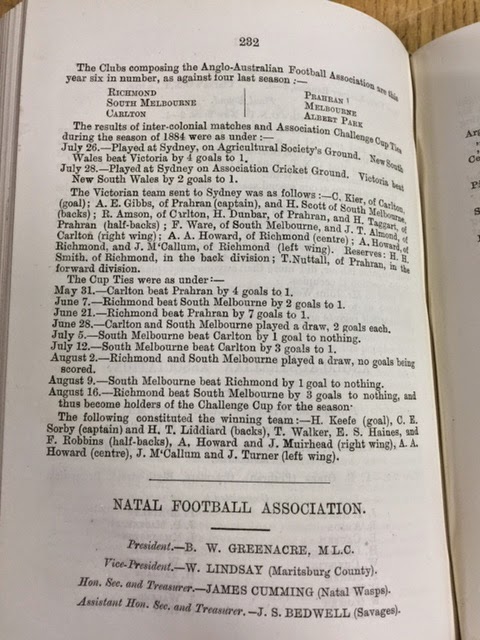
1885


Tuesday, 12 May 2015
Falling in Love Again
I guess a Sunderland supporter is bound to keep falling in love, as per the Elvis song our fans have been singing for years.
Ask Paul Mavroudis. I do keep falling in football love. And it's a long list:
A couple of things have changed that perception markedly in recent times - aside from the Cevaps at North Geelong which were definitely something of a head turner. One is the first Croatian soccer identity I have met and got to know, Pave Jusup. An office-bearer with the Melbourne Knights, he is a calm, intelligent and peaceful young man who has his foibles but lets others have theirs. What's more he can write. I wish many of my writing students could write as well as this cultivated Western Suburbs wog electrician. He loves his club passionately and is always thinking of how to defend it (sometimes pre-emptively with rhetorical aggression). For this, social media sometimes turns him into a kind of fire-breathing monster out to wreck Australian soccer only just rescued from the wog abyss by the new breed. He's not. It wasn't.
And it makes sense. How can a community be identical with the representations a sensationalist media makes of it? Of course some people at his club behaved and still behave on a scale between bad and despicable. Meeting Pave has made me realise that I was too influenced by the stereotypes without ever getting to know the people behind them to make a proper judgement.
I hope this doesn't disappoint Pave, but I haven't fallen in love with him, merely developed a strong fondness.
 On the weekend I had the privilege of going to watch my son play for Brunswick City U16s in an early season wooden spoon 6-pointer against St Albans Dinamo. We arrived during an U12 girls game and were struck by the number of people milling around the club. Lots of support; lots of encouragement.
My son found his team mates and I wandered into the club, guided by the welcome sign (left) above the entrance. "Welcome", not "You are entering our territory" or "We are shit hot!". Inside the door were two things that caught my eye. First was an old soccer ball in the trophy cabinet. It reminded me of the ones I used to kick around when I first started playing.
.jpg) The second item was something I'd never seen at a Melbourne soccer club, a well-placed noticeboard (right) both welcoming opposition players and parents and giving a timetable of the day and ground layout. A magnificent example that is a lesson to all.
The second item was something I'd never seen at a Melbourne soccer club, a well-placed noticeboard (right) both welcoming opposition players and parents and giving a timetable of the day and ground layout. A magnificent example that is a lesson to all.
Tracing my way via the odours wafting from the canteen I found myself in the clubhouse proper: a hall that might hold 300 people or more, a stage, a bar and a food servery advertising some pretty amazing fare. The cevap roll was not offered on Sunday so I had to make do with a bacon and egg roll. I will be going back with a friend or two to order the $80 plate.
I looked at the walls and saw some fairly standard paraphernalia but was blown away by the wall on which were mounted the shirts from present-day A League players and socceroos, Viduka, Culina and Franjic. The A League players were Dugandzic, Kalmar, Kovacevic and several others.

The Socceroo shirts were in pride of place, as was a poster in the entry declaring support for the Socceroos. The first thing that came to my mind was that this was a club with pride. Pride in being Croatian, pride in being Australian, pride in being a valuable contributor to the game in Australia and elsewhere, pride in being a soccer breeding ground.
The next thought was anger. Anger at those who would dismiss St Albans Dinamo as a bunch of wogs living in the past with no relevance to the future of Australian soccer. I wanted to round up everyone who had ever dismissed 'ethnic' clubs and drag them through an impromptu guided tour of this place of history, culture and dignity combined in a most perfect way. Indeed I was falling in football love.
On marshall duty for the day, I wondered whether my new-found respect might be tested by the locals (Our parents were not going to be a problem I tell you. I had to ask them to make some noise at one point.) On the contrary, it was a day of mutual respect and a hard fought game between two teams knowing that this game would be one of their few chances of a win this season. Even the linesmen were brilliant. Theirs was excellent (at least 4 offsides called against his team); ours was OK, missing a couple of offsides (yes, when I saw his AFL umpires jacket I was a bit worried).
The conversation I had at the end with the other marshall was the clincher. A lovely bloke who expressed concern for our kids and gave compliments as he saw fit. He was pleased with the win but commiserated with us. The Dinamo kids were overjoyed. They sang the first verse of the victory song "Oh when the saints etc" but trailed off when the second started (it was the first time they'd sung it this year).
I'd had a great afternoon in what has been a nursery of Australian soccer. It will be a great mistake and a great tragedy for our game if it ever loses that aspect. If I had any influence at all I would get those who want to 'fix' the game down to a day at Dinamo to see just how valuable, progressive and, yes, ethnically diverse this club is.
As I was leaving I sung a song to myself borrowing from Johhny Cash: "St Albans I love every inch of you," without his irony.
Since the day I have wondered about how much AFL star Ivan Maric's presidency has had an impact on the club. Maybe a lot; maybe not much.
Maybe it'll soften my heart to AFL . . . Though perhaps that's a love too far.
Ask Paul Mavroudis. I do keep falling in football love. And it's a long list:
- Bob Jane Stadium (sigh, and fuck you Eddie)
- Kevin Nelson (a goal a game and still not good enough for South fans)
- Fernando de Moraes
- Mitch Langerak (he hadn't even circumnavigated his penalty area at Kington in his debut warm up and I knew he was going to play for Australia: "Safe as houses!")
- Hobart soccer in general and Shae Hickey in particular
- A kid who plays for my son's futsal team who makes me smile all the while he is playing and who will also play for Australia (I won't name him)
A couple of things have changed that perception markedly in recent times - aside from the Cevaps at North Geelong which were definitely something of a head turner. One is the first Croatian soccer identity I have met and got to know, Pave Jusup. An office-bearer with the Melbourne Knights, he is a calm, intelligent and peaceful young man who has his foibles but lets others have theirs. What's more he can write. I wish many of my writing students could write as well as this cultivated Western Suburbs wog electrician. He loves his club passionately and is always thinking of how to defend it (sometimes pre-emptively with rhetorical aggression). For this, social media sometimes turns him into a kind of fire-breathing monster out to wreck Australian soccer only just rescued from the wog abyss by the new breed. He's not. It wasn't.
And it makes sense. How can a community be identical with the representations a sensationalist media makes of it? Of course some people at his club behaved and still behave on a scale between bad and despicable. Meeting Pave has made me realise that I was too influenced by the stereotypes without ever getting to know the people behind them to make a proper judgement.
I hope this doesn't disappoint Pave, but I haven't fallen in love with him, merely developed a strong fondness.

My son found his team mates and I wandered into the club, guided by the welcome sign (left) above the entrance. "Welcome", not "You are entering our territory" or "We are shit hot!". Inside the door were two things that caught my eye. First was an old soccer ball in the trophy cabinet. It reminded me of the ones I used to kick around when I first started playing.
.jpg) The second item was something I'd never seen at a Melbourne soccer club, a well-placed noticeboard (right) both welcoming opposition players and parents and giving a timetable of the day and ground layout. A magnificent example that is a lesson to all.
The second item was something I'd never seen at a Melbourne soccer club, a well-placed noticeboard (right) both welcoming opposition players and parents and giving a timetable of the day and ground layout. A magnificent example that is a lesson to all.Tracing my way via the odours wafting from the canteen I found myself in the clubhouse proper: a hall that might hold 300 people or more, a stage, a bar and a food servery advertising some pretty amazing fare. The cevap roll was not offered on Sunday so I had to make do with a bacon and egg roll. I will be going back with a friend or two to order the $80 plate.
I looked at the walls and saw some fairly standard paraphernalia but was blown away by the wall on which were mounted the shirts from present-day A League players and socceroos, Viduka, Culina and Franjic. The A League players were Dugandzic, Kalmar, Kovacevic and several others.

The Socceroo shirts were in pride of place, as was a poster in the entry declaring support for the Socceroos. The first thing that came to my mind was that this was a club with pride. Pride in being Croatian, pride in being Australian, pride in being a valuable contributor to the game in Australia and elsewhere, pride in being a soccer breeding ground.
The next thought was anger. Anger at those who would dismiss St Albans Dinamo as a bunch of wogs living in the past with no relevance to the future of Australian soccer. I wanted to round up everyone who had ever dismissed 'ethnic' clubs and drag them through an impromptu guided tour of this place of history, culture and dignity combined in a most perfect way. Indeed I was falling in football love.
On marshall duty for the day, I wondered whether my new-found respect might be tested by the locals (Our parents were not going to be a problem I tell you. I had to ask them to make some noise at one point.) On the contrary, it was a day of mutual respect and a hard fought game between two teams knowing that this game would be one of their few chances of a win this season. Even the linesmen were brilliant. Theirs was excellent (at least 4 offsides called against his team); ours was OK, missing a couple of offsides (yes, when I saw his AFL umpires jacket I was a bit worried).
The conversation I had at the end with the other marshall was the clincher. A lovely bloke who expressed concern for our kids and gave compliments as he saw fit. He was pleased with the win but commiserated with us. The Dinamo kids were overjoyed. They sang the first verse of the victory song "Oh when the saints etc" but trailed off when the second started (it was the first time they'd sung it this year).
I'd had a great afternoon in what has been a nursery of Australian soccer. It will be a great mistake and a great tragedy for our game if it ever loses that aspect. If I had any influence at all I would get those who want to 'fix' the game down to a day at Dinamo to see just how valuable, progressive and, yes, ethnically diverse this club is.
As I was leaving I sung a song to myself borrowing from Johhny Cash: "St Albans I love every inch of you," without his irony.
Since the day I have wondered about how much AFL star Ivan Maric's presidency has had an impact on the club. Maybe a lot; maybe not much.
Maybe it'll soften my heart to AFL . . . Though perhaps that's a love too far.
Subscribe to:
Posts (Atom)