Playing long balls into empty space since 2012.

Thursday, 20 May 2021

100 Years Ago Today 20 May 1921

Sun (Kalgoorlie), Sunday 22 May 1921, page 4


Sport as a Nation Builder

Britons the world over are noted for their fondness for sport and pastimes. Before the commencement of the war, students of national character were getting restless at the evergrowing importance attached to sporting events as compared with the more serious problems of life. ...

.... cricket outrivals football, but all the same the latter is the most popular game, because the thrills of a single afternoon's play are quick and numerous. Footballers require a steady nerve too, but not to the extent that a topnotch cricketer does. 

In Australia, football is played under a code of rules entirely our own, and it is gradually supplanting the old English games of rugby and Soccer. In Sydney the Australian game is making steady progress, but it will probably take many years of cultivation before it becomes the principal winter pastime in that city. 


Armidale Chronicle, Saturday 21 May 1921, page 7


SOCCER.

The Armidale City Soccer Club held its weekly meeting on Tuesday last. Correspondence was read, and the team selected to play to-day (Saturday), at Tenterfleld. It is as follows:—Goal, A. Woodcock; hacks, W. Gill, A. Bidley; half-backs, L, Gaites, F. W. Miner, (Capt.), G. Handley; forwards, W. Reach, C. Lesnie, R. Woodcock, J. McAvoy, A. N. Other. Reserve: J. Simpson, J. A. Gardner. Referee. Mr. T. Smith.

Four new applications were received for nomination, which were approved and accepted, which brings the total number of members up to 59. Three new applications from players of note in the Soccer code, arc anticipated shortly, and, by the inclusion of these players in the team, it is considered that Armidale will be capable of fielding an eleven well able to hold their own against the N.S.W. State team, which is expected to visit this town in August next.

Applications for membership to the Club will be received at all times by the Captain, Vice-Captain, and Secretary, so those desirous of Joining are asked to do so quickly, in view of the matches to be played in the near future.

Players selected to visit Tenterfield are reminded to assemble on the Railway Station not later than 3 o'clock this (Saturday) morning, 21st inst.


Geraldton Express, Friday 20 May 1921, page 4


FOOTBALL.

BRITISH ASSOCIATION.

(By Onlooker.")

On Saturday last the opening league match of the season took place at Queen's Park, the teams being Town and Queen's Park Rangers. It was a typical opening match, and one could see at a glance that the players were not up to concert pitch. Rangers started off well, and should have scored in the first minute. However they scored about ten minutes from the start, Glendenning scoring from a penalty given against Bishop for handling in the penalty area. The Rangers continued to monopolise the play, and scored again twice through Cooper and Currie. Half time arrived with the scores: Rangers, 3 goals. Town, nil. 

In the second half play was a little more even, but Rangers were always dangerous near goal, Glendenning and Cooper scoring. Result: Rangers, 5 goals. Town, nil. Rangers, who could only muster ten men, played better combination than their opponents, but Glendenning was the pick, and in fact the best player on the field. Secker a right half, a new player also played well. For Town Barker and Bishop at back were the pick, but they played very ragged football. However, they are sure to improve as the season advances. Second Officer Crickmer, of the S.S. Athol, had charge of the game and gave general all round satisfaction.


Swan Express, Friday 20 May 1921, page 3


FOOTBALL.

BRITISH ASSOCIATION.

On the Esplanade last Saturday Midland Athletic tried themselves against Perth City, and although beaten they played a fair game, but their failure was due to lack of training. Midland won the toss, and the home team kicked off. In the first half play was only fair and Perth City managed to score. In the second half Midland tried hard to equalise, but their efforts proved fruitless. In the latter stages Perth bombarded Midland's goals, but the Athletic's custodian proved too good, until Graham shot from well out, and scored the second for Perth City. Final result: Perth City 2, Midland 0. 

To-morrow the local lads travel by the usual train to Claremont, and there they will line up against the Training College eleven. Midland will be represented by Dower, Clarke (2), Motteram, Smart, Bond, Davidson, Wright, Birch, Kimber, Bradshaw, Christian and Gallagher.


Southern Districts Advocate (Katanning), Monday 23 May 1921, page 3


Katanning Road Board

A request was to hand from the soccer players for the use of the recreation ground for playing matches on Sundays, and this, after discussion, was refused by six votes to four.


West Australian, Monday 23 May 1921, page 9


FOOTBALL. THE LEAGUE GAMES. 

The third round of games in the league ±ompetition were decided last Saturday afternoon in wet weather. Continuous rain during the afternoon completely spoiled the football and soccer tactics were much in evidence. ... Sparrow received a free in front of the posts. but only managed a single. In the blinding rain, Subiaco rushed the ball forward. and Beisley soccered a goal. From a scrimmage Easts added a single. 

[imagine if today's IP conventions were in force then]


Telegraph (Brisbane), Monday 23 May 1921, page 5


        • Bush Rats 2 Corinthians 1
        • Queen's Park 1 Suburbs 0
        • Bundamba 2 Brisbane City 0


Argus, Monday 23 May 1921, page 5


BRITISH ASSOCIATION.

Melbourne results 21 May

League I

  • Melbourne Thistle 2 Windsor 0
  • Spotswood 0 St Kilda 6
  • N & D 4 Preson 0
  • Footscray Thistle 2 Albert Park 0

League II

  • St. Kilda A beat St David, 0. 
  • Welsh United. 3 drew with Brunswick. 3. 
  • Windsor A, l beat Melbourne Thistle 0
"A meeting of the Protest Committee will be held at St. David's Hall Latrobe street, at the protest of Spotswood against Footscray Thistle" (2 weeks ago FT won 6-1)
[a strong narrative of improvement is being pushed by the writer: best goal all season ...; best new player etc]

Wednesday, 19 May 2021

The rise and fall of Slavia

 By Roy Hay 

Article first appeared in Goal! Weekly on Monday 19th April 2010. 

Slavia was one of the great names of football in the 1960s becoming the national club champion in 1963 and fielding some of the best players of that generation. The Slavia club was formed in 1950 by Czech migrants to Australia and played its first competitive league game in the Fourth Division of the Victorian Amateur Soccer Federation League on 7 April 1951 against Heidelberg, another newcomer. Slavia came out on top by four goals to one. 

In that first season the club won 8 games and lost 6, finishing third behind Polonia and Ulsterville. Maccabi ended its interest in the Dockerty Cup in the second round. 

Slavia shared a ground at Yarra Park with White Eagles. 

Two years later Slavia won the fourth division, and in 1954 it finished on top of division three on goal difference from Flinders Naval Depot and Hellenic in one of the closest finishes on record. All three teams had 31 points from 18 games, 13 clear of Sandringham in fourth spot. In 1955 Slavia completed a hat-trick of championships and thus promotion to the first division. This time it was six points clear of Prahran, the runner-up. The club president was M Roznetinsky and the secretary H Fuksa. J Roessler was the coach. 

Now the club had moved to a new ground at Murphy Reserve in Port Melbourne. Slavia began its first season in Division One with a one-all draw against JUST on 31 March 1956. Among the players who turned out for Slavia that year were Ray Barotajs, A Terek, Kodak, Roznetinski, Bob Zablocki, Kotatko, Billy Bell, Joe Lachman, Ted Bialek, Kostromin, Issy Ressler, Steiner, Brenner, John Dickson, George Rakic, Mario Busidoni, Vince Varcirca, Karl Engelbogen, Joe Gottesman, Colin Brady, Kriz and Volny. Barotajs was capped by Victoria against New South Wales that year at only 19 years old and was an outstanding keeper. Slavia came third in the league only a couple of points adrift of Juventus and Hakoah. 

It was third again in 1957, but dropped to seventh in 1958, the first year of the Victorian State League. Slavia bumped along in mid-table in the league in the first half of the 1960s. In 1966 however it had a brilliant year pushing South Melbourne Hellas to within a couple of points at the head of the ladder. The team that year included John Young, Ray Barotajs, Nigel Shepherd, David High, Tommy Randles, Billy Cook, John Goodwin, David Short, Peter Laraman, Sandy Jones, Bill Savage, Charlie McCorquodale, Harper, Hall, Grant McGregor, Peter Lowen. So the playing staff was no longer Czech. But that league success was short-lived and in 1970 Slavia was relegated to the Metropolitan League. 

The peripatetic club had now moved to Essendon and appeared under the unwieldy title of Essendon Sunshine Heights Slavia. If the league performances were up and down, it was as a cup side that Slavia made its mark in the 1960s. It won the Dockerty Cup in 1964, 1965 and 1967 and was runner-up in 1966. In 1963 it took out the Australia Cup coming from fourth in the First Division and in 1967 it won the Ampol Cup and the reserves trophy, the Armstrong Cup. 

Hammy McMeechan helped Slavia win its first Dockerty Cup in 1964 but then was bought by Croatia. His team-mates that season included Ray Barotajs, Fred Vine, Nigel Shepherd, A Zanatta, John Auchie, Billy Cook, John Sanchez, Pat McDonagh, David Meechan, Tommy Harper and Charlie McCorquodale. John Hammerling coached the team. It was in 1964 that Slavia took on and beat the might of the VFL in a charity soccer match. Jack Dyer had described soccer as a game for big girls, but the Slavia boys won 8-0. 

In 1972, Slavia won Metropolitan Division One and so resumed its place in the State League which it held through the rest of the decade. In 1974 the squad included Lou Ivanoff, Jim Campbell, Jim Tansey, Frank Campbell, Steve McCombe, John Howie, Tony Harris, Jim Train, Ian Humble, Bobby Kent, George Train. John Sanchez, who played in the 1960s and won the Argus medal, was now coaching Slavia. 

Jim Tansey took the Argus medal in 1976, the second Slavia player to do so. But relegation in 1980 was followed by a further drops in 1982 and last place fi nishes in the next two years at which point the club effectively folded, though Laverton Park, which now plays in Division One of the Provisional League, claims a linkage to the defunct Slavia. 

Honours 

Australian Cup Winners – 1963 

Victorian Runners-Up – 1966, 1977 

Victorian Division 1 Champions – 1955, 1972 

Victorian Division 2 Champions – 1954 

Victorian Division 3 Champions – 1953 

Dockerty Cup Winners – 1964, 1965, 1967 

Dockerty Cup Runners-Up – 1966 

Ampol Cup Winners – 1967 

Slavia’s brief history 

1951 Fourth Division Position 3rd 

1952 Fourth Division - 5th 

1953 Fourth Division - 1st 

1954 Third Division - 1st 

1955 Second Division - 1st 

1956 First Division - 3rd 

1957 First Division - 3rd 

1958 State League - 7th 

1959 State League - 5th 

1960 State League - 6th 

1961 State League - 6th 

1962 State League - 7th 

1963 State League - 4th 

1964 State League - 5th 

1965 State League - 4th 

1966 State League - 2nd 

1967 State League - 7th 

1968 State League - 8th 

1969 State League - 10th 

1970 State League - 12th 

1971 Metro Div 1 - 3rd 

1972 Metro Div 1 - 1st 

1973 State League - 9th 

1974 State League - 5th 

1975 State League - 8th 

1976 State League - 8th 

1977 State League - 2nd 

1978 State League - 5th 

1979 State League - 11th 

1980 State League - 12th 

1981 Metro Div 1 - 11th 

1982 Metro Div 1 - 14th 

1983 Metro Div 2 - 14th 

1984 Metro Div 2 - 14th

Footscray Thistle Images

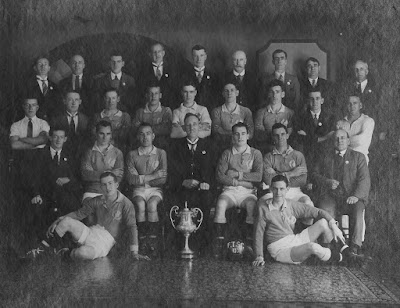
This mini-trove of Footscray Thistle material comes from the Footscray Historical Society (many thanks!). The photos span the period 1919-1932 and they contain some useful notes from those who donated them. Some confusion exists about the name of the team in various notes. I have used the descriptions and nomenclature from the FHS (which is well worth a visit) and I have kept them the order in which they were sent to me. Some will notice that 'the large trophy' is in fact the Dockerty Cup!

PIc 9110 F.T.S.C. [Footscray Thistle Soccer Club] 1932

Group of boys and men with 10 in soccer uniform with thistle on jersey. The man seated in front row second from the right was Walter Gilbert, a manager at the Parkinson Stove Co (Australia ) Ltd.


Pic 9111 F.T.S.C. [Footscray Thistle Soccer Club] 1930s

Group of men with 10 in soccer uniform with thistle on jersey and a large trophy. The man seated in front row on the right was Walter Gilbert, a manager at the Parkinson Stove Co (Australia ) Ltd.

Pic 9112 [Footscray Thistle Soccer Club] 1930s


Group of men with 10 in soccer uniform with thistle on jersey


Pic 9114 Management at Parkinson Stoves 1930C

Nine members of the management at Parkinson Stove Ltd. in Footscray.


(From John Dell: My Grandfather, Walter Gilbert moved to Australia in the 1920s to help set up the Parkin Stove Company Factory. While there he helped run the Footscray Harriers Football team. - These are photos from the family collection - The striking girl on horseback is not a known family member - the photo is labelled "Pauline - Footscray". My grandfather is the bald man in the light suit second from the right in the front seated row in the "Footscray Harriers" image and on the left of the "Parkin Stove Management" photo. He had served at Gallipolli as a private in the Warwickshire Regiment and had then fought the Turks again in Mesopotamia (modern day Iraq) where he was captured in the attempt to relieve the British and Indian Division surrounded at Kut. - He endured years of captivity by the Turks (statistically you had a much higher chance of surviving as a prisoner of the Japanese in World War Two than as a Prisoner of the Turks in World War One!)).

I hope the images are of interest, and might find a place in your archive, if they are not there already. Note: The images supplied labelled Harriers were actually of the Footscray Thistle Soccer Club.)

Parkinson Stove was at Sunshine Road Footscray West in 1957.


Pic 9158 1919

Group of 26 men, some in soccer uniform and some in suits.
A large trophy cup is in the foreground.

[The owner of this post card sized image, noted that her mother was told that the club was formed before World War 1 and that the players were all Scottish lads most of whom signed up together to fight in WW1.]

Pic 4002 [1927]

Two team photos, one players shaking hands 
FDSC 1927, Footscray District Soccer Club


Val Finlayson contacted me to let me know the her dad, George Macaulay and his brother Jack are in the above two teams shots. She replied to my fb post in Lost Footscray, saying that in "1927 photo my father, George Macaulay is 3rd from the left, middle row. His brother Jack is first in the middle row."

On a further post originated by Val in Lost Footscray she put up these two images with her comments below them: 

Thistles soccer team, my father, George Macaulay is in the middle of the top row. Year?

My father’s soccer medallions - left to right, 1927 Dockerty cup, 1928 Northern Section winners, 1930 Dockerty cup, 1932 Dockerty cup, no inscription.


This is a sobering reminder of the collapse of Footscray Thistle. Vandals attack the clubhouse while 17 of their members are away fighting in WW2. The piece is from the Footscray Adverstiser cJuly 1940


Thistle team lists 1 June 1928

Footscray. — Parker, A. Lyons, McGregor, Ballantine, Calderwood, R. Lyons, Templeton, Bellingall, W. Wilson, Orr, Robb. Reserves: W. McKelvie, G. McAuley. Reserve team— Pateman. A. McLean, Beveridge (new man) Jim Wilson, Morton, Fulton, S. McKelvie, John Wilson. A. Robb. Wilkinson, Rhind. Reserves: Craig, Mills. Simmonds, Mackerras.

Thursday, 13 May 2021

JJ Liston

The following documents were sent to me by Roy Hay. They reference a strange moment of ecumenical thinking in Australian football. They centre on the figure of JJ Liston, simultaneously president of the Victorian Football Association and Victorian Soccer Football Association, something unthinkable today. The first is his Australian Dictionary of Biography entry by David Dunstan. The remainder are from newspaper articles during the 1930s. The first is a breathtaking piece of brinkmanship in which Liston threatens to convert the VFA to another code. The others document his introduction to the soccer code.


Liston, John James (1872–1944)

John James Liston (1872-1944), civic leader and liquor trades spokesman, was born on 21 September 1872 at Granny, Roscommon, Ireland, son of John Haire Liston, constable, and his wife Mary Ann, née McNamany. The family migrated to Victoria about 1882 and settled at Williamstown where, after education at St Mary's Parish School, young Liston became a hairdresser. A member of the Catholic Young Men's Society, he was an outstanding debater and a keen sportsman; he played for Williamstown Football Club and in 1889 joined the Williamstown Racing Club. He was to head both organizations (the Football Club in 1923-33, the Racing Club in 1939-44) and become a prominent racehorse-owner. His barber's shop in Nelson Place was remembered as 'a sportsman's bureau'.

A big, ambitious man who studied to improve himself, Liston stood for Williamstown Council in 1897, revealing 'an astonishing grasp of municipal affairs' but losing the election by two votes. Next year he was returned unopposed. He was mayor in 1901-02 (the youngest in the State) and again in 1913-14. By 1906 he was licensee of the Customs House Hotel and that year was appointed secretary of the Liquor Trades' Defence Union, based in Melbourne. He sold his hairdressing business and, on 3 August 1910 at St Mary's Catholic Church, West Melbourne, married a milliner Eva Emily Roberts (d.1928).

Williamstown was a working-class suburb whose industries were in decline. As its representative on the Melbourne Harbor Trust in 1909-13, Liston sought public works for his area, expressed strong protectionist views and urged the trust to build its own ships at Williamstown. Even before his five successive mayoral terms in the 1920s it was said that Liston ran the town. Chairman of the finance and lighting committee, he persuaded the council to light the suburb with electricity in 1917 and take over supply. The financial success of the venture led to a new town hall and the purchase of a theatre and ferry steamer. Liston's plan to charge the cost of new streets to the benefiting property-owners was implemented after a long legal battle. In 1922-27 his supporters abandoned the rotation of the mayoralty so that he might carry out his programme of public works. But towards the end of the decade Liston and his 'progressive party' lost their grip. In August 1930 'grave irregularities' were alleged. A royal commission cleared Liston of wrongdoing but he resigned from the council and, after marrying May Ward on 15 December at St Patrick's Cathedral, moved to St Kilda. He claimed at this time to have lost all his Williamstown investments.

Liston had long ceased to be a purely local man. In 1918-30 he was Williamstown's representative on the Melbourne and Metropolitan Board of Works; he was the northern and western suburbs representative on the Metropolitan Town Planning Commission in the 1920s; and in 1923-31 he was a Melbourne city councillor and for six years chairman of the traffic and building regulations committee. A supporter of a Greater Melbourne Council, in 1931 he was defeated by one vote for the position of lord mayor.

Liston worked with Montague Cohen to amalgamate Melbourne's breweries and strove to thwart the prohibitionists. He led 'the wets' to victory in the 1930 and 1938 'no licence' referenda; during the first campaign a Herald writer called him 'the busiest man in Melbourne'.

In his rise from humble origins and in the scope of his influence Liston may be compared with his co-religionist John Wren. He devoted an extraordinary amount of effort to public service, bestowing patronage on sporting and charitable associations and performing unpublicized acts of kindness during the Depression. A Williamstown high school, a regional hospital at Footscray and the Friendly Societies' Association were among his causes. He was a trustee of the Port Phillip Pilots' Association and of the Melbourne Cricket Ground and president of both the Victorian Soccer and Victorian Football associations.

Liston died of heart disease at Cliveden Mansions, East Melbourne, on 12 April 1944, survived by his wife and by two sons from his first marriage, one of whom was killed on active service next year. Archbishop Mannix attended his funeral and J. H. Scullin was a pallbearer. His estate was sworn for probate at £293,481. There is a bust in the Williamstown Town Hall and the Williamstown Historical Society holds a portrait. He is also remembered by the J. J. Liston medal for the best and fairest player in the Victorian Football Association and by the J. J. Liston Stakes at Sandown.


Tuesday, 11 May 2021

100 Years Ago Today, 13 May 1921

Mercury (Hobart), Saturday 14 May 1921, page 5

SOCCER.
NOTES BY "HALF-BACK."
TO-DAY'S MATCHES.


Division I.-Corinthians v. South Hobart, at Show Ground.

Division II.-Hobart v. South Hobart, at South Hobart.

The result of the senior match at Elwick this afternoon will have an important bearing on the Cottrell-Dormer cup competition. In the event of South Hobart proving successful, all the teams will be bracketed together with an equal number of premiership points, but a win for Corinthians would give that team a very useful lead. In the second division, Hobart could only muster a weak team for their first match last Saturday, but they have got together a good side for to-day's game, and are confident of re-peating the success of the senior team.

Last season's State champions, South Hobart, sustained their first defeat in a league match since 1919. It was a thrilling contest, and undoubtedly one of the fastest exhibitions of the game seen in Tasmania. It is pleasing to learn that Cadbury's have started a team, end their first practice match will take place at Claremont this afternoon. A number of experienced players are at the works, and the new club should be further strengthened by further arrivals from the Old Country.

It is certainly time that the association properly organised the C grade competition. There are a great number of youngsters playing the game in Hobart, and representation has been made to the T.F.A. that the Honeysett cup should be again made available for competition. The association must bear in mind that the boy of today is the man of tomorrow.


Register (Adelaide), Friday 13 May 1921, page 4


FOOTBALL.


Following are the soccer football fixtures for Saturday:
  • North Adelaide v. Prospect, Mackinnon parade; 
  • Sturt v. Glenelg, Wayville; 
  • South v. Ports, Hutt street; 
  • Cheltenham, a bye.


Advertiser (Fremantle), Friday 13 May 1921, page 7


BRITISH ASSOCIATION.


The Fremantle Caledonians played their first "away" match against Perth City and had to admit defeat by 5 goals to nil. The score was not a true reflexion the play, as up till the last twenty minutes, although City showed the best football, the game was fairly even. The Caleys have not yet been able to put their full strength in the field, owing to one reason and another, and as a number of players have to be tried yet. It will be a few weeks before the team is properly settled down. The game on Saturday opened in a downpour of rain and the conditions were all against good football. It was Evident from the start that training would tell, and so it turned out. Caleys were obviously leg weary at the finish, whereas City looked as if they were only beginning. The backs deserve a special pat on the back for the way they stood up to what must be considered one of the best forward lines in the League. The next game is against College on the East Fremantle Oval on Saturday. The students are a lively lot and have been doing well this season, and as Caleys expect to have out their best team so far, a game worth watching is expected.


Advertiser (Fremantle), Saturday 14 May 1921, page 4


SOCCER.

Fremantle Caledonians, 7. Claremont College, 1.


Melbourne results 7 May 1921

League I

  • Albert Park 0; St. Kilda, 0;
  • Melbourne Thistle, 3 (Robertson 2, J. Russell), Preston, 0.
  • Footscray Thistle, 6 (Issard 3, Cumming, Fletcher. Pearce); Spotswood, 1 (H. Watson).
  • N & D 1 Windsor 1

League II
  • Brunswick, 2; St. Kilda A, 0.
  • Windsor A, 5;.Yarra Falls, 2.
  • Welsh United, 4 (Watkins, Cann, Manger, Campbell) ; St. Davids, 0

Melbourne results 14 May 1921

League I
  • Melbourne Thistle 2 St Kilda 1
  • Windsor 3 goals; Spotswood 0
  • Footscray 1 goal; N. and D. 0

League II
  • Brunswick 10 goal, Preston A 0
  • Thistle A 2 goals St. Kilda A 0
  • Windsor A 4 goals, St Davids 1 goal.

Wednesday, 5 May 2021

100 Years Ago Today 6 May 1921

 Herald (Melbourne), Friday 6 May 1921, page 4


BRITISH ASSOCIATION

"Soccer" enthusiasts have been busy during the past three weeks in preparation for competition games. which begin tomorrow. There is every indication of a successful season, for although Burns and Osborne House teams have dropped out, their places have been taken by the newly-formed Brunswick and Yarra Falls clubs. The Council, at its last meeting, decided upon two Leagues, the first division to consist of Albert Park. St. Kilda, Footscray Thistle, Melbourne Thistle, Preston, Windsor, Northumberland and Durham United, and Spotswood: while Brunswick, Yarra Falls, St. David's, Welsh United, Windsor "A." Preston "A." St. Kilda "A." and Melbourne Thistle "A" will constitute the second division. In addition to the League fixtures, arrangements have been made for the annual England v. Scotland match, to be played on the Fitzroy Cricket Ground on August 6. This fixture will he followed by the Dockerty Cup final on the same ground.


Age, Friday 6 May 1921, page 10


SOCCER

British Association.— This body will also open its league programme, when the following matches will be played: — 

league 1.: 

  • Albert Park v. St. Kilda, Cumming: 
  • Melbourne Thistle v. Preston, Morrison {?}: 
  • N. and D. United v. Windsor. Butler: 
  • Spotswood v. Footscray Thistle. McDonald. 

League II.: 

  • St. Kilda. A v. Brunswick, Dempster: 
  • Preston A v. Melbourne Thistle A, Barker: 
  • Windsor A v. Yarra Falls. Armstrong; 
  • Welsh United v. St. David's. McKenzie. 

Kick-off 3 pm.


Northern Territory Times and Gazette, Tuesday 10 May 1921, page 3


The town is quite lively with sailors from the Geranium, which arrived in port on Sunday morning. They are a splendid lot of young fellows-good-humored and courteous to civilians-and evidently out to make the best of their short stay in port.

Having no matting to cover the concrete wicket, a cricket match with the sailors was impossible, but it is understood that a football match is being arranged. The cricket materials will arrive in the Mataram and, if the Geranium is still in port, a match will he played.


Monday, 3 May 2021

George Macaulay

Paul Mavroudis thinks that I research soccer in order to discover my roots in a mining village in Durham, and this explains my Weston obsession. Maybe he's right. This thought occurred to me as I retraced my origins in Melbourne on the Number 1 tram on Saturday morning as I visited Val Finlayson at Albert Park, just two streets away from my first residence in Melbourne.

Val is the daughter of George Macaulay who played for Footscray Thistle for more than a decade between 1927 and the Second World War. Val had noticed that I put some photographs on the Lost Footscray Facebook site and contacted me letting me know that one of the people in the photographs was her father. I subsequently chatted with Val on the phone and arranged to meet her at brother Ed's place in Albert Park to talk about her father and to look at some of the artefacts and photographs he left.

Initially I surmised that Val must have been quite old, perhaps even in her 90s. It turns out that she was the first baby from a late marriage. Her parents married in November 1941 and her father George enrolled in the army a month later, training in Puckapunyul and Bonegilla for a year before serving in New Guinea. Val didn't meet her father until after the war in September1945 when she was 3 years old! Meeting Val and her brother Ed was a real privilege; both of them sprightly and active with a keen interest in learning about what I was researching and a real commitment to helping me understand their father's story.

Val and Ed generously provided me with the opportunity to learn about their father's origins and showed me a number of artefacts and photographs that I could copy. Ed was particularly helpful charging up and down the stairs to the scanner to produce high-quality scans of certain items.

Hughes Academy, George top row 3rd left
George
George Macaulay was born on 27 July 1907 in Aghadowey Northern Ireland. The youngest of five siblings growing up in a flax farming family, George was the only child to be educated beyond primary school. He attended the Hughes Academy where he learned to play football. Today, the academy, in Belfast, is a training college for young soccer players. After the untimely death of George’s father in the mid-1920s the family migrated to Australia. They arrived in Melbourne in 1926 and settled at 17 Napier Street in the suburb of Footscray. Despite having trained for the Civil Service George obtained a job as a foundry worker at Metters - a job he retained until the company closed in the 1960s. He then worked at Angliss Meatworks until retirement. Val mentions that he would proudly recount working there with the actor, John Wood.

George's 1930 Dockerty Cup medal
No name inscribed on the back.

In 1927 George, a Presbyterian, was playing with Footscray Thistle, one of Melbourne's champion Scottish-based teams. In sporting terms George must have felt that he had landed on his feet. Over the next five years he would obtain four championship medals (three Dockerty cups and one northern section championship). He also played a number of times for Victoria. Val laughed when she told me about the letter he received inviting him to play for Victoria. “It told him where he needed to be at a particular time on a particular day and to bring his own socks.”

It's clear that Macaulay was an excellent player. He is prominent in match reports throughout the decade. Though it should be said that Footscray Thistle was on something of a decline throughout the decade being relegated to the second tier in 1937.

George Macaulay enlisted in the Australian army in 1941 at the age of 34. He served in New Guinea, shattering his kneecap, contracting malaria, and returning to Australia in September 1945. It appears that George never played an organised game again. Val certainly remembers him kicking a ball in the backyard, showing her some tricks, but she has no memory that includes games of soccer. Perhaps it was the malaria; or the shattered kneecap; or his age, but his soccer career was over. But maybe also it was because he lost his team. A familiar story in Australian soccer is the death of clubs and the despondency and sometimes defection of those who follow them. Footscray Thistle seems to have been one of the war’s many casualties. Of all the teams that were deleted by the war, perhaps Footscray Thistle was the best of them. In any case, George seems to have lost interest in local soccer, preferring to follow the broadcast of English games on his scratchy radio in the back shed or local games of VFL.

Sadly, George’s wife, Valerie died when Val was 10 in 1953. The family moved to 79 Hyde Street Footscray until George's retirement when they moved to 16 Station Street in Blackburn. George Macaulay died in 1997 at the ripe old age of 90.

When it came to George's soccer records, photographs, and medals, Val didn't have a vast number of items. However, the quality of what she has is immense. These included a number of photographs of the Footscray Thistle team and the Victorian State team, some of which I had not seen before. One in particular took my attention because of the width of the
undated picture of the Footscray Thistle team
photograph. In the background we see detail normally excluded from team photos, that might well give us information about the locality of the game. The 1937 program for the English game against Australia excited me because I've never seen anything like it. My excitement was attenuated by realising a copy of it was already on Mark Boric’s Melbourne soccer site. I had seen photos of George’s Dockerty cup and Northern Section medals but to hold them in my hot little hand and be able to photograph the inscriptions on the reverse side was was a thrill. But the big ticket items were . . . little tickets: two tiny blue booklets from 1935 and 1936, called Footscray Thistle member 
1935 and 1936 Member's Tickets
tickets. These little booklets hold so much information as can be seen below: the committee, the season fixtures, the ground that they play on, even the little advertisements for local products contain information available nowhere else. I half-jokingly offered Val $200 for them on the spot. She seriously declined. One item I missed was the letter informing him that he was in the Victorian team, Val having misplaced it.

A wonderful amount of information about Footscray Thistle
 and Victorian soccer in such small bundles
Leaving Val and Ed, a familiar feeling came to me. Having visited many people for such interviews, I was aware of taking a little piece of their personal history. This produces a sense of responsibility and desire to treat the material with care — not in a physical sense in this case, because all I had was photographs and scans of originals and the notes — in an emotional sense. I need to respect the implied trust the siblings have placed in me. I will be pleased if this little piece fits that bill.

More is to be discovered about George Macaulay's personal history and Footscray Thistle’s rise and fall. This piece is my first contribution to the that project.

Thursday, 29 April 2021

Soccer in Victorian Schools in the 1950s

Last Saturday I received a call from Barbara at the Footscray Historical Society, alerting me to some photos she had found in Blue and Gold, the annual publication of the Footscray Technical School. She had noticed some soccer photos and thought I might be interested. 

Their holding runs from 1941 to1965, so I started at 65 and worked backwards. I found a healthy soccer culture that ran back to the formation of the senior team in 1956 [Horsham moment]. Prior to that soccer existed more marginally in the junior school but nonetheless with a sense of commitment.

After looking through the Footscray tech mags:

  • Soccer first played there in 1949 (though subsequently I have found references to a pre-war Footscray U14 school team)
  • First played by senior college in 1956
  • Rugby, baseball and lacrosse have a stronger presence
    • Indeed Rugby team seems to play in APS comp.
  • Continental European names gradually become dominant

Much of this seems to accord with what I thought I'd find -- though the pace of change seemed rapid:

  • 1956 Olympics?

Had to be more than that. And I think the main reason is the instutional push from the VASFA


Argus, Monday 30 June 1952, page 2


SOCCER men are after your boy!

By ROBIN PAYNE

IN a few days, maybe, a soccer football organiser, known as the Director of Schools' Football, will "grab" your son.

Overnight he may "convert" him from Australian Rules - which you, your father, and your grandfather played - to a "foreign" code.

The organiser is Mr. V. J. M. "Dick" Dixon, who last week was given this propaganda mission by the Victorian Soccer Association.

Under the very eyes of the Victorian Football League, he will distribute soccer balls and rule books, show the lads a trick or two, and encourage our many migrant teachers to spread the game.

Already soccer's strength has increased by about 400% in the last five years!

A professional man who last week heard of Mr. Dixon's "nefarious" plan lost his temper.

"Quit the sentiment," he snapped, "and let's kill soccer."

"If my kid took up a foreign, sissy game, I'd feel like kicking him out. I'd certainly pull him out of a soccer school."

NEED our friend really have worried?

Let us look at Victoria's football statistics. The following table lists the estimates of the various codes controlling bodies. Rugby Union and Rugby league are grouped together.

The table gives the total number of clubs, players and supporters, respectively.

Aust'n Rules           Soccer       Rugby

1,594                         170              46 

49,500                      2,200           950 

528,000                    8,000           6,000

The national code - Australian Rules - appears to be in an unassailable position.

Essendon district, alone, has 32 clubs and 1,300 players-almost as many as the State's entire rugby following!

Where, then, lies the danger?

Unquestionably it lies in the support of almost 600,000 migrants and in the brilliant and sustained organising zeal of the soccer controllers.

RUGBY, although not a spent force, is not as powerful as it was before the war. It is not a serious challenger in Victoria.

But soccer's backing has increased fourfold in five years - and it is said to be still rising rapidly!

And now, with "sinister" intent, the soccer men plan to attack our State schools. The future power of our own game may well depend on the ensuing football battle in the schools.

There's nothing slipshod about the Soccer Association's methods. Not satisfied with Mr. Dixon's activities, they also plan to appoint an English or Scottish professional as "coach of coaches."

He will be paid £1,000 a year - big pay by. English standards - and begin his campaigning on January 1, 1953.

The "pro." will devote much of his time to polishing the school coaches.

And what has Mr. A. H. Ramsay, the Director of Education, to say about this soccer infiltration into his schools?

*

MR. RAMSAY mastered both our game and rugby and has an open Mind.

"I'll leave it to the head masters," he says. "If they want soccer they can have it."

"My only concern is that every fit boy should be given the chance to play a winter game in which he can acquire skill and enjoy himself.

"It's a good thing for a lad to get some skin off his nose now and then. It makes a man of him."

You might be surprised what Mr Like McBrien, secretary of the all-powerful V.F.L., says about schools and soccer.

"The V.F.L. has no desire to "dictate what game boys play," he comments charitably.

"Any sport that requires teamwork is a marvellous game.

"We're not at war with soccer. But we are proud of our game, and, naturally, we'll do our utmost to foster it.

"One thing is certain: Soccer won't succeed by revolution; maybe it'll get somewhere by evolution."

Some school authorities would not be as kind as Mr. McBrien.

The Christian Brothers, for instance, are most unlikely to let soccer get a hold In their schools In Victoria.

One Brothers' sportsmaster said: "Australian Rules is the game in our schools. And it will stay that way."

But Mr. C. M. Gilray, head master of Scotch College, adopts the tolerant attitude.

His boys get a choice"Rules," rugby, hockey, basketball. . . . "It's better that way," he says.

Mr. George Langley, principal of Melbourne High School, Victoria's biggest school, agrees with Mr. Gilray. His boys play lacrosse and baseball also, and they used to play rugby, but It lapsed for want of support.

CONTRARY to popular opinion, there is no quarrel, overt or hidden, between the V.F.L. and the Soccer Association.

Certainly, there have been hot words over the V.F.L.'s alleged "selfishness" with its enclosed grounds. "But that's all forgotten now," the football men say.

Mr. E. B. Coles (of G. J. Coles'), who is president of the Soccer Association, emphasised the "harmony" between the two codes.

"You couldn't even say we are challenging Australian Rules," he says.

"All we're doing is to try and provide facilities for all those who want to play the international game."

Mr. Ray Locke, secretary of the Victorian Rugby Union, is emphatic that there is room in Victoria for all football codes.

He believes that many small men, incapable of succeeding in Australian Rules, can be champions at rugby. And Mr. Locke, too, has his eye on the schools.

Ten years should tell the story.

The "goalie" saves . . . a familiar scene to Victoria's

growing number of soccer players and supporters. Soccer men are now infiltrating school territory with this international game.


So indeed there was a driving force behind the shift. And there were a number of responses also.

The problem was the difficulty of finding a coach which took three years. Len Young came and instituted a lot of improvements in Victorian soccer culture


Argus (Melbourne, Vic. : 1848 - 1957), Tuesday 29 March 1955, page 20


Soccer in schools this year

By BILL FLEMING

The Victorian Soccer Council will allocate un limited funds this season for the propagation of soccer in Victorian schools.

Mr. Len Young, imported soccer coach from England, last night asked the council for £500 to start a school competition in Victoria.

He said that in the 10 months he had lived in Melbourne he had been in touch with a number of schools and had been surprised at the response he had received.

Made friends

Some masters had told him that soccer, because of its liberal distribution of footballs, training books, and referees' charts, had made many friends among Victorian schools.

Mr. W. R. Thomas, V.A.S.F.A. chairman, told the council that Mr. Young's request for £500 needed no discussion. He suggested to council that the £500 should be only a first payment.

"We have more than £3,000 in a trust fund, and this should be made available to Mr. Young to propagate the game here," he said,

The association decided to organise a school competition in soccer this year and to buy equipment and lease grounds.


I spoke with Socceroo Ted Smith about the process, figuring that his development occurred during this time.


He told me that in 1950 there were 4 high school teams

  • northcote
  • uni high
  • melb high
  • hampton

went to Preston tech old boys

vic colts coached by Len Young

at 18 he went to moreland.

In Ted's case the soccer in schools program certainly produced a result and he points to a number of players who made it to a pretty high level. He also bemoans the colts program being squashed after on two years. This 1953 article from the Australian Jewish Herald also points to the value of this program


SOCCER

Negotiations are under way for the Swinburne Technical School senior soccer team to join the ranks of Hakoah.

Hakoah easily outmatched their slower opponents, Preston, in a charity game at St. Kevin’s Oval last Sunday.

Final scores were Hakoah 8, Preston 5. (Friday 4 September 1953, page 17)


Then there is the response of Australian Rules, not directly to soccer in schools but rather the whole growth of the game.


Age (Melbourne, Vic. : 1854 - 1954), Tuesday 28 July 1953, page 15


Collingwood's Offer on Northcote Ground

Collingwood Football Club made an offer to Northcote city council at its meeting last night to pay the rental of the Northcote football ground in the event of Northcote Football Club disbanding.

Three representatives of Collingwood club waited on the council — the president (Mr. Sid Coventry); secretary and manager (Mr. G S. Carlyon), and treasurer (Mr. Neil Kearns). Mr. Carlyon explained that his club had received a letter from Northcote club saying it might have to disband. 

"Collingwood, as a friendly body in this area, felt it should make a move to ensure that Northcote ground was retained for Australian football, even if only by a junior club on a Saturday," he said. "We do know that foreign codes of football desire to obtain, the ground. . . "


Lest we think that Collingwood was a loose cannon on this instance, a year later this analysis of the problems facing Australian rules in Melbourne was published in the Argus given the threatened collapse of the VFA.


If this went out of existence - and that is a real possibility - the way would be opened for other codes to take over the grounds in the growing outer districts.

The threat from these other codes means little at the moment. Any expansion, they may have made in recent years is due solely to the number of New Australians now in our midst. Nothing can draw them from their national games, so what they do has no effect upon Australian Rules.

What does matter, however, is what their children do.

In this lies the danger to Australian Rules if these other codes get control of the outer ring of grounds now occupied by the Association. This would give them a tremendous impetus in the rapidly growing areas of Melbourne.

Not only would it make the way easy for the New Australians to have their children play the other codes, it would also give them a splendid opportunity to woo young Australians, for the major ground in any district is the focal point for all young sports lovers.

Consequently the League must decide whether to bolster the Association sides or, somehow or another, hold their grounds. (17 April 1954, page 4)