Max Lucchesi
Born Mar 16 1927 in Lucca, Italy
Attended school in Pisa
Kids played football in the courtyards with balls made of rags.
Migrated to Perth in the early 1950s
Played for Azzuri there
In 1954 he represented WA at the interstate carnival in Adelaide.
He impressed many people in a WA team that went pretty well. He nullified the NSW striker (possibly Reg Date) in a noteworthy performance.
Adelaide Juventus liked what that saw and poached him in 1956 or so.
After a few years his trade as a fitter and turner took him to Sydney and then to Newcastle where he played for Austral.
He stopped playing in the early 1960s. Later that decade he obtained his coaching qualificationas and his first job was coaching the Newcastle rep team in 1970.
He then moved to Weston and here is where my stories converge. He basically revived Weston as a powerhouse in the Hunter region.
He returned to Adelaide in the late 1980s when he retired.
When I interviewed Max I asked him what the highlight was of his soccer career in Australia. Weston was very important but he also enjoyed his time with Juve.
Even though he played rep football (WA and 4 B internationals, once as captain) he seemed to want to downplay that.
Tuesday, 25 February 2020

Sunday, 23 February 2020
100 Years Ago Today: 25 February 1920
Newcastle Sun (NSW : 1918 - 1954), Monday 23 February 1920, page 2
Newcastle Sun (NSW : 1918 - 1954), Tuesday 24 February 1920, page 2
'WE WANT YOU'
'Soccer One,' of Holmesville, does not want a new secretary for the Newcastle British Football Association. He says: The district is quite satisfied wiih the one it has had for three or four seasons. We do not require a new one. I was not at the last meeting, when Mr. Tamlyn resigned, but I will be at the next, accompanied by my little popgun. I then hope to hear that our old secretary has reconsidered his decision. If he won't, then my little popgun will pop him in the eye. We want him, and we mean to have him.Newcastle Sun (NSW : 1918 - 1954), Tuesday 24 February 1920, page 2
SOCCER FOOTBALL
At a well-attended meeting of the Hamilton British Football Club a long debate ensued on the question whether the club should support' 'club' or 'district' football. The latter had by far the greater number of supporters. Progress was reported in the matter of securing permission to play on Learmonth Park. It was decided to invite two South Maitland teams down (senior and third grade), and to return the visit in a few weeks' time. Mr. Tamlyn said he had decided to stand for the position of secretary again, and it was unanimously resolved that Hamilton club nominate Mr. Tamlyn for the position of association secretary. Delegates to represent the club at the association meeting were elected.
Newcastle Morning Herald and Miners' Advocate (NSW : 1876 - 1954), Wednesday 25 February 1920, page 6
Newcastle Morning Herald and Miners' Advocate (NSW : 1876 - 1954), Wednesday 25 February 1920, page 6
SOUTH MAITLAND BRITISH FOOTBALL. The annual meeting of the South Maitland British Football Association was held at the Allies' Stadium on Saturday, Mr. J. W. Earp presiding. The balance sheet showed an income of £151. 7s 11d, and an expenditure of £133 4s 6d, leaving a credit balance of £18 3s 5d. The auditors, Messrs Edean and Auld, reported as to correctness of same, and the efficient state of the books. The annual report stated that notwithstanding the 'flu epidemic, good progress had been shown, and the following officers were elected for the ensuing year:- Pat ron, Dr. Woods; president, J. W. Earp; vice-president, S. Willetts; hon. sere-tary, W. McBane; treasurer, A, Linsey; assistant secretary, R. Smith; manage-ment committee, Messrs, H. Spears, D. Auld, C. Perris; auditors, Messrs. G. Arus and J. Endean; delegates to referee's as-sociatlon, C. Perris; referees' selection committee, Messrs. S. Willetts, C; Perris; referees' examination board, W. Lam-bert; delegates to N.S.W.B.F.A., J. W. Earp, W. McBlane. It was decided that the association play club football; and the grades to be catered for be second grade, third grade, under 18, under 16, under 14. It was resolved that last year's semi-finallsts, Hebburn, Rothbury, Abermain, and Neath, be classed as second grade teams. The Hennings Cup, which was won outright by Weston, all grade, was donated to the association subject to a conference between the association and Weston Club. The meeting, adjourned until Saturday, March 20. Entries for the various grades will be received up to March 20, but entries and registrations of players must be accompanied by entrance fees.
Newcastle Morning Herald and Miners' Advocate (NSW : 1876 - 1954), Wednesday 25 February 1920, page 7
Newcastle Morning Herald and Miners' Advocate (NSW : 1876 - 1954), Wednesday 25 February 1920, page 7
FOOTBALL SOCCER CODE. A meeting of Soccer supporters was held in Clough's refreshment rooms, Wallsend, on Monday night. Mr. Frew presided. The object of the meeting was to endeavour to again form a senior team in Wallsend. After discussion it was decided to again apply for a district, and to enter a team in the Newcastle Association's senior competition. Mr. Frew was elected president. Mr. E. A. ("Lige") Bower, secretary: Mr. A. Morgan, treasurer: and Messrs. A. Lewis and Mat Pettigrew association delegates. The return of Wallsend seniors should be good reading to the district's Soccer supporters, Wallsend having won the Ellis Cup in 1917 and 1918. and they should again be able to put a team in the field capable of keeping up their reputation. A delegates' meeting of the association will be held in the Trades Hall on Saturday night. The rules revision committee will meet at 6 o'clock, and the proposed alterations - if any - will then be submitted to delegates, along with that greatly debated point "club" or "district" football for 1920.
Albany Advertiser (WA : 1897 - 1954), Wednesday 25 February 1920, page 3
[in a very long list]
Parks and Gardens Committee.
The Town Hall Committee recommended "That the application for the use of the Parade-street reserve for football matches be granted to the Albany Football Association for the Australian game, and the Ulster-road reserve be allotted to the British Association, the Council reserving the right to re-allocate either or both grounds on any special occasion."-Adopted.
[both reseves appear to remain]
Queensland Times (Ipswich, Qld. : 1909 - 1954), Monday 23 February 1920, page 3
Examiner (Launceston, Tas. : 1900 - 1954), Thursday 26 February 1920, page 2
Albany Advertiser (WA : 1897 - 1954), Wednesday 25 February 1920, page 3
ALBANY TOWN COUNCIL SEMI-MONTHLY MEETING.
[in a very long list]
Parks and Gardens Committee.
The Town Hall Committee recommended "That the application for the use of the Parade-street reserve for football matches be granted to the Albany Football Association for the Australian game, and the Ulster-road reserve be allotted to the British Association, the Council reserving the right to re-allocate either or both grounds on any special occasion."-Adopted.
[both reseves appear to remain]
Queensland Times (Ipswich, Qld. : 1909 - 1954), Monday 23 February 1920, page 3
Bush Rats' Football Club-The annual meeting of the Bush Rats' Football Club, was held in the Alliance Hall on Thursday evening. There was a splendid attendance of players and supporters. Mr. Alex Stewart, sen., presided. The secretary (Mr. Joe Potts) submitted a report dealing with the year's working. The financial report showed that the club was in a very sound position. The income for the year, inclusive of the credit balance brought forward, amounted to £55/7/3l; while the total expenditure was £35/12/11, leaving a credit balance of £19/14/4. It was decided to enter three teams for the various grades. The following officers were elected: Patron, Mr. A. Stewart: president, Mr. O. Butt; numerous vice-presidents were appointed, and Mr. Joe Potts, secretary and treasurer. Mr. Potts submitted a report on a meeting of the association held in Ipswich, and it was decided to protest against the personnel of the present executive, as it was not considered a fair representation. It was resolved that a deputation should interview Mr. Bognuda, asking for the use of the Reliance football ground. February 19.
Examiner (Launceston, Tas. : 1900 - 1954), Thursday 26 February 1920, page 2
FOOTBALL. ENGLISH CUP TIES. LONDON, Feb. 24. The Cup ties attracted the greatest crowds since 1914. His Majesty the King was present at Stamford Bridge, and received a tremendous ovation from 70,000 spectators when he appeared in the field and shook hands with the players. The King spoke to a number of disabled and blinded soldiers before returning to his seat, whereupon there was a renewed outburst of cheering.
Tuesday, 18 February 2020
Tour of Hunter Region Soccer Grounds: Part 2
 |
| Under a blood red Hunter sky |
Todd Blackwell and David McGaw were their typical generous selves and helped me get around. On the Sunday, I found myself back in David's car doing the second part of his well-guided tour of grounds and clubs in the district.
First we tried to identify the site of the Tramways ground in Hamilton, perhaps the crucial ground to enable the boom in Newcastle soccer in the early 1920s.
 |
| This was the spot we calculated. Corner of Denison and Lawson Sts Hamilton |


The afternoon saw us head west to the Weston Workers where we had lunch in the archetypal Australian Chinese restaurant and I had my epiphany. Here, in what seemed like the middle of relatively nowhere, stood a well-appointed workers club attached to a soccer ground in a town where the only sport that seemed to be played (other than darts) was soccer. Throughout the club were reminders that this indeed was a soccer club, one with a fabulous history that it is actually aware of (in the form of records and plaques on the walls). I am also assured that there is a swag of trophies under the grandstand, to which we could not gain access. Next time.


Next stop was Cessnock. David took me to the white elephant that is Baddeley Park, Cessnock RL's home ground (with its Garry Jack training field, the name of which prompted a discussion about Ian Roberts, whom bizarrely we saw in Beaumont St as David was dropping me off at the end of the day) in order to contrast it with the condition of Turner Park, the Cessnock City Hornets FC home ground. I preferred Turner Park to be honest. There's a political shenanigans back story to this.


 |
| Turner Park, Home of Cessnock City Hornets |
On the way back we passed by perhaps the most impressive ground of the day, Orange St Abermain. Impressive not because of its facilities or qualities but for the very fact of its existence. Esablished in 1908, the ground is one of many tiny soccer grounds in old pit towns. As David said, the story is that this is Rugby League heartland; so why are there so many old soccer fields and relatively few old Rugby League grounds?


David got me back to my hotel in one piece but not before the aforementioned encounter with Ian Roberts. Another great day that opened far more doors than it closed.
100 years ago today 18 February 1920
Sydney Sportsman (Surry Hills, NSW : 1900 - 1954), Wednesday 18 February 1920, page 8
SOCCER FOOTBALL.
There was a large attendance of delegates at the annual meeting of the Northern District Soccer Football Association, held at the Trades Hall on Saturday night. In the absence of Mr. R. Martin, the president, vice-president E. Buxton occupied the chair. The report submitted by the committee was of a highly satisfactory character. The balance sheet showed an income of £699 17s 11d, and an expenditure of £526 1s 1d, leaving a credit balance of £173 16s 10d. It was mentioned that one gate was a State record, while the whole takings constituted a State Soccer record. The report showed that the popularity of the code had increased considerably, which was shown by the greatly Improved gate receipts. Much enthusiasm was manifested in the election of officers; Mr. J. McCartney was re-elected patron, Mr. R. Martin president, and Mr..E. Buxton vice-president. For the position of secretary, Mr. Larry Tamlyn was opposed by Mr. A. Harley, and the voting resulted in twelve votes to three. The result of the ballot had no sooner been announced than the delegates received an unexpected shock, Mr. Tamlyn announcing that he could not accept the position. While he welcomed opposition (which was for the good of the game), he allowed the critics, but time would not allow him to again accept the position to which the delegates had elected him. Most of the delegates, together with the auditors, and members of the committee, expressed the wish that Mr. Tamlyn would reconsider his decision and again take on the duties. While thanking the delegates and others for the complimentary references to his work, and expressions of good will, Mr. Tamlyn said his decision was final, but assured those present that he would not sever his connection with Soccer. He pointed out that the Association had made considerable headway, and he had not the necessary time which the position demanded. It was decided not to elect a secretary at that meeting, but to call for fresh nominations, to be dealt with at a meeting to be held a fortnight hence. Mr. W. Ryshton was elected assistant secretary, and Mr. Shillings treasurer. It was decided to play five grades, senior, second, third, under 18, and under 16, as last year. Consideration of the question of club or district football was deferred until the next meeting. All the matters brought for ward were discussed in an amicable way, and ths prospects of another suc cessful season are particularly bright. This is assuming, of course that Mr. Tamlyn will again take on the secretaryship, if he does not do so, the game will get a big set-back, as there is no getting away from the fact that he is responsible for the proud position it enjoys to-day. When Mr. Tamlyn took over the duties, the association was in debt, but as a result of his energetic efforts during the past four years, he has wiped the deficit out, and the association now boasts of a substantial credit balance. For the sake of the game, it is to be hoped that Larry will reconsider his decision. He possesses wonderful organising capabilities, and the code must have his services and advice.
Newcastle Morning Herald and Miners' Advocate (NSW : 1876 - 1954), Wednesday 18 February 1920, page 3
Queensland Times (Ipswich, Qld. : 1909 - 1954), Wednesday 18 February 1920, page 5

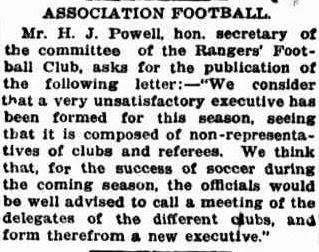
Toowoomba Chronicle (Qld. : 1917 - 1922), Wednesday 18 February 1920, page 4
Newcastle Morning Herald and Miners' Advocate (NSW : 1876 - 1954), Wednesday 18 February 1920, page 3
FOOTBALL BRITISH ASSOCIATION. '"Admlrer of Soccer" writes eulogising the officers of the northern association for the good work performed during the past season, but is disappointed at the secretary tendering his resignation. He says Mr. Tamlyn has done wonders for the game, and in declining to carry on he is taking a wrong stand. The writer considers that Mr. Tamlyn is the man for the position, and having made the associatlon what it is he should not be allowed to leave it: The delegates should make another effort to retain his services. As a supporter of the game, the writer says he wants Mr. Tamlyn to know that the followers of the code should be considered, and hopes that he will alter his present decision.
Queensland Times (Ipswich, Qld. : 1909 - 1954), Wednesday 18 February 1920, page 5


ASSOCIATION FOOTBALL.
At Herriott's rooms, this evening, the British Football Association rneets. Particulars are advertised.
Independent (Footscray, Vic. : 1883 - 1922), Saturday 21 February 1920, page 2
Independent (Footscray, Vic. : 1883 - 1922), Saturday 21 February 1920, page 2
SPOTSWOOD FOOTBALL CLUB. British Association. A Special Meeting of the above will be held on 28th February, 1920, NEAR SPOTSWOOD HOTEL at 7.30, to elect Officers for ensuing season. All persons interested are invited to be present.
J. HEWITT, Hon: Sec.
FOOTSCRAY FOOTBALL CLUB. The ANNUAL MEETING of the FOOTSCRAY FOOTBALL CLUB will be held at the FEDERAL HALL, Nicholson-street, on Monday, March 8th7,-920, at 8 p.m. Nominations for the position of Office-bearers must be in the hands of the Secretary, 26 Austin-street, Footscray, not later than Monday, March 1st. Election for Office-bearers will be held at the Old Mechanics' Institute, opposite the Federal Hall, from 6 to 6.30 p.m., on March 8th, prior to the Annual Meeting. Season Tickets must be produced to entitle Members to vote.
E. J. SMITH, Secretary.
Wednesday, 13 November 2019
SA’s soccer’s lost wartime tribute found
By Rob Greenwood, taken
from Adelaide Advertiser 13 November 2019
from Adelaide Advertiser 13 November 2019
A PIECE of state soccer history, honouring the nation’s wartime sacrifices, has been located in suburban Adelaide and there are growing calls to preserve it for future generations.
On August 3, 1941, the SA Soccer Football Association planted 125 white cedar trees at Rowley Park as a tribue to local players who had enlisted to serve in World War II.
But within eight years the Brompton venue, which had initially been intended to become the home of SA soccer, had been leased off and converted into a speedway track.
While the association moved 3km to the now Hindmarsh Stadium, the trees were thought to have been swallowed up by the housing development that took over the site in the 1990s.

That was until a discovery by Melbourne-based soccer historian Ian Syson last week, who spotted a number of them still standing in and around dwellings on the former ground.


“We thought probably the trees had been chopped down to make way for the new housing estate,” said Dr Syson, a retired academic from Victoria University.
“But there are still scores of those trees left and they’ve built the new housing estate around the trees.
“Each of them was planted to represent a South Australian soccer enlistment in the second World War.
“If each tree is for a soldier, some of those trees would represent a dead soldier and someone killed at war.
“They have a sacred significance.”
Dr Syson’s images show the trees dotted around John Hindmarsh Frontage, Francis Ridley Circuit and Rowley Lane in the development, which borders Torrens Rd.


The FFA history subcommittee member, who is compiling a book titled Newcastle Soccer Anzacs, said the find had encouraged him to expand his project to cover other states.
He hoped acknowledgment on the site’s soccer history, similar to the plaque recognising its past speedway activity, would commemorate the memorial and protect the trees.
“It was actually a soccer ground before it was used for speedway,” said Dr Syson, who believed about 80 per cent of soccer players across Australia enlisted for military service.
“It’s important, but sometimes soccer doesn’t understand it’s own connection with this history.
“The AFL and the rugby league have built a connection with Anzac over the last 20 years or so, but soccer has stood by and watched.
“Soccer has as much right to claim an Anzac connection, because soccer basically halted itself during the first World War and the other codes not so much as they kept playing.”
Tuesday, 5 November 2019
Brompton Park and Ted Rowley and the 125 White Cedar Trees!
Rowley Park Speedway in Brompton was named after Mr Enoch Proctor (Ted) Rowley one of Australia's best known goalkeepers in the early days of Australian soccer.
During his eight years in Kalgoorlie (where his uncle lived) he became almost a legendary figure in the soccer world being regarded as WA's best goalkeeper, He also played 1 game of Aussie Rules kicking 10 goals but gave the game away and sticking with the round ball.
On 3 August 1941, 125 white cedar (Melia azedarach) trees were planted in honour of enlisted soccer players in 2 rows at a ground owned by the SA Soccer Football Association in Brompton Park, Brompton, Adelaide, South Australia.
In 2019 this is located on Torrens Road between Kennington Ave and Coglin St in Brompton, Adelaide.
It appears that the rows of trees are to the left of the image along Torrens Road and on the Coglin Street side.
For the record, by November 1941 - 150 players and officials, 35% of the membership and officials had enlisted in the fighting forces of WW2.
Surrounding streets and parks are named after Ted Rowley including Rowley Lane (Brompton), Rowley Terrace (Woodville) and Rowley Reserve (Woodville).
And what of the 125 White Cedar trees?
It seems that these trees (and their seeds) still exist at the John Hindmarsh frontage, Rowley Lane and have spread through to Coglin Street.
Thursday, 31 October 2019
Soccer and the Communist Archive
Trove has once more proved a bonanza.
We are constantly seeking new lines of archival research.
A couple of months ago Garry McKenzie found a some soccer stories in MIMAG, the glossy corporate magazine of Mount Isa Mines. Further invesitgation revealed a substantial soccer history of the region, including results, team lists and images.
In this last week I have found another such string of information hiding in plain sight. In a sense it was under my nose all of the time because I had researched the area extensively in a previous role to do with Australian literature. Specifically, Tribune (the newspaper of the Communist Party of Australia, a Stalinist organisation) which contains its own soccer narrative within its pages.
Moreover, its photographers have left a tantalising collection of negatives that point to more substantial holdings.
One advantage that the Tribune has in Trove is that it runs all the way to 1976 whereas the holdings of most other publications stop in 1954 (for copyright reasons).
The following is from the 12th of August 1976

To be accurate, by the mid-1970s soccer references have largely thinned out. Because of the CPA's departure from the Soviet line, the USSR's tour in 1975 received little (or perhaps no) coverage. Some of them are also references to other sports by way of comparison. RL Players Union for example.
The 60s and the previous two decades are the decades where soccer gets some decent focus, albeit inconsistent. In the immediate post ww2 period the game becomes relatively prominent, perhaps on the back of the sentiment expressed in the following letter to the editor from March 1945:
Tribune, Thursday 22 March 1945, page 6
There's a sense that Tribune is aware of the potential of the game to boom and that reporting on it is a way into the hearts and minds of workers.
It also demonstrates some familiarity with issues affecting the game.
It understands the fundamental mechansim of soccer's constant tendency to split on the back of club v. broader interests. On 14 Mar 1947 it reports "the Soccer authorities have made many blunders in the past. Broad-minded control is essential and the authorities should not let parochial club interests mar their major decisions." It's a sentiment that we still hear today.
We are constantly seeking new lines of archival research.
A couple of months ago Garry McKenzie found a some soccer stories in MIMAG, the glossy corporate magazine of Mount Isa Mines. Further invesitgation revealed a substantial soccer history of the region, including results, team lists and images.
In this last week I have found another such string of information hiding in plain sight. In a sense it was under my nose all of the time because I had researched the area extensively in a previous role to do with Australian literature. Specifically, Tribune (the newspaper of the Communist Party of Australia, a Stalinist organisation) which contains its own soccer narrative within its pages.
Moreover, its photographers have left a tantalising collection of negatives that point to more substantial holdings.
One advantage that the Tribune has in Trove is that it runs all the way to 1976 whereas the holdings of most other publications stop in 1954 (for copyright reasons).
The following is from the 12th of August 1976

To be accurate, by the mid-1970s soccer references have largely thinned out. Because of the CPA's departure from the Soviet line, the USSR's tour in 1975 received little (or perhaps no) coverage. Some of them are also references to other sports by way of comparison. RL Players Union for example.
The 60s and the previous two decades are the decades where soccer gets some decent focus, albeit inconsistent. In the immediate post ww2 period the game becomes relatively prominent, perhaps on the back of the sentiment expressed in the following letter to the editor from March 1945:
Tribune, Thursday 22 March 1945, page 6
Letters To Editor
Soccer News
Dear Sir.—I wish to suggest that some space in the Sporting section be devoted to Soccer News. The visit of the British Navy has stimulated much interest in this game especially as Navy teams including many prominent British players will be competing in the forthcoming season. Five thousand people attended a recent exhibition game in Bankstown. One hears widespread disappointment at the inadequate reports of the code to the daily papers and I am sure that if regular reports could be published in the Tribune we could win many supporters for our paper.— HECTOR ROSS
There's a sense that Tribune is aware of the potential of the game to boom and that reporting on it is a way into the hearts and minds of workers.
It also demonstrates some familiarity with issues affecting the game.
It understands the fundamental mechansim of soccer's constant tendency to split on the back of club v. broader interests. On 14 Mar 1947 it reports "the Soccer authorities have made many blunders in the past. Broad-minded control is essential and the authorities should not let parochial club interests mar their major decisions." It's a sentiment that we still hear today.
The Tribune is also across the constant question - the sleeping giant question - about whether soccer will ever take a place alongside the dominant football codes.
So I suspect there are a number of socceristas involved in the Australian communist hierarchy.
While this all sounds pretty useful, and it is, there is a rider. They are not particulalry interested in the game for its own sake. It's used as a way into other issues: as a stalking horse, a pretext for political attacks on opponents, a vehicle for the promotion of the Soviet Union, an issue to attract migrant workers.
As an example of this lack of love for the game, in 1963 Tribune quoted famous communist author Frank Hardy as making the light-hearted comment that "Socialist Australia would not abandon Rugby and Australian Rules in favor of soccer".
So why would an organisation that claimed to be part of an internationalist movement wants to assert parochial local culture over global cultural commerce? Without getting too far into the complexities of Australian left-wing politics, this is a period in which cultural nationalism asserts itself on the left. The straight promotion of soccer shifts to more careful and qualified support.
So why would an organisation that claimed to be part of an internationalist movement wants to assert parochial local culture over global cultural commerce? Without getting too far into the complexities of Australian left-wing politics, this is a period in which cultural nationalism asserts itself on the left. The straight promotion of soccer shifts to more careful and qualified support.
So what will you find in Tribune:
- glowing and substantial coverage of tours from Soviet bloc countries
- a curious and obsessive Melbourne-centred focus on Croatian soccer supporters and the purported links of some of them to the Ustashi
- features on individual communists and trade unionists who are involved in the game
- at times reasonable political/cultural analyses of the game in Australia and internationally.
In 1967 in an article title "Australia Shines in Big Soccer" it asked a question close to my heart and the rationale for IYKYH: "SOCCER is reputed to be a "young" game in Australia. When was the first Soccer Association formed here?" In doing so the author reveals a nuanced and deeper understanding of the history of the game than might be expected. It's almost as if the writer anticipated the idea of: short memory!
Steak Knives
But that's not all. The Tribune had another string to its propaganda bow: photography. It sent photographers to cover many of the touring Soviet bloc teams. I have found three small digital cachets of photos, two of which are linked here:
They are high quality photos taken by good photographers. Their existence points to the probabilty that there are many more such cachets, yet to be unearthed.
Wednesday, 30 October 2019
Slovan Bratislavia v Pan Hellenic 1966
More images from the Tribune archive. This time from Pan Hellenic's 1-1 draw with Slovan Bratislavia (Czechoslovakia), at Wentworth Park, 23 January 1966.
From SLNSW Item 080: Tribune negatives including South African dance troupe, cleaners, and soccer match, Wentworth Park, New South Wales, January 1966.
Thanks to Sydney Olympic FC - Social Media 101 @olympic_101 and Sydney Olympic Supporters @SOFC_Supporters for help with the captions below


From SLNSW Item 080: Tribune negatives including South African dance troupe, cleaners, and soccer match, Wentworth Park, New South Wales, January 1966.
Thanks to Sydney Olympic FC - Social Media 101 @olympic_101 and Sydney Olympic Supporters @SOFC_Supporters for help with the captions below


 |
| From left: George Pappas (Secretary) (Half cut off), George McCulloch, David Johnston, Johnny Sanchez, Sotiris Patrinos, Brian Tristram, John Karagiannis, John Cole, Doug Wright, Jim Fernie, Helmut Rademacher. |
 |
| Far left Doug Logan; 3rd from left Johnny Sanchez (?), 4th from left Sotiris Patrinos, 6th from left John Karagiannis |


Torpedo Moscow v NSW 1965
These images are from the Tribune archive. Tribune was the main newspaper of the Communist Party of Australia.
The images are held in 'Item 004: Tribune negatives including international soccer matches between Torpedo Moscow and Sydney and N.S.W. XI, Sydney, New South Wales, February-March 1965' at the State Library of NSW. More photos will be uploaded forthwith.


The images are held in 'Item 004: Tribune negatives including international soccer matches between Torpedo Moscow and Sydney and N.S.W. XI, Sydney, New South Wales, February-March 1965' at the State Library of NSW. More photos will be uploaded forthwith.


Subscribe to:
Posts (Atom)