Playing long balls into empty space since 2012.

Saturday, 19 May 2012

Moreland City v. Fawkner Blues, Campbell Reserve, 19/05/12

Game starts at 3pm. Must be off. Top of the table clash and either team gets a good opportunity to put some distance between itself and third place on the ladder.

Arrive at half-time in the ressies. Two nil to Moreland.

Sheltering from the cold in the clubhouse, famously lined with football tops and team shots from Europe. No Sunderland tops I notice, I'll have to give them one.
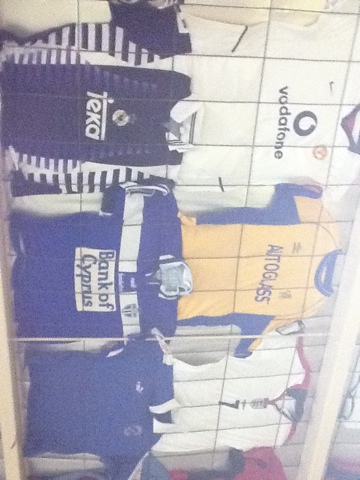
What's that South Melbourne top doing there?


Flavor of the moment or more permanent allegiance?

Nice run through the middle by mc no9 results in saved shot.

Thought this Moreland free kick was going in. Just wide.

Moreland dominating. Look much better in midfield. Morealnd go on to win the game 2-0 with a third goal being ruled out for offside.

Moreland senior coach, Maurice Bisetto, before the game.


3.01. Game commences. Fawkner Cyanazzuris attacking clubhouse end.

3.03.  Fawkner attacking free kick. Offside.

3.04. Moreland attacking free kick from left headed away.

3.10. Good attacking period from Moreland. Neither keeper yet troubled.

3.12. Good free kick from Moreland right met by glancing header missed left.

3.13. Fawkner free kick from right. Met at back post. Headed into side netting.

3.17. Periodic Moreland control. Fawkner break defused.

3.19. Good composed defense from Moreland under pressure at left back.

3.20. Moreland Cross from right goes behind.

3.23. Dangerous  Fawkner free kick from left headed away well.

3.24. Good f cross from right beginning of sustained minute of pressure. Finally cleared.

3.26. Fawkner attacking well on right.

3.27. Good hard Fawkner tackle. Could have been carded.

3.28. Fawkner free kick30 out. Headed clear. Returned and a neat headed goal looping the keeper. 1-0 fawkner. Deserved lead.

3.30. Another good  Fawkner attack. Keeper out to collect. Moreland free from right headed over.

3.31  Long ball from Fawkner eludes everyone. Keeper out bravely.

Latrobe score against Altona east. 1-0.

3.34. Another good attack from  Fawkner. Moreland need to find something.

3.37. Moreland fc on right wing. Headed into side netting at back post.

3.39. Good attack by Fawkner. Breaks down through poor decision by f no 9,Stevie.

3.40  Fawkner corner from right. Cleared. Sliced volley goes behind for goal kick.

3.41. Fawkner fc on right wing. Floated into box. Headed clear. Moreland break. Put behind for corner. Headed wide.

3.43. No 19 from mc coming into his own. Fawkner break. Moreland Keeper saves from deflected shot.

3.47.  Fawkner still combing well and looking good in attack.

3.48. Half time. 

Fawkner deserve their lead. Have played pretty well without making the Moreland keeper have to work.

Here's a prediction. Moreland have a lot of to do. But they can do it. 2-1 after a bollocking in the sheds.

South Melbourne legend Jimmy Armstrong on an irregular visit to Campbell reserve.
He thinks Fawkner has the edge as do most of the 150 spectators.


4.04. Second half underway.


Who is Alan Lugg?

4.06  Free kick corner from right cleared. Fawkner attack again.

4.07. Fawkner No. 8 does all the hard work and has a high shot tipped over. May have been missing.

4.08. Moreland have trouble clearing the resulting corner. Rare attack from Moreland.

4.09. Fawkner free kick right. Cleared.

4.10. More pressure from Moreland.

4.12. Two Moreland subs. Very early but something needed to be done.

4.14. Fawkner free kick 30 out in front. About 30 over!

4.15. Yellow to Fawkner for crude tackle. Moreland free kick on left. Cleared.

4.17. Ridiculously high shot by Fawkner.

4.18. Magnificent off balance save by Fawkner keeper from a dipping swerving shot. It really was a classy save.

4.19. Moreland corner. Good sustained pressure relieved by defensive free kick for offside.


4.22. Another yellow to Fawkner. Moreland free kick 30 out.
Second yellow for dissent. Player claims it was only his first card as he leaves the field reluctantly.

4.24. Moreland yellow. Game on the edge of getting ugly.

4.26. Fawkner free kick from left. Headed clear.
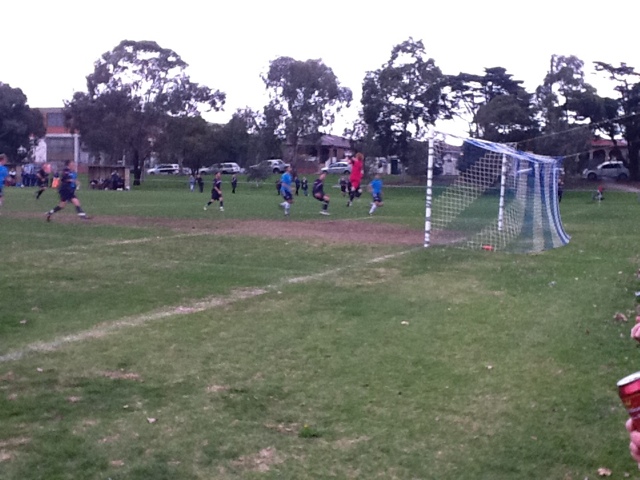
Keeper saves well.

4.28. Good period for Moreland.

4.31. Fawkner free kick 25 out. Cleared. Another shot. Saved by keeper.

4.34. Moreland cross/shot juggled by keeper.

4.35. Fawkner keeper saves high shot on line.

Even though Moreland are going through a good period, Fawkner are not really struggling even with a man short.

4.38. Fawkner attack from free kick on left. Goes behind.

4.39. Moreland break. Corner on left.

4.40. Fawkner free kick 25 out on left. Headed clear. Defensive fc.

4.41. Moreland free kick near right corner. Keeper feels he was impeded but ball cleared anyway.

4.43. Moreland sustained period of attack. Not penetrating though.

4.45. Fawkner shot just wide.

4.46. Moreland great opportunity. Blasted into side netting.

4.51. Moreland free kick 30 out on left. Behind for corner. Good header just over.

4.52  Game over. Fawkner 1-0.

With a man over Moreland had every opportunity to take this game back. Fawkner's resilience won the day. This should send alarm bells through the league. Highlight of the day was that save by the Fawkner keeper.


Fawkner keeper congratulated by his new friends from the Moreland supporters.
Why is he still wearing that horrible strip?

Tuesday, 15 May 2012

Henry John Dockerty, 1882–1965

by Roy Hay


Henry John Dockerty, better known as Harry, was a pioneer of the game in Victoria and probably the single most influential figure in its history in this state. He was most likely born near Glasgow, probably in 1882, the son of James Dockerty, a farmer, and Grace Hunter. [1]. However, a search of the birth registers of Scotland’s People reveals only onemale Dockerty born in Scotland between 1870 and 1900, and that person was born in 1870. None of the Henry Dochertys born between 1878 and 1885 fit the information contained on his death certificate. [2]

He was trained (apprenticed?) as a tailor and cutter and set out to make his fortune abroad in his early twenties, arriving in Melbourne via India, New Zealand and Sydney in 1907. He set up business in Collins Street where he became a successful businessman, later moving to Flinders Lane, where he had all the doctors on his books for their bespoke suits. [3]

On 21 July 1908 he put a small item in the Argus, ‘All those interested in the formation of a British Association Football League in Melbourne are asked tosend in their names to H. Dockerty, 259 Collins Street.' [4] A subsequent report in the Argus on 30 July noted the success of this appeal.

During the pastweek some lovers of this game who reside in Melbourne have had practice matches and formed a league, the full title being the British Association Football League of Victoria. In answer to Mr. H. Dockerty’s (one of the organisers) invitation, several players assembled at Middle Park last Saturday, and indulged in practice, and judging from the attendance the game should make rapid strides. An enthusiastic and largely-attended meeting was held at the Orient Hotel on Tuesday night, with the result that the league was formed. Several matters were discussed, and office bearers elected. There will be practice matches every Saturday, until the executive committee form clubs.[5]

Dockerty played with the St Kilda club when competition got under way. Not content with forming a league, he presented a handsome silver cup, which became known as the Dockerty Challenge Cup, first played for in 1909 and won by Carlton which defeated St Kilda by two goals to one on 15 August. That trophy was to become the Victorian equivalent of the FA Cup involving all the senior clubs in the state in knock-out competition for nearly a century. It was last won by Green Gully in 2004 and has now been returned to the Football Federation of Victoria.[6] Let’s hope the competition can be revived in future.[7]

Dockerty was influential in the formation of teams beyond Melbourne including Wonthaggi Rangers. As president of theVictorian association he led a Melbourne select to Powlett River to take on the new team in June 1910.[8] He also helped set up junior competitions to bring on the next generation of players. Harry Dockerty was also involved in the formation of the Commonwealth Football Association in 1912 and subsequent attempts to establish a continuing national body to organise the game. His contribution to Victorian football was recognised as early as 1909 by the presentation to him of a magnificent framed collage of pictures of the six league teams, the executive committee, an immaculately turned out Harry Dockerty himself and the trophy he had instigated.

Framed picture presented to Mr Harry Dockerty on 23 September 1909, showing the Dockerty Cup, the six teams taking part in the competition and the executive committee of the British Football Association of Victoria in 1909. The picture now hangs in the FFV boardroom. Photo: Roy Hay. The teams are from top left anti-clockwise: Melbourne United, Williamstown FC, Carlton United, St Kilda FC, Prahran FC, Fitzroy District.

Harry Dockerty married Mary Jane Hastings in Sydney in 1919. They had one son John Denison Dockerty who was born in Melbourne in 1926.

When football resumed after the First World War Dockerty continued to lead the way, and the Dockerty Cup went from strength to strength. The Commonwealth Football Association was reformed in 1921 and Harry Dockerty was elected as its first president.[9] He tried hard to get Victorians to support the visit of an English touring team and when this was finally achieved in 1925 he was there as president to greet the tourists.[10]

Source:Argus, Tuesday 19 May 1925,p. 9.

After the Second World War, Harry Dockerty was president of the Victorian Amateur Soccer Football Association from 1956 until the demise of that body in 1962. Previously he had been vice-president every season since the end of the war.
Dockertyat a game, probably in the 1960s.
Photo: Laurie Schwab collection, Deakin University Library.
Dockerty also helped mend two of the great splits in the game in Victoria from 1927 to 1929 and again in 1958 to 1962.[11] While factions were at loggerheads his was always the voice for reason, compromise and conciliation. He was pleased when the post-war dispute was settled with the Victorian Soccer Federation taking over the running of the game from the predecessor organisation, the Victorian Amateur Soccer Football Association. He was nominated unopposed as the president of the new body in 1962, a position he held until his death in 1965. The honorary position reflected the esteem in which he was held by all involved in the game. He had worked tirelessly to try to bring about an amicable resolution of the split between the amateur body and the new semi-professional federation.

So he was able to greet Sir Stanley Rous, then president of FIFA, when he visited Australia in the 1960s, and provide backing for the move to rejoin the world game which was finally achieved in mid-1963.

VSF President, Harry Dockerty (left), with FIFA officebearers on their visit to Australia in 1963,
Dr Helmut Käser, Secretary, SirStanley Rous, President and Dr Ottorino Barassi,
Vice-President. Photo: LaurieSchwab collection, Deakin University Library. [12]
The next year Harry Dockerty commended the formation of a players’ association saying, ‘I am pleased to be here and wish your association good luck for the future. I think the move will improve Soccer in Victoria.'[13] By then Dockerty had only a year to live but he had overseen the development of the code from a tiny participant game into a significant semi-professional spectator sport and a major part of Australian life, for the domestic population and for successive generations of migrants like himself.

 Harry Dockerty spent the latter part of his life at 43 The Ridge in Canterbury and died on 26 May 1965. He was cremated at Springvale.

Harry Dockerty was posthumously inducted into the Hall of Honour of the Australian Football Hall of Fame in 1999. This is the highest award available for a contribution to the development of the game in Australia, and is given for eminent service or contributions to football in Australia, whether at state/territory level, nationally or internationally. In 2010 he was an inaugural inductee into the Football Federation Victoria Hall of Fame.

Never comfortable in front of a microphone, Harry Dockerty was always
impeccably dressed. Photo: Laurie Schwab collection. Deakin University Library.

Harry Dockerty was much happier in domestic life. Here with his wife Mary Jane and Lassie.
Photo:Laurie Schwab collection. Deakin University.

References


  1. Henry John Dockerty, death certificate, Victoria, 10435/65.
  2. There were two Henry Dochertys born illegitimately in 1882. Inneither case was the mother’s name Grace.
  3. Information from his daughter in law, Joan Marguerite Dockerty(née Ferguson) by telephone, 28 May 2010.
  4. Argus, 21 July 1908, p.7.
  5. Argus, 30 July 1908, p.7.
  6. In that revival it was known as the Crazy John’s Dockerty Cup. Inthe final Green Gully beat Fawkner one-nil. Ozfootball website, http://www.ozfootball.net/ark/States/VIC/2004CJCup.html
  7. Roy Hay and Ian Syson, Thestory of football in Victoria, Football Federation Victoria, Melbourne,2010, pp. 6–8.
  8. Argus, 2 June 1910, p. 5.
  9. Minutes of the Meeting of the Commonwealth Football Association,16 August, 1921.
  10. Sydney Morning Herald,30 December 1924, p. 8; Argus, 19 May1925, p. 9.
  11. Roy Hay, ‘Marmaras’s oyster or Seamonds’baby? The formation of the Victorian Soccer Federation, 1956-1964’, Sporting Traditions, 10, No 2, 1994, pp.3-24; Sporting Globe, 20 April 1927.
  12. Caption has picture dated 18 December 1963, but Rous visited in1962 and 1964 as well.
  13. Braham Dabscheck, ‘Early attempts at forming soccer player unionsin Australia,’ SportingTraditions, 10, No 2, 1994, pp. 33-34.

Monday, 14 May 2012

If you know your history . . .

Football Federation Victoria (FFV) History Committee today. Met up with the committee at the FFV headquarters on St Kilda Road. Great little coffee shop below the FFV was the forum for much discussion, including: Moreland City U13 B's failure to capitalise on a 2-0 half-time lead over Fawkner in a game they ended up drawing 2-2, Man City's ascension, female referees, whether Victorian referees were too soft on hard tackles or vice versa.

Our job is to encourage and enable the preservation and recording of the game's history in Victoria. We meet monthly and discuss issues like the digitisation of Victorian Football history, Football museums and the storage of heritage items, the written history of the game in Victoria.

Today we met in Training Room #2 in which we were overlooked by a framed Matildas' shirt.

Matilda's 2006 team shirt with signatures.

Important issues for today's meeting were the ongoing difficulty of getting the print media to acknowledge FFV competitions, the new Sporting Pulse system for entering match results and nominations for the Hall of Fame. Some discussion was also held as to whether 2013 or 2014 represented 130 years of organised soccer in Victoria. The jury is still out, though 2014 is the 130 anniversary of organised club competition.

1956 Socceroo, Ted Smith, Historians Roy Hay and Paul Mavroudis,
pondering a weighty issue in today's meeting.

Maggie Koumi revealed to the committee the recently recovered McQuarrie-Rocco Award (for the most valuable Victorian state team players), set up to memorialise two outstanding young women players who lost their lives in a car accident returning from a game in Sydney. Some discussion was had as to its purpose in the future given that interstate competition is a thing of the past.

Maggie Koumi holds the McQuarrie-Rocco Award for the most valuable State team player.
 
Winners include Fiona Young, Carolyn Monk, Theresa Jones (Deas), Amanda Norgate,
Andrea Martin, Leeanne Hamilton, Kate Walker.


On the way out we notice these two glorious remnants of Victorian soccer history, the Armstrong Cup and the Dockerty Cup at the FFV reception desk. Playing for these would be one way of bringing our game's history alive.

A very shiny Armstrong Cup. Roy Hay on Armstrong Cup.


The Dockerty Cup, in all its glory. Roy Hay on Harry Dockerty.

Sunday, 13 May 2012

Soccer in Geelong is more than a hundred years old


By Roy Hay, first published in Geelong Advertiser, 1 August 2007, p. 43.


For many years the first evidence I could find of a soccer match being played in Geelong was in 1920, a reference I owed to a former colleague, GaryCotton.

I knew this was far too late, but finding earlier games on trawls through the sources, particularly the Geelong Advertiser, had proved fruitless.

Then the historian of the World Game, Dr Bill Murray of La Trobe University drew my attention to a brief note in the Australasian which announced that the game would be demonstrated to the students of Scotch College in Melbourne, and the Geelong Grammar School in June and July 1884, thanks to the headmasters of both schools.

I asked my friend Steve Radojevic, Bursar of the Grammar School, if he or the school archivist could check their files, but no record of the game could be found.

So it was back to the Advertiser to see if the game in Geelong took place.

There was an advertisement for the Grammar School on the front page on 1 July 1884 but only about its scholastic performances and a note, which obviously had not been proofread, saying the school would reopen after the holidays in February 1884.

But then on page three there was a notice about a game under Anglo-Australian rules to be played on Corio Oval between the Richmond and Carlton clubs from Melbourne—not the footy clubs, the soccer clubs of the same name.

The soccer clubs had been founded at least a year earlier and were playing regular matches in Melbourne and the first interstate matches between Victoria and New South Wales were played in 1883.

Next day, Wednesday 2 July 1884, the Advertiser carried a lengthy match report, detailing the teams, aspects of the rules which would be puzzling to observers, an estimate of crowd numbers and some critical comment on the code in comparison with the domestic game.

‘Some of the players exhibited much dexterity, but no excitement was created, and nearly all present voted the pastime decidedly slow, after the purely Australian method of playing football’.

Spence for the red and whites scored the first goal early in the second half, and Ware equalised for the blues late in the game, so it ended one-all.

The anonymous correspondent noted that there were around 300 people present at the start but not more than 100 remained at the end.

The writer noted that only the goalkeeper could handle the ball to prevent a goal and he could not carry it forward.

A crossbar or tape was in use to mark the height of the goal, a referee and two umpires who patrolled the wings and indicated when the ball was out of play by blowing a whistle.

The referee was a Mr. Gibbs, A. E. Gibbs, one of the pioneers of the game in New Zealand and Australia, who was later to be the representative of Australian soccer on the Football Association council in England.

Though the correspondent was cutting about the quality of the entertainment, this was quite common among domestic writers on Association Football in the period.

It did not prevent the game becoming established as a participatory sport in other parts of Australia in the 1880s, though the depression of the 1890s and the consequent fall in immigration resulted in a hiatus in Victoria.

Thereafter the code was reinvigorated in 1909 by Harry Dockerty and others when inward migration picked up again.

Subsequently the Dockerty Cup became the state-wide knock-out Cup which was played for until the 1990s.

The link between migration and the growth of soccer was re-established in the 1920s and again after the Second World War, and while migration is high at the moment, this is the first period when the expansion of soccer has been driven by the domestic population of Australia.

Saturday, 12 May 2012

Clifton Hill United v Moreland City, Quarries Park, 12/05/12

Tough choice today. Go to Altona to photograph Ballarat's famous supporters' couch or Quarries Park to see table-topping Moreland City's visit to Clifton Hill? The proximity and the cheaper ouzo swing it for me.
Moreland currently sit on top of SL2 NW. Their for and against (11 and 3) from 4 games looks very impressive when compared with the Hillmen's mid-table position (7 for, 7 against). The numbers suggest a Moreland 3-1 win.
Having seen both teams play this season I think it will be closer and if both play well a 0-0 draw is in the offing. Though Clifton Hill can win this if they play to their potential.
I'll be blogging from 2.30. 

_________________________________________

Arrived in time to see Moreland ressies go 2-1 up from a well-hit corner. A major iPad malfunction sees me lose all my preliminary work (the spontaneity of which I'm going to have trouble recreating) and causes me to miss the lead up to the third goal.

The keeper brought down the Moreland striker for a pen and was red carded. 3-1. Clifton Hill coach very unhappy.

The game finishes 3-1 to Moreland City. Altona east reserves hammered 5-1 by the way.

Quarries Park really is a nice spot. Every view is scenic. And though the wind is cold and the skies are threatening it's a good place to be.

Clifton Hill in foreground. Moreland warming up at far goal in front of a parkland backdrop.

Managed to slip into the dressing room and get a couple of snaps.
The 2007 trophy for winning State League 2 and gaining promotion to State League 1
The club song on the wall. Are they aware that Bloody Richmond footy club pinched it from them?


 The match officials make their way onto the field.

They know how much abuse they will get so why do they do it?

Minute's Silence

Minute's silence for a figure attached to Clifton Hill. Their players have armbands.
An announcement would be helpful. Do they have a PA?


3.00 game underway. Clifton Hill with strong wind behind them.

3.01. Moreland free kick on right holds up in wind and comes down dangerously. Dealt with amid penalty claims.

3.03. Sustained pressure from Moreland. Number of dangerous free kicks. Not troubling Clifton Hill excessively.

Bobby. "I didn't touch him!"


3.06  Clifton Hill keeper nearly fumbles into his own net. Moreland looking the better team so far.

3.08  Good defending prevents moreland striker getting good shot away. Keeper saves.

3.09  All Moreland. But good break by Bobby for Clifton Hill on right leads to curling shot just wide left.

3.10  Another good attack from Clifton Hill on left.

3.12  Clifton Hill free kick on left results in weak shot just wide.

3.13  Clifton Hill kick 30 out comes to nothing.

Clifton hill now coming into their own. Game seems well-poised.

3.17  Moreland free kick on left. Glancing header wide.

3.21  Moreland forward attempts hand of god. Not effective, or dignified!

Typical light contrast on a Melbourne football afternoon

This is a good hard game. Lots of commitment from both teams.

3.28  Moreland free kick 30 out. Comes to nothing. Though Moreland are looking the more dangerous in attacking positions.

3.29  Injury break.

3.31  Moreland break down right. Comes to nothing.

3.32  Moreland break after good attack from Clifton Hill breaks down.

3.33  Bobby close from 20 out for Clifton Hill.

3.33  Bobby goes down theatrically. Though he was fouled. Kick from right palmed away by keeper.

3.34  Moreland attack down right produces clearance - though keeper had it covered.

End to end stuff now. Defenders not seeming troubled.

3.36  Long Moreland shot easily covered. Next wave: goal! Moreland 1-0. Missed it. Too busy typing to be able to describe it.

3.38  Foul by Moreland just outside area. Yellow. Kick to come. Good kick bent low around wall. Defender gets a foot to it.

3.40  Long bomb free kick by Clifton Hill saved easily by keeper.

3.41  Two good Moreland attacks. Shot just over in the second.

3.42  Wasted long ball by Moreland.

3.44  Long Clifton Hill throw into box headed over.

3.45  Moreland keeper palms high ball. Behind for corner. Corner goes through box crossed back in and headed wide.

3.46  Half time. Clifton Hill needed to score there and won't be happy running into the wind one goal down. Moreland looked the better team but Clifton Hill very good at times. Bobby and the other striker always looked threatening.

0-0 at half time in Altona.

4.01  Second half underway. Moreland attack.

4.02  Clifton Hill Foul outside area. Moreland kick badly hit. Keeper gathers on second attempt.

Series of Moreland raids.

4.07  Clifton Hill caught offside.

4.08  Extravagant dive by Moreland player in box. Referee ignores it.

4.09  Moreland Free kick on right. Goes behind but Clifton Hill having trouble clearing their half.

4.11  Moreland free on left 25 out. Cleared for corner. Corner produces scramble and save.


4.14  Moreland keeper takes high ball. Another high ball attack from Clifton Hill comes to nothing.

4.17  Bobby temporarily back In a more defensive role. Clifton Hill having a better period.

4.18  Moreland attack on right through ball too long. Moreland attack on right. Breaks down.

4.19  Strong Clifton Hill defense defuses through ball.

4.21  Sustained Moreland attack results in offside call.

4.22  Moreland free kick on right down line. Produces cross that isn't met. Cleared.

Moments after the photo taken, Moreland player in foreground puts ball in net. 2-0.

4.26   Moreland attacking throw. Comes across goal and put into net from close range. Clifton Hill cry offside but it wasn't. 2-0 to Moreland.

4.28  Deja vu all over again. Keeper takes out mc forward and is red carded. Almost carbon copy of the ressies send-off. Free kick 20 out.

Replacement keeper saves kick well onto left post. Cleared. Use your imagination!


4.34  Moreland shot from left when cross was the cry from the coach.

4.36  Moreland attack down right. Defender puts behind for corner. Great double save by keeper. The second a great reflex save.

4.39  Long ball from Moreland. They don't need to do it.

4.40  Clifton Hill copy. Keeper deals with it easily. Moreland break and keeper fouled coming out for high ball.

4.41  Great save by Moreland keeper. Possibly Clifton Hill's only real chance of the game Behind for corner.

4.42  Moreland attack defused after foul on defender.

4.43  Beautiful touch by Moreland no. 19 to turn defender in area. Shot comes off his teammate's backside and is cleared

4.44  Moreland striker's control lets him down ball balloons behind.

4.45  Moreland no 19 heads wide.

4.46  No 19 again in thick of it down right wing. Skillful player.

4.48  Nearly time. More long ball. Weak shot from Moreland no. 19 easily saved.

4.49  Clifton Hill blast over after good attack and ref blows for full time. Clifton Hill 0, Moreland 2.

Even allowing for the extra man Moreland looked superior in most aspects. They had better midfielders on the day who gave the team their dominance. The game resembled aerial ping pong at times in second half. The wind will do that. And when you are tiring it's the easier option. Moreland sitting pretty at the top. Clifton Hill have to find something soon.

Oh and Altona and Ballarat played a 0-0 draw.


SL2 NW Ladder After Round 5

POS TEAM P W D L F A GD PTS
1
Moreland City SC 5 4 1 0 13 3 10 13
2 Fawkner Blues FC 5 4 0 1 9 3 6 12
3 Westgate FC 5 2 2 1 9 7 2 8
4 Banyule City SC 5 2 2 1 10 9 1 8
5 Altona East Phoenix SC 5 2 2 1 4 6 -2 8
6 Brunswick City SC 5 2 1 2 11 11 0 7
7
FC Clifton Hill 5 1 2 2 7 9 -2 5
8 Preston Lions FC 5 1 2 2 6 9 -3 5
9 La Trobe University SC 5 1 2 2 4 7 -3 5
10 Keilor Park SC 5 1 1 3 8 8 0 4
11 Altona City SC 5 1 1 3 3 9 -6 4
12 Ballarat Red Devils SC 5 0 2 3 5 8 -3 2

Thursday, 10 May 2012

Soccer growing in pre-WWI Melbourne.

An interesting long piece from the Argus (29 June 1914), speaks to the popularity and growth of soccer in Melbourne immediately prior to the First World War. The author acknowledges crowds of sometimes between two and four thousand down at Albert Park. By comparison the weekend after this piece was published 3,568 spectators turned up at the MCG to see Geelong hammer Melbourne, though this figure does seem to represent a lower crowd than usual.

It's written by an outsider, one brought up on Australian rules but who is sympathetic to the game. Clearly he sees soccer as a migrants' game, even though locals are starting to get involved. Victoria's strength in a recent intercolonial game against NSW was very much determined by its being made up of experienced migrant Scottish and English players as against the callowness of the native born from NSW. Soccer is seen to be technically skillful, a "pretty" and "clever" game lacking the corruption of professionalism that has poisoned the "Australian game". Moreover, it has a referee who tends not to interfere and is respected.

This latter point leads to the fascinating implied claim that Australian rules is a bastion of corruption and match-fixing.

Thinking about it in today's terms the piece reads like a Greg Baum/Richard Hinds feature (without the sarcasm and bad faith) commissioned by the editor after the regular soccer writer has failed to notice that something pretty interesting is going on down at Albert Park. The usual soccer fare of derisory team lists, basic results and no write-ups -- (
or brief ones, when possible, when space is available, when people are interested, 'We're not publicists, you know!') -- are shown up by this sustained and positive piece.


"SOCCER" FOOTBALL. 

GROWING POPULARITY.

A PLAYERS' GAME.


Organised by a few enthusiasts from England, who found the Australian game, even as it was played several years ago, not at all to their liking, British Association football now draws from 2,000 to 4,000 people to Middle Park every Saturday. That the internal growth of the Victoria Amateur Football Association now affiliated with the governing body in England, has been equally steady is shown by the fact that there are 22 clubs in Victoria, with a roll of about 500 playing members, while New South Wales has 130 clubs. Most of those who are satisfied to stand in the open all the afternoon, threatened by batteries of artillery and stray horses, were keen followers of the game before they reached Australia, but there is a growing percentage of local "barrackers" who come down as curious sceptics, and soon find themselves fascinated by what is one of the prettiest and cleverest games in the world to watch. A game that will attract 100,000 Englishmen must necessarily have some good features, and these are beginning to be more and more recognised by many who are disgusted at the present condition of the Australian game. It might be thought that some of the supporters are won by the prospect of a free show, but no suggestion of that can be found in the appearance of the men and women round the side lines. To a great extent it is a family outing, and renewal of home ties.

Men who have seen the game at its best laugh when asked how the standard of play here compares with that in England, but the things that are done with the ball at Middle Park are eye-openers to followers of League football. The principles underlying British Association are the prevention of handling of the ball and the reduction of rules, and consequenty interference by the umpire or referee, to minimum. The playing area is smaller than ours, and there are only eleven men a side, who stand all in their own half of the ground at the kick-off and play largely in their places, the attack being made by the five forwards—centre and inside and outside left and right. The goalkeeper is the only player allowed to handle the ball, and he may not run with it. This formation and the use of a spherical ball make the game clean and open. Passing becomes a feature of the play, and even the mediocre player seems able to direct the ball to any angle with any part of the foot, toe, or heel while running. Naturally, the round ball is easier than the oval to deal with but the precision with which it is got under control from the air and 'dribbled' along a few inches in front of the feet at top speed is only less surprising than the use made of the opposite end of the body. Meeting the ball on the full a player will "head" it across to the wing with the front of his skull farther than an Australian would pass with his hand. A man prominently connected with a sport once as popular as football, but killed by corruption, was keenly interested in the play on "Saturday, and speculated as to the result if first-class League players acquired the same control over the ball as these amateurs. As he spoke an incident capped his remark. The ball flew high to the wing. A man "headed" it back. An opponent headed it out again and a fellow of the first smothered it with his foot as it landed, and swung it hard towards the goal.

After the skill of the players the insignificance of the referees part is the most striking feature. Imagine a league umpire in boots and blazer, walking about the centre of the ground most of the time! The only penalties he has to inflict are for handling the ball or the man, charging in the back, tripping and kicking, and "offside." But when he speaks he speaks with authority. Any player can be ordered off the ground. An incident on Saturday showed the spirit of the game. A player was tripped and he turned and kicked his opponent. Shouts of "Play the game" came from both teams and as the referee merely warned the kicker and gave a pen- alty against him, a burly spectator growled. "And he didn't order him off. No wonder the game doesn't get on in the colonies".

Still, it does get on and its supporters even prophesy that it will solve the problem of universal football. Australians are not yet excelling as players, for their speed is counteracted by a lack of restraint. That is why Victoria won all four matches against New South Wales recently. One has only to listen to the shouts of the players and the keenest supporters to discover where they hail from. But they hold that the morals of the game will win a way for it. Already the round ball has made its appearance in school playgrounds. The prime advantage claimed for British Association is that to achieve corruption one must buy most of the team. The referee has so little to do in comparison with the Australian umpire that he is a valueless asset.

SATURDAY'S MATCHES

LEAGUE. 

Division I

Albert Park, 3 goals (Anderson, Cox, Campbell), beat Burns, 1 goal (Johnston).

St. Kilda, 1 goal (Slade), drew with Preston, 1 goal (Phelps).

Prahran, 1 goal (G. Brown) beat Thistle, nil.

N and D, 2 goals (Bell, Madden), beat Birmingham, 1 goal (Allen).

Yarraville, 0 goals, drew with Spotswood, 0 goals.

Division II

Hawthorn, 2 goals (J. Turnbull, T. Turnbull), drew with Burns A, 2 goals (Monk, Rawles).

Burns were fully expected to take 2 points out of Albert Park, but the latter team have improved considerably in the last few weeks, and have well deserved their victory 3 goals to 1. The Park won the toss, and kicked with the wind, the game being only five minutes old, when Liversedge crossed the ball, and Anderson opened the score with a shot which struck the bar, and turned into the net. Burns continued to act on the defensive for the rent of the first half, there being no further scoring. In the second half, the wind had dropped, but Burns soon took up the attack, but failed to score, and the Park, getting away the ball was crossed from the left, Cox making no mistake with the shot. Burns, who badly missed Ruddiman, now seemed to fall to pieces, and it was not long before the Park increased their lead. Campbell netting from some distance. A quarter of an hour from the end, good work bv Anderson for Burns brought up their only goal. Johnson accepting a pass, scoring with a cross shot, the game ending as stated. For the winners, Kelly, Cox, Liversedge, and Fraser were the best of a well-balanced team, the pick of the Burns team being, Jones, T. Anderson and Bellis.

Saturday was quite a day of surprises, Prahran gaining their first League win of the season at the expense of Thistle, who are at present the leaders in the the for premiership. The only goal came from G. Brown, who was entrusted with a penalty kick, for which he gave Russell no chance of saving. For Prahran, Calversley in goal was very safe, Luker and Earthey also doing well in defence, with Mark Caulfield at left full back in his best form, George Brown being easily the best of the forwards. Thistle seemed to have quite an off day, Bottomley being the best of the forward rank, whilst Goodson played his usual sound game.

St. Kilda were another team who were expected to win easily, but though Preston were without the services of Robson, Bailey and Purcell, they managed to make a creditable draw of 1 goal each. Slade, who, since his promotion to the first team, has been the most consistent scorer, was again successful in finding the net, but S. Lowe was badly at fault when be allowed Phelps to equalise, as he should have saved without difficulty.

Yarraville visited Spotswood, a goalless draw being the result, the visitors being unlucky in losing Joey Grieves, who was carried off with a broken ankle. For Yarraville, Dowser was not up to his usual form; but Hamilton, Stranger, Gardiner, and Blackburn all did well, the most outstanding player of the Spotswood side being Charlie Grieves.

Birmingham received a rare setback in their chances of the premiership in being defeated by N. and D., who had the best of a good game, Robinson (in goal) being brilliant as usual. 

Tuesday, 8 May 2012

Soccer in Melbourne in 1870? surely not!

It is generally accepted that soccer (Association rules) was not played in Australia until the one-off Woogaroo game in 1875. We have to wait until 1880 in Sydney to get a sense of competitive games being played regularly, even though soccer had been officially (but fleetingly) adopted by clubs in Brisbane, Adelaide and Hobart throughout the 1870s. One competitive game of soccer was played in Hobart in 1879, the result of which was part of the premiership calculations that year. Competitive games were attempted in Adelaide in 1873 but a number of players refused to adhere to the non-handling prohibition, thereby rendering the games farcical.

From time to time the "English Association rules" were advocated by letters to the editors around the country, urging the authorities to adopt the game because it was: a) safer, b) more sensible, c) better, d) more "scientific" (whatever that means) or e) all of the above.

These appeals seemed to fall on deaf ears until the 1880s. A correspondent to Bell’s Life in Sydney and Sporting Chronicle commented on the way football was being played in Sydney in 1867, "I must here say that the code of rules under which these matches are played, a strange combination of Rugby and other rules, is not by any means the best that could be selected." He felt that it "would be far better for the two clubs to discard at once these now generally condemned laws, and play under those of the English Football Association or the joint Oxford and Cambridge Rules, both of which are decidedly superior and much more comprehensible." (27 July)
 
Despite frequent urging it is not until 1878 that we see a report on a practical application of FA rules in a half-and-half soccer/rugby game played in Sydney.
A football match, between Old Victorian Players and All-comers, was played on Saturday at Moore Park. It was intended to show the relative merits of football as played by the English Association rules and the game as played under Rugby rules. About 3000 spectators witnessed the sport. The play resulted in a draw, with a slight advantage on the side of the All-comers.(Sydney Morning Herald, 31 August 1878)
Yet the half-and-half game shows that clubs and authorities around Australia were able to be flexible and keep something of an open mind on football codes and laws.

Even in hidebound Melbourne there seemed a willingness to be open, occasionally. The Argus reported in 1870 that an
amusing game of football will be played on the Metropolitan ground, Yarra-park, this afternoon, between the local club and a team chosen from the ranks of the Victorian police force, who will play under the guidance of Mr. J. Conway, of the Carlton Club. The game will be played something after the home style, and holding or running with the ball will not be allowed. (9 July 1870)
When the Police team and Melbourne FC were scheduled to have a match it was felt that (severe) rule modifications were needed to be fair to the police team. As a result the game was to be played in the "home [British] style".

The report followed two days later. The Melbourne team proved too strong for the police, who struggled to cope despite the rules being modified in their favour.
The Melbourne Club v. the Police. This match, as was expected, was a most amusing affair, and attracted a large number of spectators to the metropolitan ground. The toss was won by the police, who elected to kick down the hill. With the view of equalising the chances of the teams, the rules of the Melbourne Club were slightly departed from, neither "marks," holding, nor running with the ball being allowed. (Argus 11 July 1870).
To try and work out just what this game might have looked like is difficult. We need to imagine the Melbourne rules of the time with three crucial aspects missing. Players could handle the ball but they could not claim a mark, hold on to it or run with it. Most likely they needed to get rid of it quickly after catching it to avoid being pummelled.

Yet it's the notion of the "home style" that intrigues me. The various prohibitions and the absence of offside rule out Rugby and the Public School games. They also rule out Association football as codified in 1863. If anything the 'home' game they most closely resemble is the football of the Sheffield rules (a game which is formative in the development of soccer) -- though it too allowed a mark.

When I found this piece I was excited to think that I might have found a very early example of a soccer-derived game being played in Australia. Unfortunately, wishful thinking won't make it so. Despite its being a close relative, this modified game can't be claimed as an immediate progenitor of Australian soccer.

But the point that should also be made is that the game bears little resemblance to Melbourne rules of the time and virtually no likeness to footy today. Though that won't stop the AFL in its endless campaign to colonise the past, present and future of Australian footballs.


Saturday, 5 May 2012

Altona East Phoenix v Fawkner Blues, Paisley Park

Off to Altona East today for the game against Fawkner. Will blog from about 2.30. Fawkner is top of the table and Phoenix needs to rise.

Altona crest
Arrived in time to see Altona reserves equalize 3-3. Coach Jim Georgakakis made the point that the shortest man on the field scored with his head. 
Reserves coach, Jim Georgakakis, looking pensive with the score at 3-3.


15 mins to go. Game could go either way.

4-3 fawkner after good save by keeper one on one. Follow up slammed into net.

Another good save by Altona keeper.

Deflection for Altona corner.

All over. Two minutes early according to unhappy Altona coach.

Popped into the clubrooms before the main game for a memorabilia check. A number of things of interest but this has to take the cake!

2003 Least Worst Cup Finalists!! Still scratching my head over this one.


Main game about to start.

The first time I've seen a female referee at a senior men's game.


3.01. Game underway. Altona into the wind.

Altona pushing well. Some discussion as to whether Fawkner is playing in cyan. I think they are. Azure is the counter claim.

You be the judge: cyan or azure?


3.09. Good period of pressing for the cyanazzuris.

3.15.  Fawkner corner. Put behind for another. Too long. Goalkick.

3.21. Altona corner. Bad fawkner tackle outside area. Freekick and yellow. Another yellow for dissent. Good refereeing.

3.22. Good kick dipping onto roof of net.

3.23. Altona long ball. Fawkner long ball. Hmmm.

3.26. Injury. Bourakis off. Replaced by Burnett.

3.28.  Dangerous Fawkner long ball put behind for corner. Headed off the post.

3.30. Another Fawkner corner. headed clear.

3.31. Heavy clash in midfield. Free kick to fawkner. Period of dominance for Fawkner .

3.34. Counter attack by Altona easily defused.

3.35. Altona yellow. Ref stands up to coach and assistant. Good on her.

3.36. Good work by Fawkner forward. Awful shot.

Fawkner dominating but no sense of penetration and too much long ball.

3.38. Fawkner Corner. Goalmouth scramble. Well gathered by keeper in the end.

3.39. Altona counter. Defused.

3.40. Poor decision by by Altona forward after good lead up work on left. Fawkner counter attack looking dangerous.

3.43. Fawkner free kick near left corner. Cleared.

3.44. Fawkner left back has it over Altona winger meletis. He needs to lift because he looks the player most likely to have an impact up front.

3.46. Half time. 0-0.

Fawkner dominated but lacked penetration. Altona has something to give this game but needs to lift. Reminds me of the Clifton hill game.

4.00. 2nd half underway.

4.02. Good attack by Altona. Goal kick given but crowd unhappy.

Game seems to be opening up with both teams looking more threatening.

4.06 Fawkner free kick on right. Headed over.

4.09. Gwyther for Altona. Strong run under pressure from centre back. Gets off good shot.

4.10. Fawkner shot wide to right.

4.11. Good period of pressure from Altona.

4.12. Fawkner attack down right. Shot over and to the right. Feels like a goal is coming.

4.14. Another disputed free kick to Fawkner 30 out. Cleared.

4.19. Interception by Fawkner #14. Fouled outside area. Kick booted clear.

4.21. Yellow to Altona. Another foul on #14.

4.22. No 14 in thick of things. Getting fouled and fouling in equal measure. Goes in hard for a small player.

Fawkner's #14. Definitely working his way into man of the match calculations.


4.29. Altona Crowd furious at failure to give yellow.

No. 14 replaced! So much for my judgement. Must have run out of puff.

4.30. End to end stuff now. Fawkner cross. Keeper fouled.

4.33. Good attack by Altona. Keeper holds cross well.

4.34. Good shot by Fawkner forward off outside of boot. Good save.

4.35. Good period for Fawkner.

4.37. Bizarre moment! Referee indisposed and leaves field. Assistant takes over. Referee ran out of breath. A shame because she was having a good game (occasional over-officiousness aside) and to leave the field with 8 mintes remaining is not a good look. Will try to follow up.

4.38. Good counter by Altona. Forced for corner.

4.39. Foul outside of area. Altona free kick. Banged into wall and cleared.

4.41. Good pressure by Altona. Crowd erupting!

4.43. Two to go. Looks unlikely but game deserves a goal.

4.44. Fawkner player lucky not to go. Hands to face. Replacement ref probably makes right decision.

4.46. Brave keeping from fawkner at feet of Altona striker Franck la Bakohler.

4.47. Fawkner nearly score.

4.48. Altona attacking in left corner.

4.49. Miracle goal!! 94th minute. Gwyther on left blasts in from very tight angle. Celebrations intense. Altona 1-0.

4.50. Full time crowd erupts again.

Good second half. Either side could have won it. Frantic ending very enjoyable. Feel a bit for the Fawkner players who probably deserved to leave with something today.


A devastated Fawkner keeper trudges from the field at the end of the match. He had a good game and can't be blamed for the goal. Someone should tell him though that a hot pink strip and red hair don't work together!

Ladder After Round 4

POS   TEAM P W D L F A GD PTS
1   Moreland City SC 4 3 1 0 11 3 8 10
2   Fawkner Blues FC 4 3 0 1 7 3 4 9
3   Brunswick City SC 4 2 1 1 9 6 3 7
4   Altona East Phoenix SC 4 2 1 1 4 6 -2 7
5   FC Clifton Hill 4 1 2 1 7 7 0 5
6   La Trobe University SC 4 1 2 1 4 5 -1 5
7   Preston Lions FC 4 1 2 1 6 8 -2 5
8   Keilor Park SC 4 1 1 2 8 6 2 4
9   Westgate FC 3 1 1 1 6 6 0 4
10   Banyule City SC 3 1 1 1 4 6 -2 4
11   Altona City SC 4 1 1 2 2 9 -7 4
12   Ballarat Red Devils SC 4 0 1 3 5 8 -3 1