Playing long balls into empty space since 2012.

Tuesday, 16 July 2013

Back on Woogaroo: the origins of soccer in Australia

Revisiting and Re-Imaging the Woogaroo Question

Glen Hickey's revelation that the first time he saw soccer was at the Willowburn "mental hospital" in Toowoomba, reminded me that I had a couple of photos to add to the Woogaroo story. I thought it might also be a good idea to isolate the story from the context in which it is presented elsewhere on the blog.

Wolston Park Hospital Cricket Ground. Likely site of
the first recorded game of soccer in Australia

In "The Chimera of Origins" I showed that the Wanderers first game in 1880 was not the first game of soccer in Australia. Two games were played by the Hobart Cricketers FC in 1879.

But nor were the Hobart Cricketers’ two matches the first games of soccer in Australia. Even earlier games were played. One took place on Saturday 7 August 1875 in Woogaroo (now Goodna) just outside of Brisbane. The Queenslander reported that the Brisbane Football Club met the inmates and warders of the Woogaroo Lunatic Asylum on the football field in the grounds of the Asylum: “play commenced at half-past 2, after arranging the rules and appointing umpires; Mr. Sheehan acting as such for Brisbane, and Mr. Jack for Woogaroo. One rule provided that the ball should not be handled nor carried.” In itself this description is not enough to justify the claim that the game is Association football. The clinching evidence comes from the Victorian publication The Footballer in 1875 which notes in its section on “Football in Queensland” that the same “match was played without handling the ball under any circumstances whatever (Association rules).” 


Goodna Asylum in 1919 (?). Note the soccer goalposts


A fascinating story is waiting to be told about why the Woogaroo Asylum played Association rules when all other clubs around the region were playing rugby or a Queensland variation on the Victorian rules. It might well have boiled down to the preference of an authority figure (in this case the Asylum’s superintendent) or even the players themselves. The choice might also have been determined by assumptions about what would or would not be an appropriate game for inmates to play.

John Jaap was the superintendent on the Woogaroo Lunatic Asylum between 1872 and his death at 39 years in 1877. He graduated from Glasgow University with an MD in 1858 and appears to have resided in Britain until he was married in London 1869. In January 1871 he was living and working as a doctor in Warwick, Queensland. Jaap was noted for implementing humane methods and programs at the Woogaroo institution. According to the web site,
'The road to recovery - a history of mental health services in Queensland 1859-2009' he “employed patient labour to establish a piggery and farm pursuits, which were a feature of the asylum for many years. Jaap drew attention to the overcrowded conditions at the asylum, a perennial problem which plagued the institution for most of its existence.”

Jaap also supervised the implementation of a sports program. For example, in November 1873 the Asylum held a sports day and ball.

Following the humane and indulgent treatment which characterises the modern system of dealing with the insane, the Surgeon superintendent of the Woogaroo Lunatic Asylum (Dr. Jaap) afforded the patients in that institution an excellent day’s amusement on Saturday last, in the shape of athletic sports, &c, with a ball in the evening.
Football can be seen as part of a continuum of ‘improving’ activities established by Jaap, who would very likely have been in favour of Association rules, given the probability that he learned his organised football at Glasgow University. David Murray notes that the game there was
a dribbling one, the ball must be kicked and could not be carried or handled, no collaring or hacking was permitted and there was little rough play. If the ball was caught in the air a free, that is an undisturbed, kick was allowed. The player who held the ball dropped it from his hand and kicked it as [it] fell. The game was practically the same as Hand Ball as regards numbers and manner of playing; in the one case the ball was struck with the hand and the other with the foot.
There were at least two other games of football under Jaap’s supervision, an earlier one against Brisbane FC on 19 July 1873 and one against Rangers FC on 24 June 1876, though there is no indication of the code used in those games. Had the 1873 game been played under Association rules (as might have been likely under Jaap’s direction) it would be the earliest codified game on record in Australia. 
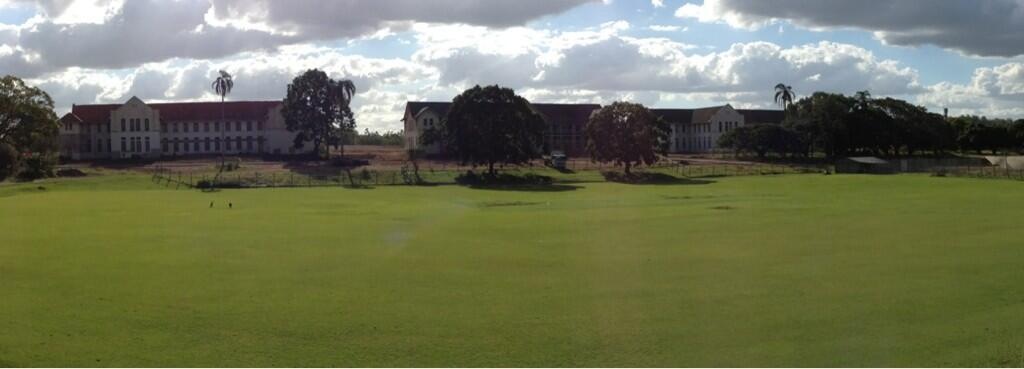

The cricket ground at the Woogaroo Asylum today.Courtesy @pinkpawprints


PS. As an example of the influence of Glasgow University in relation to association football, the founding of Sunderland AFC is a case in point. James Allan arrived in Sunderland from Scotland to teach at Hendon Board School in 1877. He had developed an interest in football while at Glasgow University but discovered that rugby was the predominant winter team sport in the North-East. As Roger Hutchinson points out in Into the Light (1999) “Allan uncovered a group of other teachers in the area who shared his interest in righting this wrong, and at a meeting in Norfolk Street in the October of 1879 the Sunderland and District Teachers’ Association Football Club was formed.” http://www.spartacus.schoolnet.co.uk/Fsunderland.htm

"Pie-eating, cowardly, mercenaries who were too ashamed to go opened up their dismal game of Rugby League" and other Toowoomba reflections


Glen Hickey sent me this marvelous email in response to "spot the wog" and my "Soccer and ANZAC" material. It rambles and he's probably wrong some of the time but it's such a warm-hearted and whimsical piece of writing that I thought I'd put it up for other eyes than just mine. If it's about any one thing it is about football in Toowoomba.

Glen wanted me to edit it but as that would take too long (semester starts next week) and I think it can stand on its own as a rambly piece. Therefore it's presented as he sent it.

In any case I wanted an excuse to publish the image that he sent me of the flyer for the very first Harvard Yale Foot Ball Match.

Littleton Groom

Private. Littleton Campbell Groom. 42nd Bn. Australian Inf.
Killed in action
10th June, 1917. Age 28. Son of Frederick
William and Fanny Matilda Groom, of Lorriane, Herries St.,
Toowoomba, Queensland. Australian War Memorial
Seriously the thing that struck me was the photo of Littleton Groom -  how did they ever let a boy like that sign up was my first reaction. But then I recalled another Gallipoli veteran from Toowoomba who was even younger – and in later life denied all in order to conceal his age, his wife being very, very young. Interestingly, Littleton Groom was Toowoomba ‘Royalty’. [My Grandmother, who was of the same ilk, frequently had the Grooms around.] His father, Fred, owned the Toowoomba Chronicle and went on to become a Murdoch (Keith not Rupert) lieutenant. His Grandfather (also called ‘Littleton’) was founder of Toowoomba, first Mayor and a Parliamentarian. His Uncle (‘Littleton’ too) finished his education at Melbourne University [as did my Grandfather and father] before entering Federal Parliament where he was a Minister and Speaker during World War I. The ANU  library holds the ‘Groom’ papers and the federal electorate is called ‘Groom’. The other names in the list of Soccer casualties are also not unfamiliar to me – definitely representative of the Toowoomba upper crust. We’ll come back to Toowoomba shortly.

Games in the Armed Services
On to the article and Soccer being played by Australian serviceman in World War I.  One of the characteristics of the Australian Army (and Navy) is the huge emphasis on ‘games’. Why? Well, once you are running a Regiment, it is amazing how often you have everyone standing round waiting – and waiting. At Duntroon, we were taught all sorts of ‘games’ to use including one that I loved based on reversed hockey sticks and a single quoit. Intercompany competition was engendered and idleness kept at bay. And ‘games’ had to be competitive, simple, easy to play, and open to modified rules so they could take place, say, on the deck of an aircraft carrier. Soccer fits the bill. Many of the formal ‘Sports’ don’t – such as Australian Rules; to the teeth-grinding anguish of Officers from Victoria! Worse, for a Battalion such as the 25th from Toowoomba, with a company from Tasmania bolted on, formal ‘Sports’ such as Rugby would make inter-company competition uneven. Hence ‘games’.  Hence Soccer.

But the one thing in the article that I cannot explain is the reference to: 50 soccer footballs [my emphasis], 50 association footballs – I’ve searched hard on this and suspect that ‘association’ probably means ‘Rugby’ but have zip evidence in support! Mind you, balls have had differing shapes; the above image shows a ‘Rugby’ ball used for the ‘first’ football  match in the US.

Origins of Football
I will come back to Queensland shortly but, as a precursor,  would you indulge me as I share my version of: How Football was invented!

Back in the early 19th century, an unknown English genius discovered that blowing air into a deceased pig’s bladder produced a delightful outcome. The person probably later died from the resulting infection! Others encased the bladder in leather; subsequent developments saw rubber used for the bladder. But the die was set. Prior to this, so-called proto-‘footballs’ existed using hard, unforgiving objects. Despite piteous claims to the contrary, it was the new ball that invented the Game of football – not the other way round. And the fundamental difference was that the Ball now ‘floated’ in the air. What fun! It was easy and rewarding to kick; easy to catch – and resilient. Schoolboys in England took up playing with it during school breaks and, eventually, developed ‘word-of-mouth’ rules in the same way that schoolboys in Australian use ‘Red Rover’, ‘British Bulldog’ et al. The common rules seemed to encompass:
  1.  Game started with a ‘Kick-off’
  2.  Team objective (goal) is to kick the ball between two posts (or an open  gate) to score
  3.   If ball caught on the full, player can claim a mark (still in Austrules, RugbyU and American)
  4.  If caught ‘on the hop’ [first bounce], no entitlement to a ‘mark’ but player retains ball.
  5. Progress of player with ball can be impeded by tackling (alive in all modern versions), tripping or [controversially] hacking.
  6. When progress stopped, a ‘scru(i)mmage’ takes place where the player has to put the ball Down (American) and play the ball (RugbyL) with foot.
  7.  If ball goes behind (sic)goal, put back in play with something akin to the current RugbyU 22 kick.
…. And so on.

Perhaps most delightfully, the rules could be quite fluid and, in stark contrast to today, players would modify their attitude and play to the home team’s rule variations. Visiting British warships would play locals – first half Rugby; second local game. Hence, when the British Lions Rugby side first toured, they played at least one game of Australian Rules. Indeed, I am told that the St Kilda Football team stripped down for a Rugby game as late as the early  20th century.

Now when the schoolboys left their school, they took their game with them – often to the two English Universities, the services, and to the colonies. The Winchester game went to South Africa, Rugby to Canada (McGill)  who subsequently introduced it to Harvard. A Rugby- ‘lite’ version to Victoria (ie no ‘hacking’) and Rugby itself to New Zealand. And the rules were slowly formalised – but all the written rules that I have seen assume a huge background knowledge of playing the game and read more like a ‘refinement of contentious points’ rather than as  ‘Instruction on how to play the game’. So, when soccer/rugby split in 1863, it was much more a gently break than the zealots would have one believe; for example, a ‘soccer’ club – such as Sale – would play Soccer one week end/ Rugby the next well into the 1870’s. Even after rules were formalised, variations proliferated: that first British Lions tour demonstrated that British Rugby and Australian were different variations.  Even in Melbourne where Australian Rules ruled (ouch), Geelong played to a variation that still inspires them today in their song: We play the game as it should be played.

Back to Toowoomba
First it is important to recognise that Queensland is ‘different’; it is the only state where most of the population does not live in the Capital City. As the then second largest city in the state (ie the largest country representative), Toowoomba held a lot of sway!  Prior to World War I, football was popularly played across all the country towns – mainly in the schools. The version was referred to as ‘Melbourne’ rules – but I find that unpersuasive given that even Geelong did not play it! I suspect that is was the usual hybrid – bit like the US where Princeton/Rutgers played a soccer-ish version while Yale/Harvard played a rugby-ish version.[The three Ivy league schools eventually got together to invent American football.]

In Queensland, the whole was overseen by the Queensland Football Association [sic].  The day of reckoning came late in the 19th century when the aforesaid Queensland Football Association decided to have all games played to the ‘London’ rules; not really sure what that was but it introduced the crossbar. (Actually, the crossbar has a noble pedigree. It was adopted as a solution to a problem still existing in Australian rules where people could not be sure if the ball actually went through the goal when it passed above the posts; hence a tape was occasionally introduced – but usually at a much greater height than the modern equivalent.) This was a disaster! The players – particularly in the country – acted in totally revulsion; the crossbar changed the nature of the game from a free-flowing,  running, all skills-showing delight that Australian players were accustomed to.  (Don’t let Martin Flannigan near this!). This grass roots (country-led) revolt blindsided the Brisbane based administration who then watched the Capital city follow their country cousins. Inevitably, a northern Rugby Union was established and that was that.

But not quite! My hypotheses is that Association football drifted along in a tiny shape supported by the sons of the upper crust as noted above – but not as the main winter sport. For example, I know that the Groom family were behind the Toowoomba Rangers Rugby Club pre-war. I suspect that Association football survived in relation to Rugby in the same way that ‘real/royal’ tennis survives in Melbourne alongside tennis (ie a touch of snob appeal where one meets the right sort of chap). But only a hypothesis.

World War I
However it was, both Rugby and Soccer came to a catastrophic end with the outbreak of World War; they both closed down to go and fight. While the pie-eating, cowardly, mercenaries who were too ashamed to go opened up their dismal game of Rugby League and took over the existing Union clubs. So when the heroes returned, all they could play was league. (Grandma speaking here!) There was a feeble attempt to revive Union in the 1930s – and it was played in the two boarding schools (one Catholic; one not); [My father captained the team as did my uncle who trialled for the Wallabies and, much later, became President of Collingwood -  probably the last true “don’t care what variety it is” footballer.] But Union again  closed down in 1939 not to reopen until the late 1990’s. Mind you, Toowoomba being a hotbed of League had its advantages, visiting English and French teams took them seriously and incidents of Toowoomba defeating France were great fun.

It’s all about me!
Growing up in Toowoomba after World War II, I was conscious of Union (our family’s game) and League (everyone else’s); we were totally unaware of Australian Rules or Soccer – like no idea of their existence. Having parents and grandparents educated in Melbourne helped, but their explanations of Australian Rules fell on disbelieving ears. I recall quite well the day we children came across a game played at Willowburn (the mental hospital) and it seemed to be what had been explained to us as Australian Rules; we subsequently found out it was soccer!

TheWillowburn magpies still exist; though their fortunes have waxed and waned over the years – they claim to be the first soccer club in the town; founded in 1949!

History has been lost.

Friday, 5 July 2013

Soccer at the Fitzroy Cricket Ground


Fitzroy Cricket Ground, c. 1925-1935

The Scotland team
The England team
It's probably a little-known fact that the Fitzroy Cricket Ground (known today as Brunswick Street Oval) has hosted many soccer matches in its time. The images right and below are from page 32 of the Melbourne Leader on 17 August 1912. They depict the 1912 match between teams representing 'Scotland' and 'England'. Scotland won 3-0. This tradition goes back to 13 September 1884 with the first so-called 'International' being played in Albert Park.

The crowd for the 1912 game is not mentioned but the photograph below suggests a decent number. A year later the Argus claimed a crowd of 4000 attended the 1913 game. Using this figure and the image as evidence, we might assume that 4000 is a 'normal' crowd for the Melbourne soccer community's game of the season. Though the purported 1921 attendance of nearly 9000 should warn us against underestimation.

Many (perhaps as many as 40) high level club, cup, interstate, 'local' international and 'genuine' international matches were held at Fitzroy in the first half of the 20th century. Most attracted a substantial crowd. The highest was the 12,000 that turned up to watch a touring Chinese team play there in 1923.

The Fitzroy ground was crowded on Saturday, when the spectators, including a large
percentage of Chinese residents, watched a keen game
between an Australian
"soccer" team and the visiting Chinese players. Incidents in the play are depicted.

The England v Scotland games are games between English and Scottish born players in Melbourne and represent a significant tradition in early Melbourne soccer. These games appear to be relocated (from Middle Park) to the Fitzroy Cricket Ground in 1911 and are moved again after 1926. I can't find a 1927 game. From 1928 the games are played at the Motordrome.  

Perhaps this report from the Argus (11 June 1927) clarifies things a little. It expresses the VFL's displeasure at Fitzroy Cricket Club's hiring out its own ground out to soccer bodies.
Resisting Foreign Code.
At the ordinary meeting that followed further reference to the action of the Fitzroy Cricket Club in allowing a soccer match on a Saturday, which meant that the [Fitzroy FC] second 18 had to make other arrangements, was made when the Fitzroy Club wrote that the arrangements had been made between the bodies concerned, and there was no intention on its part to foster a foreign code.  

Even though the cricket club found an alternative ground for the 2nd 18, it was still subjected to humiliation and bullying by the VFL who requested that "a clause be inserted in the agreement that the ground be available for the Australian game during the whole of the season." Despite VFL objections the Chinese game against Australia went ahead but soccer appears to have been immediately exiled from the ground. The VFL's objections are outlined further in an article published in May 1927.

The next game is the Test against New Zealand which was played at the ground in 1954, nearly 30 years later. In more recent times the ground also hosted one NSL game when Heidelberg/Fitzroy Alexander took on Brisbane Lions in 1977. In the 1970s and 1980s over 70 State and lower league matches were played on the Fitzroy cricket ground.


Incomplete List of Games on Fitzroy Cricket Ground (revisit for updates) 

The list below contains the date, game, score and crowd in that order for each game identified. The crowd figure is bolded. Notes and hotlinks are also provided where useful. 

The South China Athletic Association and Chinese University teams were usually described as 'China' in the press coverage when they were in fact club or student teams.

The crowd figures are taken from newspaper reports. When sources are divergent both figures are given. If no figure is available then a qualitative assessment is given.

Airbrushing soccer history or just an oversight?

This list of over 100 games is impressive, especially when we factor in games still to be included. Therefore it was a bit of a shock when I came to read Mark Fiddian's Forever Fitzroy: a history of the Brunswick St Oval (published 2004) to find that of the sports played there only Baseball, Australian Rules and Cricket had been deemed worth mentioning. Soccer is the game that never happened on Brunswick St Oval. The dullness of this book might have been excused had it been appropriately encyclopaedic. Unfortunately, its only mention of soccer is to point out to readers that Fitzroy Alexander Soccer Club was the tenant at the time the grandstand (on the left in the 4th picture above) burnt down. Wogs eh? If they don't have knives they have cans of petrol!

An interesting counterfactual exercise would be to speculate on what might have happened if the grandstand hadn't burnt down and Fitzroy had kept its tenure throughout the NSL and beyond. Would it have modified the ground more in keeping with the requirements of the NSL and soccer in general -- much like what happened at South Melbourne Cricket Ground when South Melbourne Hellas created Bob Jane Stadium? It would have changed the inner-city sporting landscape markedly.


Soccer Action July 1976. Alexander v Hellas on Fitzroy Cricket Ground, if front of a crowd exceeding 10,000.
Thanks to Les Street for the image.

Soccer Action July 28 1976. Gary Cole for Alexander shoots and misses against Mooroolbark on Fitzroy Cricket Ground.
Thanks to Les Street for the image.

Another great image found by Les Street
Sport history is an important record of our culture. If historians are unable or unwilling to record games of association football in their stories then they need to have a good hard look at why they are writing their histories and the effects their histories have on readers.

Fortunately, few people take Mark Fiddian's book seriously. Unfortunately those who do get a distorted picture of a rich and diverse history.

Soccer in the War Prison Camps

This post was inspired by presentations by Martin Crotty: "Sport in the Turkish POW Camps" and Jorge Knijnik & Bob Petersen: "Sport Among the Internees 1914-1919" at the Sporting Traditions XIX conference, 4 July 2013.
These following are images housed at the Australian War Memorial. There are many such images of Australian soccer players in the the POW camps. Below each image is the citation in the AWM. Soccer was played by many Australian POWs.
This one is striking because of the national mix of the team. It consisted of five Australians, two Canadians, four Englishmen and two Frenchmen.

P03236.289

Group portrait of an allied Prisoner of War (POW) football team, possibly at Dulmen POW camp, Germany. The team consists of five Australians, two Canadians, four Englishmen and two Frenchmen. In the background are two Russians and one Italian. Identified standing in the back row of the group, second from the left (and marked with an x) is 3388 Private (Pte) Frederick William Nichols, 3rd Battalion, from Junee, NSW, who enlisted on 29 June 1915 at the age of 18 and embarked for overseas on 2 November 1915 aboard HMAT Euripides. Identified standing in the back row fourth from the left (and marked with an x) is 3288 Pte Thomas Harrison Dobson, 1st Battalion, from Auburn, NSW, who enlisted on 18 July 1915 at the age of 21 and embarked for overseas on 5 October 1915 aboard HMAT Themistocles. Identified kneeling in the centre row (and marked with an x) is 3467 Pte Herbert Alfred Wilkins, 3rd Battalion, from Howlong, NSW, who enlisted on 20 July 1915 at the age of 24 and embarked for overseas on 2 November 1915 aboard HMAS Euripides. Identified sitting in the front row on the far left is 4151 Pte John Joseph Costello, 54th Battalion, from Sydney, NSW, who enlisted on 20 August 1915 at the age of 23 and embarked for overseas with the 2nd Battalion on 20 December 1915 aboard HMAT Aeneas. Identified sitting in the front row, second from the left is 3112 Pte Stephen Soper, 53rd Battalion, from Sydney, NSW, who enlisted on 8 July 1915 at the age of 21 and embarked for overseas on 8 October 1915 aboard HMAT Warilda. All of the five Australians were captured at Fleurbaix, France, on 20 July 1916 and held as POWs in Germany until repatriated to England on 29 November 1918. They all arrived back in Australia the following year. The postcard was sent to the Australian Red Cross in London by 4512 Pte Percy Arthur Haslam, 54th Battalion, from Newcastle, NSW, who enlisted on 28 July 1915 at the age of 24 and embarked for overseas with the 13th Battalion on 16 February 1916 aboard HMAT Ballarat. He was captured at Laventie, France, on 20 July 1916 and held as a POW in Germany. On 14 October 1917, he wrote from the POW camp at Dulmen "The advice of the despatch of the Boxing Gloves was hailed with delight by the boys. Would you send a couple of packets of playing cards and a few parlour games to help pass the time during the winter nights. The football which has provided such good sport for us will soon have to be put aside for milder weather conditions as the winter is very severe." Pte Haslam was repatriated to England on 5 December 1918 and arrived back in Australia on 29 February 1920.
This is a particularly jolly image. Each is dressed in his best gear and most are putting on a bit of a smile. Their young German guard looks the unhappiest.

P01981.046

Outdoor portrait of Prisoners of War (POW) and their German guard at POW camp Munster 3, Germany. The POW sitting in the centre is holding a football inscribed 432 F.C. 1918 and the two sitting in front are holding a dog and a rabbit, pets or mascots. Identified standing in the back row, second from the right is 3219 Private (Pte) Raymond Edward Stevens, 54th Battalion, from Bega, NSW, who enlisted at the age of 21 on 2 August 1915 and embarked for overseas on 20 November 1915 aboard HMAT Suevic. He was captured at Fleurbaix, France, on 20 July 1916 and held as a POW until repatriated to England on 14 December 1918. Pte Stevens arrived back in Australia on 4 March 1919. Identified standing in the back row on the far right is 3536 Pte Charles Joseph McCue, 53rd Battalion, from Manly, NSW, who enlisted at the age of 20 on 18 August 1915 and embarked for overseas on 2 November 1915 aboard HMAT Euripides. He was captured at Fleurbaix, on 20 July 1916 and interned at various German POW camps. He was repatriated to England on 14 December 1918 and arrived back in Australia on 26 March 1919. He re-enlisted in the Army in the Second World War and served from 13 December 1939 to 29 September 1943. Identified sitting in the second row, second from the right is 3067 Pte James McCullock Galloway, 55th Battalion, from Balmain, NSW, who enlisted at the age of 20 on 4 August 1915 and embarked for overseas on 20 December 1915 aboard HMAT Suevic. He was captured on 20 July 1916 during the fighting around Fromelles on the Somme, France. He was held in German POW camps until he was repatriated to England in December 1918. Pte Galloway embarked to return to Australia on 2 March 1919. Identified sitting in the second row on the far right is 3339 Pte John Francis Killalea, 53rd Battalion, from Surry Hills, NSW, who enlisted at the age of 43 on 15 August 1915 and embarked for overseas on 2 November 1915 aboard HMAT Euripides. He was captured at Fleurbaix, on 20 July 1916 and held as a POW in Germany. Pte Killalea was repatriated to England on 14 December 1918 and arrived back in Australia on 26 March 1919. Identified sitting on the right in the front row, holding the rabbit, is 3563 Pte Herbert George Lohmann, 54th Battalion from Balmain, NSW, who enlisted on 2 November 1915 and embarked for overseas on 12 December 1915 aboard HMAT Berrima. He was captured at Laventie, France, on 20 July 1916 and was interned in at least two POW camps in Germany. He was repatriated to England on 14 December 1918 and arrived back in Australia on 26 March 1919.

This is a photograph of an 'English' football team in a Turkish POW camp. The prisoners were captured at Gallipoli and a number of them were Australian.

H19405
INTERNATIONAL FOOTBALL IN TURKEY, MEMBERS OF THE ENGLISH P.O.W. CAMPS TEAM, BELEMEDICK, 1918-04. FOR NAMES SEE PROVISIONAL CAPTION KEY SHEET. (DONOR G.K.KERR)

On the other side of the world, in Australia a mirror process took place and German 'Aliens' interned at Holdsworthy were playing their own games of imprisonment soccer.

H17406

HOLSWORTHY, NEW SOUTH WALES. C. 1916. A BRITISH ASSOCIATION FOOTBALL MATCH (SOCCER) IN PROGRESS AT THE NO 1 COMPOUND OF THE GERMAN INTERNMENT CAMP.
to be continued . . .

Soccer at Fitzroy Cricket Ground from the 1980s


So we found a few games of soccer on the Fitzroy Cricket Ground before WW2. Between 25 and 40 in fact. The following list indicates that soccer was played extensively on the ground in more recent times.
 
Paul Mavroudis has sent me a list of 52 games gleaned from Ozfootball played on Fitzroy Cricket Ground/Brunswick St Oval/Fitzroy Community Oval in 1983-85 and 1990. 


1983 Victorian Provisional League Division 3

Round 1
Saturday, March 19, 1983. Fitzroy Community Oval, North Fitzroy.
Burnley           1          -           1          Mitcham United

Round 3
Saturday, April 2, 1983. Fitzroy Community Oval, North Fitzroy.
Burnley           3          -           2          West Geelong

Round 5
Saturday, April 16, 1983. Fitzroy Community Oval, North Fitzroy.
Burnley           1          -           2          University of Melbourne

Round 8
Saturday, May 7, 1983. Fitzroy Community Oval, North Fitzroy.
Burnley           1          -           0          Moe United

Round 10
Saturday, May 21, 1983. Fitzroy Community Oval, North Fitzroy.
Burnley           3          -           1          Altona United

Round 12
Saturday, June 4, 1983. Fitzroy Community Oval, North Fitzroy.
Burnley           2          -           3          Pascoe Vale

Round 15
Saturday, June 25, 1983. Fitzroy Community Oval, North Fitzroy.
Burnley           1          -           7          Springvale United

Round 17
Saturday, July 9, 1983. Fitzroy Community Oval, North Fitzroy.
Burnley           1          -           0          Brunswick City

Round 19
Saturday, July 23, 1983. Fitzroy Community Oval, North Fitzroy.
Burnley           1          -           2          Hampton Wanderers

Round 20
Saturday, July 30, 1983. Fitzroy Community Oval, North Fitzroy.
Burnley           3          -           1          Clarinda-Kooyong Rangers

Round 22
Saturday, August 13, 1983. Fitzroy Community Oval, North Fitzroy.
Burnley           1          -           4          Cheltenham

Round 24
Saturday, August 27, 1983. Fitzroy Community Oval, North Fitzroy.
Burnley           0          -           1          Dallas City

Round 26
Saturday, September 10, 1983. Fitzroy Community Oval, North Fitzroy.
Burnley           8          -           2          West Melbourne


1984 Victorian Provisional League Division 2

Round 1
Saturday, March 17, 1984. Fitzroy Community Oval, North Fitzroy.
Fitzroy City     2          -           2          Altona United

Round 3
Saturday, March 31, 1984. Fitzroy Community Oval, North Fitzroy.
Fitzroy City  2             -           3          South Dandenong

Round 5
Saturday, April 14, 1984. Fitzroy Community Oval, North Fitzroy.
Fitzroy City     3          -           3          Nunawading United

Round 7
Saturday, April 28, 1984. Fitzroy Community Oval, North Fitzroy.
Fitzroy City     1          -           2          Berwick City

Round 9
Saturday, May 12, 1984. Fitzroy Community Oval, North Fitzroy.
Fitzroy City     3          -           3          Cranbourne

Round 12
Saturday, June 2, 1984. Fitzroy Community Oval, North Fitzroy.
Fitzroy City     1          -           2          Kyneton

Round 15
Saturday, June 23, 1984. Fitzroy Community Oval, North Fitzroy.
Fitzroy City     0          -           3          Regent

Round 17
Saturday, July 7, 1984. Fitzroy Community Oval, North Fitzroy.
Fitzroy City     2          -           0          South Yarra

Round 19
Saturday, July 21, 1984. Fitzroy Community Oval, North Fitzroy.
Fitzroy City     1          -           4          Abbotsford Tassa

Round 23
Saturday, August 18, 1984. Fitzroy Community Oval, North Fitzroy.
Fitzroy City     1          -           1          University of Melbourne

Round 24
Saturday, August 25, 1984. Fitzroy Community Oval, North Fitzroy.
Fitzroy City     3          -           2          Geelong United

Round 26
Saturday, September 8, 1984. Fitzroy Community Oval, North Fitzroy.
Fitzroy City     0          -           2          Pascoe Vale


1985 Victorian Provisional League division 3

Round 2
Saturday, March 30, 1985. Fitzroy Community Oval, North Fitzroy.
Fitzroy City     1          -           1          Cranbourne

Round 6
Saturday, April 27, 1985. Fitzroy Community Oval, North Fitzroy.
Fitzroy City     0          -           2          Brunswick City

Round 8
Saturday, May 11, 1985. Fitzroy Community Oval, North Fitzroy.
Fitzroy City     2          -           1          Lyndale United

Round 9
Saturday, May 18, 1985. Fitzroy Community Oval, North Fitzroy.
Fitzroy City     2          -           1          Parkmore

Round 11
Saturday, June 1, 1985. Fitzroy Community Oval, North Fitzroy.
Fitzroy City     2          -           2          Ascot Vale City

Round 13
Saturday, June 15, 1985. Fitzroy Community Oval, North Fitzroy.
Fitzroy City     2          -           1          Burwood United

Round 14
Saturday, June 22, 1985. Fitzroy Community Oval, North Fitzroy.
Fitzroy City     0          -           2          Monbulk

Round 16
Saturday, July 6, 1985. Fitzroy Community Oval, North Fitzroy.
Fitzroy City     4          -           0          Mossfiel Rangers

Round 18
Saturday, July 20, 1985. Fitzroy Community Oval, North Fitzroy.
Fitzroy City     1          -           0          Mitcham

Round 20
Saturday, August 3, 1985. Fitzroy Community Oval, North Fitzroy.
Fitzroy City     2          -           3          Westall

Round 23
Saturday, August 24, 1985. Fitzroy Community Oval, North Fitzroy.
Fitzroy City     6          -           1          Kensington United

Round 25
Saturday, September 7, 1985. Fitzroy Community Oval, North Fitzroy.
Fitzroy City     2          -           3          Glenroy


1990 Victorian Provisional League Division 2

Round 1
Saturday, March 17, 1990. Fitzroy Community Oval, Fitzroy.
Fitzroy City     1          -           2          Lalor

Round 3
Saturday, March 31, 1990. Fitzroy Community Oval, Fitzroy.
Fitzroy City     1          -           0          Ballarat

Round 6
Saturday, April 21, 1990. Fitzroy Community Oval, Fitzroy.
Fitzroy City     0          -           1          Brintons

Round 8
Saturday, May 5, 1990. Fitzroy Community Oval, Fitzroy.
Fitzroy City     0          -           1          South Springvale

Round 10
Saturday, May 19, 1990. Fitzroy Community Oval, Fitzroy.
Fitzroy City     6          -           2          Kew Eagles

Round 12
Saturday, June 2, 1990. Fitzroy Community Oval, Fitzroy.
Fitzroy City     0          -           2          Lyndale United

Round 14
Saturday, June 16, 1990. Fitzroy Community Oval, Fitzroy.
Fitzroy City     0          -           0          Port United

Round 17
Saturday, July 7, 1990. Fitzroy Community Oval, Fitzroy.
Fitzroy City     1          -           0          South Yarra

Round 19
Saturday, July 21, 1990. Fitzroy Community Oval, Fitzroy.
Fitzroy City     1          -           1          Ascot St Marks

Round 20
Saturday, July 28, 1990. Fitzroy Community Oval, Fitzroy.
Fitzroy City     2          -           1          Ringwood Rovers

Round 22
Saturday, August 11, 1990. Fitzroy Community Oval, Fitzroy.
Fitzroy City     2          -           1          Meadow Park

Round 24
Saturday, August 25, 1990. Fitzroy Community Oval, Fitzroy.
Fitzroy City     1          -           1          University of Melbourne

Round 26
Saturday, September 8, 1990. Fitzroy Community Oval, Fitzroy.
Fitzroy City     1          -           3          Frankston United (Goals: Simon Parrott, Bonny Botha, Vic Wotherspoon_

Round 28
Saturday, September 22, 1990. Fitzroy Community Oval, Fitzroy.
Fitzroy City     2          -           2          Brandon Park

Round 30
Saturday, October 6, 1990. Fitzroy Community Oval, Fitzroy.
Fitzroy City     3          -           0          Waverley United