Playing long balls into empty space since 2012.

Thursday, 9 July 2015

4 Melbourne soccer teams from 1909

Below are some very high quality photographs of four (or perhaps only three or even two) of the six teams to play soccer in Melbourne in 1909. The 6 teams can be seen in the fixture below for the first round (first 5 rounds in today's terms) of the competition.


The teams are:

  • Williamstown (the 'blues')
  • St Kilda
  • Prahran
  • Melbourne
  • Fitzroy
  • Carlton


Of the teams below only one, St Kilda is identified in the Trove archive. The others need to be ascertained. The bottom two may well be teams representing the same club. Indeed, it is starting to seem likely that 1, 3 and 4 are all St Kilda

Click on the photos to enlarge.

1. St Kilda FC

2. Cartlon United FC
3
4

Sunday, 5 July 2015

Karmichael Hunt Revisited

Here's a piece I published on the Roar 4 years ago. While I think I was generally right about the risks he posed to the AFL, I missed completely the central dilemma his defection would introduce. 

While the AFL was sitting smugly in the glow of all of the publicity surrounding the defection of Karmichael Hunt and Israel Folau, a dilemma was never far away. If the players failed to make the grade, the ploy would be seen simply as a cynical exercise in attention seeking. But that was not the worst that could happen.
Their success might prove an even greater problem because it would raise the suggestion that Australian rules football is not that hard to play and that any developed athlete could learn to play the code with relative ease. 
Footy might then be painted as a fall-back sport for athletes who don’t make the grade elsewhere.
It could also create a further disconnection between the game’s grass roots and the elite level.
Why should a boy play his heart out for a club, rising through the pathways and representative football, struggling in second tier footy hoping for a breakthrough when ‘elite’ athletes from other codes and sports are waltzing in through the side door and getting paid millions in the process?
Nonetheless, the code-switching of Folau and Hunt is a historic moment in Australian sport.
Even if their shifts are complete flops (which seems to be a distinct possibility at the minute) the impact of their decisions and the way they were engineered will be lasting.
They have raised the spectre of wholesale code-switchings based on the idea that certain players are such superb athletes that they could make it in any sport they chose. The AFL’s recent acquisition of the TV squillions certainly means that there could be a fund available to tempt players over.
Asked by Mark McLure on ABC Radio Grandstand (July 31, 2009) whether he felt there were other players in Rugby League who could make the shift, Hunt replied: “Oh mate, there’s a lot of names that come to mind but I guess the obvious ones would be Billy Slater . . . down in Melbourne . . . well Greg Inglis . . . I mean these guys are natural athletes, they can do what they want.
“They could go and play basketball or play soccer if they put their minds to it, they’ve got that much ability.”
Presumably Folau was also one of those on his mind.
As a soccer supporter this proposition had me vaguely excited. The prospect of league, union and Australian rules players giving our game a fair suck of the hydration bottle is appealing.
One long-standing frustration for soccer in Australia is that many of its tens of thousands of juniors end up playing (and supporting) other codes of football at the senior level – this drift might well be the game’s fundamental problem in its ongoing efforts to establish itself on an equal footing in Australian sporting life.
At the elite level, AFL players like Adam Goodes and Brad Green were standout junior soccer players. Rugby League’s Andrew Johns starred with the round ball as a junior in Newcastle. Preston Campbell loved playing soccer as a boy. Each of them left the game in their teens. 
It’s a trend that leaves many supporters wondering if we might have had more success had those players and others stayed in the game. I know the words, “He would have been a great soccer player!” have often passed my lips.
Yet this intuitive sense needs to be countered with a good dose of realism. Whenever mature sportspeople have tried to cross codes, failure has more often been the result.
Aside from the relatively easy shifts between the rugby codes, football because of their astounding punting or place-kicking abilities, there the odd Gaelic player going to Australian rules and players entering American football are few examples of successful football code-switching. 
In relation to soccer I can’t think of one in recent times. In Melbourne, Glen Manton and Angelo Lekkas both tried out with South Melbourne Hellas when they left footy; both were unimpressive.
Needless to say, Karmichael Hunt’s apparent belief in his and others’ adaptability is newly found. In June 2008 he had this to say about his own skill levels:
“Basketball’s my game,” he says. “And soccer. I’ve been watching a lot of Manchester United. Cristiano Ronaldo is amazing. Amazing. I just enjoy watching the Premier League. I admire the skill those guys have. Their vision and touch. It’s awesome to watch. I wish I had the skill to play soccer. I’d be in England playing there. Or basketball in America . . . But I never had to decide. I was born a rugby league player.” 
Hunt was speaking from the heart in 2008. In 2009 he was speaking through his wallet.
I’m no great rap for Australian rules but even I can see how difficult the skill-set acquisition will be for men who were “born rugby league players”. Perhaps time will prove me and many others wrong but the clock is ticking and Hunt’s own words seemed to be poised to come back to haunt him.

Saturday, 4 July 2015

"Are they at war with Soccer?"

JJ Liston, powerbroker and diplomat

JJ Liston is a curious figure. Well known in VFA circles, his soccer commitment is much less known. He was president of the VSFA from the mid thirties until his death in 1944 and took a particularly ecumenical view on sport. While Australian rules was his number one he also admired and enjoyed soccer. His primary role was as a thorn in the side of VFL (from both VFA and soccer perspectives) and his ire took him to the point where he threatened to amalgamate VFA and soccer.

There is a great silence on Liston's marginal views and his story is worth tracing. For one thing it will tell us a lot about Victorian soccer in the 1930s.
LISTON STOOD FOR UNION
Football Has Lost Leader
By H. A. de LACY
In the death of J. J. Liston football has lost a leader. He loved a thrilling sporting bout and football held the highest place in his affections. He took a leading part in the politics of the Australian game. I can vouch for his sincere desire to do the greatest good for the game itself, irrespective of pre-established ideas and constitutions. Re was prepared to kick his way through any conservatism that the greater good of the game could be served.
MR LISTON was president of the Victorian Football Association, the Victorian Soccer Association, and a Trustee of the Melbourne Cricket Ground. In football he was known throughout Victoria as "J. J." He was the sponsor of the senior representation in football of the outer ring of municipalities. Early he allied himself with the Williamstown Football Club—one of the oldest football cubs, became president of that club, and later president of the Victorian Football Association. It was in this office that he took up the fight for the newer municipalities; places where the popuitaion was growing. He wanted Victorian football graded, with promotions and relegations. In sponsoring this view he mostly sat on the opposite side of the table to the League officials. He was fearless in his advocacy and often bruised shins and trod on corns. But he was respected for his ability and fighting qualities.
He was a power in the sporting world. When he spoke he did not waste words. There was the occasion when the League hoped for representation on the board of trustees of the Melbourne Cricket Ground. However. It was "J. J." who was appointed. He became president of the Victorian Soccer Association as well as of the V.F.A. His opponents criticised him for taking such an office, asking how a man who was president of an Australian rules body could also be president of the State Soccer body. He scorned criticism. "Are they at war with Soccer," he retorted. "If they are. I am not. There is room for all good healthy games, and Soccer is a damn good game. It would serve us better to get down to knowing something of the good management of Soccer throughout the world. We could learn something."
From a state bordering on bankruptcy in 1937, he battled on till before the outbreak of war. The Association clubs were bidding high prices for League stars and getting them. But even this success was not altogether to "J.J.'s" liking. Hestill wanted graded football under a State council. He knew that the trafficking could not do the game the greatest good and often said: "It will make our opponents recognise our strength, but It will not advance Australian football." Immediately prior to his death he was using his influence to bring about a conference of the League and the Association with an eye to uniting the two bodies. Football has lost a statesman.

Wednesday, 13 May 2015

Our Man in London

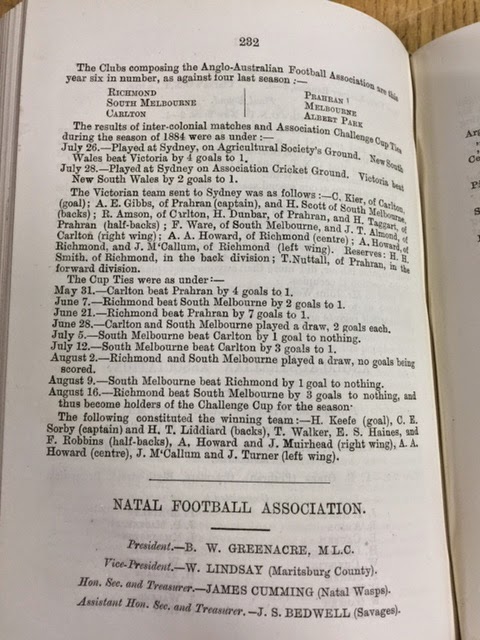
James Hothersall sent me these remarkable documents from London. They are copies from The Football Annuals of 1885 and 1886 Edited by Charles Alcock and Published by Wight & co. They give details I haven't yet found from Australian sources about players and officials. I have calculated years and put them above the document in question.


1884


1885


Tuesday, 12 May 2015

Falling in Love Again

I guess a Sunderland supporter is bound to keep falling in love, as per the Elvis song our fans have been singing for years.


Ask Paul Mavroudis. I do keep falling in football love. And it's a long list:
  • Bob Jane Stadium (sigh, and fuck you Eddie)
  • Kevin Nelson (a goal a game and still not good enough for South fans)
  • Fernando de Moraes
  • Mitch Langerak (he hadn't even circumnavigated his penalty area at Kington in his debut warm up and I knew he was going to play for Australia: "Safe as houses!")
  • Hobart soccer in general and Shae Hickey in particular
  • A kid who plays for my son's futsal team who makes me smile all the while he is playing and who will also play for Australia (I won't name him)
On the other side of this coin I can also lapse into football hate. Sometimes, bear with me, I have had problems understanding and liking Croatian teams and culture. Perhaps I have listened to the media too much - and being snarled at by an angry fan at Somers St didn't help.

A couple of things have changed that perception markedly in recent times - aside from the Cevaps at North Geelong which were definitely something of a head turner. One is the first Croatian soccer identity I have met and got to know, Pave Jusup. An office-bearer with the Melbourne Knights, he is a calm, intelligent and peaceful young man who has his foibles but lets others have theirs. What's more he can write. I wish many of my writing students could write as well as this cultivated Western Suburbs wog electrician. He loves his club passionately and is always thinking of how to defend it (sometimes pre-emptively with rhetorical aggression). For this, social media sometimes turns him into a kind of fire-breathing monster out to wreck Australian soccer only just rescued from the wog abyss by the new breed. He's not. It wasn't.

And it makes sense. How can a community be identical with the representations a sensationalist media makes of it? Of course some people at his club behaved and still behave on a scale between bad and despicable. Meeting Pave has made me realise that I was too influenced by the stereotypes without ever getting to know the people behind them to make a proper judgement.

I hope this doesn't disappoint Pave, but I haven't fallen in love with him, merely developed a strong fondness.

On the weekend I had the privilege of going to watch my son play for Brunswick City U16s in an early season wooden spoon 6-pointer against St Albans Dinamo. We arrived during an U12 girls game and were struck by the number of people milling around the club. Lots of support; lots of encouragement.

My son found his team mates and I wandered into the club, guided by the welcome sign (left) above the entrance. "Welcome", not "You are entering our territory" or "We are shit hot!". Inside the door were two things that caught my eye. First was an old soccer ball in the trophy cabinet. It reminded me of the ones I used to kick around when I first started playing.

The second item was something I'd never seen at a Melbourne soccer club, a well-placed noticeboard (right) both welcoming opposition players and parents and giving a timetable of the day and ground layout. A magnificent example that is a lesson to all.

Tracing my way via the odours wafting from the canteen I found myself in the clubhouse proper: a hall that might hold 300 people or more, a stage, a bar and a food servery advertising some pretty amazing fare. The cevap roll was not offered on Sunday so I had to make do with a bacon and egg roll. I will be going back with a friend or two to order the $80 plate.

I looked at the walls and saw some fairly standard paraphernalia but was blown away by the wall on which were mounted the shirts from present-day A League players and socceroos, Viduka, Culina and Franjic. The A League players were Dugandzic, Kalmar, Kovacevic and several others.


The Socceroo shirts were in pride of place, as was a poster in the entry declaring support for the Socceroos. The first thing that came to my mind was that this was a club with pride. Pride in being Croatian, pride in being Australian, pride in being a valuable contributor to the game in Australia and elsewhere, pride in being a soccer breeding ground.

The next thought was anger. Anger at those who would dismiss St Albans Dinamo as a bunch of wogs living in the past with no relevance to the future of Australian soccer. I wanted to round up everyone who had ever dismissed 'ethnic' clubs and drag them through an impromptu guided tour of this place of history, culture and dignity combined in a most perfect way. Indeed I was falling in football love.

On marshall duty for the day, I wondered whether my new-found respect might be tested by the locals (Our parents were not going to be a problem I tell you. I had to ask them to make some noise at one point.) On the contrary, it was a day of mutual respect and a hard fought game between two teams knowing that this game would be one of their few chances of a win this season. Even the linesmen were brilliant. Theirs was excellent (at least 4 offsides called against his team); ours was OK, missing a couple of offsides (yes, when I saw his AFL umpires jacket I was a bit worried).

The conversation I had at the end with the other marshall was the clincher. A lovely bloke who expressed concern for our kids and gave compliments as he saw fit. He was pleased with the win but commiserated with us. The Dinamo kids were overjoyed. They sang the first verse of the victory song "Oh when the saints etc" but trailed off when the second started (it was the first time they'd sung it this year).

I'd had a great afternoon in what has been a nursery of Australian soccer. It will be a great mistake and a great tragedy for our game if it ever loses that aspect. If I had any influence at all I would get those who want to 'fix' the game down to a day at Dinamo to see just how valuable, progressive and, yes, ethnically diverse this club is.

As I was leaving I sung a song to myself borrowing from Johhny Cash: "St Albans I love every inch of you," without his irony.

Since the day I have wondered about how much AFL star Ivan Maric's presidency has had an impact on the club. Maybe a lot; maybe not much.

Maybe it'll soften my heart to AFL . . . Though perhaps that's a love too far.


Monday, 11 May 2015

Assorted reactions to FFA's Whole of Football Plan

Paul Mavroudis
the unofficial voice  conscience of South Melbourne FC

First published on Paul's South of the Border Blog 

Now I'm not going to go into too much detail about a document whose contents were already decided before they'd even conducted their infamous box ticking consultation from 2014 (for some reason the most popular article ever on this blog). So they want to be the number one sport and cement their autocratic rule by abolishing the states. They told us that months ago - and if we're fair dinkum, there is nothing in this document that should surprise any of us. So here are a bunch of mostly hysterical reactions to this announcement.

Misplaced anger
Some people have been upset by the For Modern Football site's satirical take on South Melbourne's press release. If anyone should be upset though it should be me, because I was doing this kind of stuff years ago.

Cynical
The stated aim of making soccer more affordable to play, especially junior registrations, is a motherhood statement that should be eclipsed by certain realities of the situation, including the backgrounds and statements of those putting forward that rhetoric.

When during the NPL consultation process former FFV CEO Mark Rendell compared the then potential cost of the NPL junior fees to a sport like swimming (as well as classifying South's then $3,500 program as a 'Rolls Royce' program); when Tom Kalas tried to justify the cost of that South program by comparing it to dance, music or karate; and when Kyle Patterson compared the costs of junior soccer to his kid's violin lessons - what does this mean in the context of making soccer more affordable for kids?

At best it's another motherhood statement in a document full of them; at worst, it's insincere about soccer's attempts to go middle class. It's language which speaks to an aspirational segment of Australian society which is not concerned primarily with cost, but with value. In the same way that increasing numbers of middle class people scrimp, save or make sacrifices to send their children to expensive private schools - and to hell with those left behind the in the public system - it's the perceived value that's more important than the price of that sacrifice.

[A side note - whether there is also a cultural and class consciousness element to this is also worth considering. Several years ago on a certain forum, a bloke posted his observation that some middle class English people were moving towards the upper class game of rugby union, in part because of the persistent and/or residual association of soccer with the working class. I don't know if that observation was accurate, and the English class system is obviously quite different to Australia's, but there is I think something intriguing about that assertion, and something that could very well be applicable to those who see soccer as providing a more cosmopolitan sporting option than the insular and boorish (bogan?) Aussie Rules and rugby league cultures.]

In other words, soccer is now a middle class game. The participant is only useful so long as they can be leveraged for more and more money. It's not about fun any more, or belonging to a club, or even being able to take up one sport during the winter and another during the summer. Each soccer loving individual in this country has had a monetary value placed upon their head, whether they are a player, parent, volunteer, fan, media person or even - and while undoubtedly a sign of the times, also a bit frightening - someone mostly interested in soccer video games. And like the cult-ish Evangelical mega-churches the 'we are football' branding and rhetoric reeks of these days, it's bring your credit card with you when you come to worship.

Of course if your bank balance is smaller, or if your involvement in the game generates minimal value for the upper tiers - or heaven forbid, doesn't agree with every part of this Great Leap Forward - you can go and get stuffed. This is disturbing to me because in my line of work I'm required (and want) to see the best in people and their potential. FFA does the opposite. The concept of people getting into and enjoying soccer as an end in itself has been thrown under the bus.

As increasingly seems to be the case these days, I'm reminded of a comment Melbourne Heart CEO Scott Munn made at an academic conference a few years back, about the relative pointlessness of school visits by his organisation.
As an aside, one of the more curious things that was said by Munn, was that one off attempts at trying to convert people to your cause like school clinics were almost doomed to fail (he used some clever analogy about pissing on your own leg - I can't remember how it went, but it was quite funny). 
This was a point expanded upon at last year's Whole of Football Plan meeting in Melbourne, when the failure to leverage soccer's existing base for the A-League was something which FFA wanted corrected (fair enough), but was a point nevertheless which showed how different the priorities of those at the top and those at the bottom were.
The FFA... seemed to think that things like school visits and absurdly inflated participation numbers - which included intangibles like kids playing street soccer - were all about converting kids into being A-League fans. The difference with those of the community club sector was the community club representatives were showing annoyance at the lack of school visits not because of the missed opportunity of getting kids to follow the A-League, but to get them involved with the game of soccer as opposed to other sports.
Some people think soccer is first and foremost a great game to be involved in. Others think the most important thing is not how much you enjoy the experience, but how much they can fleece you for. I guess this is why I'm not in marketing.

Gallows humour

SMFCBLUES07 wrote:
I'll do the honours here

Press release:

smfc wish to announce since there is no future in football we have abandoned ship and will refocus our efforts in strip clubs not social room

The one with a forced literary allusion
In Toni Morrison's novel Beloved,  the slaves learn that 'definitions belong to the definers, not the defined'. The FFA has spent the past ten years applying that lesson. Soccer is, among other things, wogs, violence, incompetence and marginality. Football is other things: good things, Australian things, mainstream things. Most importantly, FFA has learned from the disparagement that soccer received from other codes over the decades, and vowed that it would never succumb to the same fate - not only this, but they have striven to take it to the next level, by appropriating the language of the oppressor and using it as a successful example of wedge politics.

Terms like new dawn and bitter, mainstream and ethnic, new football and old soccer  - they all create division, and almost everyone has bought into them, this writer included. From our side of the fence, there have been those like the long gone Pumpkin Seed Eaters who have attempted creating other names, such as foundation clubs; journalists, when they weren't completely on the bandwagon, traditional clubs; FFV and FFA when they tried to find the most patronising PC term possible, community clubs. The net effect of all these definitions though was to point towards two directions - the past and the future.

Regardless of whether one got sucked into using the terms created by those with the power, or those without it - even my facetious and petty 'I am soccer' catchphrase in response to 'we are football' - the debate has been had on the powerful's terms. It's too late now to to start using different language in the hope that it will somehow turn everything around, but it's not too late to define ourselves outside of the parameters that have set. How we would do that, and what would be appropriate terms to use is an etymological process I'd be interested in seeing developed.

Official
The club released its own response, and it's another in a recent line of measured posts.
MEDIA RELEASE – THE POSSIBLE END OF ASPIRATIONAL FOOTBALL
May 6, 2015 
South Melbourne FC welcomes Football Federation Australia opening up the dialogue about Australia’s football future with the ‘Whole of Football Plan’ released on 5 May 2015. 
However, the current FFA Plan spells the possible end for aspirational football in this country. 
The proposed Plan currently provides no obvious club pathway that allows any club that aspires to develop and improve their process, systems and connection with their communities – or more importantly succeeds on the field – to be promoted as occurs throughout the football world. 
We are also disappointed that the FFA does not detail plans for further development of a second tier of Australian football, to facilitate the intended expansion of the Hyundai A-League and ultimately the implementation of a viable promotion and relegation system. 
Promotion and relegation would assist the improvement of the quality of our top division and provide a breeding ground for players, coaches, officials and aspiring clubs. 
More generally, a key component of all successful ‘plans’ is ‘implementation detail.’ We are keen to review that detail when it gets released. 
The FFA has certainly made great in-roads for our code’s development (for example football broadcasting and the launching of the Westfield FFA Cup), however we are mindful that strategic errors have also been made in the past. 
As a key stakeholder of football in Australia, we will be contacting the FFA to understand and obtain greater detail about their planning processes and to ensure the long term viability and growth of our club. 
Leo Athanasakis, SMFC President
Tom Kalas, SMFC Director
Whatever I may think of the club's approach over these past few years, I'm not going to go out and fault it. They tried to play nice, they tried to be conciliatory, they tried to be collegiate. Melbourne Knights tried to be difficult, tried to dig their heels in, tried to make a scene. No issue with that either. The fact is if they don't want you, they don't want you, and no amount of niceness or hostility is going to change things. Still, it'd be nice if some people, outside of those who are with us now, could have made a bit more of a fuss, if only for show.

Abandoned
This photo is the one the club chose to use to illustrate its press release. I made a comment on the club's Facebook page that it was slightly mischievous. It's a pointed reminder of what we once were, and where we are now. More importantly, it's a reminder that those who could, at the very least, speak up for us - not in an outrageous way, but in a way that they believe that we are still relevant - have chosen not to do so.

That the photo contains two of our most beloved members adds to the sting. And where's former president George Donikian? Spruiking the A-League semi-final with George Calombaris. Where is the Greek community?  At the A-League or the footy, or making fun of us on our Facebook page, telling us we're doomed, that we should give up because they have, and that there's a newer, shinier toy to play with. To be marginalised by the authorities is one thing, but to be marginalised by your own, that's the biggest insult. Making fun of us because we don't get the crowds we used to, as if the people pointing that out aren't part of that problem. And where will Enosi 59 be this week?

Boy, I really didn't see that one coming/Defeatist
Now the part of the announcement that most South fans (plus assorted remnants of old soccer and their associated new dawn sympathisers) picked up on was the FFA finally putting to rest promotion and relegation to the A-League. I am of course on the record as stating that I don't believe promotion is suitable for Australian soccer, and I still hold to that position. But no matter how harebrained I think that idea is, there is something I admire in it, and which seems to have been lost in the wash - and that is that at some level a belief in promotion and relegation is actually an endorsement in FFA, the last ten years and in the future of Australian soccer. It puts forward the belief that there is a viable future soccer in Australia, not just for the 'mainstream' but also the 'traditional'. It's a belief that's not about the old antagonisms, but about sharing a space.

If that's an example of the circumstances of the past ten years creating a sort of forced humility, then so be it. The problem with FFA's approach of incrementally increasing the number of teams in the top flight is that there is still no detail about what plan they'll use. Their own history on the matter is full of contradictions: last October Frank Lowy says that promotion and relegation will happen soon; now they rule it out; David Gallop says they'll fish where the fish are from now on, but now adds that any region with a population of 500,000 will be looked at, despite the problems of Central Coast and North Queensland; they briefly mention in the Whole f Football document that applications for an A-League licence from an NPL team would be possible, but offer no details, no pathway, no method.

Absurd (sans Simpsons reference)
So how do we get back to the top? If the A-League teams monopolise the majority of youth development, if no matter how well you do on and off the park you're effectively locked out, where's the incentive to excel by the processes of reform and self-improvement and by trying to follow the rules such as they exist in the NPL? To merely achieve the honour of being the longest lasting of the ethnic club museum pieces? When I asked on Twitter, rhetorically of course, for someone, anyone, to at least show us the hoops that we need to jump through to make the grade, Mark Bosnich offered to explain it to myself along with the others involved in the relevant discussion, in person next time he comes to Melbourne.While I appreciate the gesture, and would happily take part in such a meeting, I'm curious as to what Bosnich thinks it will achieve. Does he have some special insight or inside knowledge that's not available to the rest of the soccer public?

Absurd (with Simpsons reference)
What I imagine Mark Bosnich will feel like if he ever follows through with his promise to meet with the bitters.

Personal
This isn't just a story about old soccer fans, or South fans in particular. This is a story that has deep resonance to me as an individual. Now I've never run a club, but I have the utmost respect for those people that do put their hand up to do it these days - even when I disagree with them, and even when they fail. No one is closer to the coal face than they are in terms of seeing the problems and institutional injustices every day, and no one understands them better.

But having written this blog for seven and a half years, and having been involved in the online arguments for long before that, I feel I have a unique relationship to this problem. Getting reconnected with South Melbourne in 2006, and having my writing on the forums praised and encouraged (especially by Ian Syson) has lead to a number of peculiar outcomes.

Firstly, for better and for worse I have become the chief voice of South Melbourne fans outside of what the club controls and what some fans on certain forums put out. My self-declared desire to be the reasonable one, to play a straight bat so to speak, has won me some admirers; but the overall effect has been that the necessity and rigour of trying to fine tune the arguments combined with the increasing and ongoing marginalisation of South means that I have found myself backed into an ideological corner.

I'm not alone in that corner, but that's not really the point. There have been plenty of times when I've been jubilant or outraged, cautiously optimistic or maudlin, inspired or defeatist - these are the general swings and roundabouts of being involved with the game at any level. The point here is that because of South Melbourne I have ended up with the career of sorts that I have now, and the option to be broader and more engaged with Australian soccer such as it exists these days.

Every few months I end up having a discussion with Ian Syson where he worries about my own increasing marginalisation in the soccer writing world, a world where he thinks I can contribute intelligent and cogent arguments to a wider reading audience than I do now. And yet every time we have this conversation, I find some myself being more adamant that I can't make myself be the kind of writer that Syson (and others) would want me to be; and instead of embracing those possibilities of taking an interest in and writing for a broader audience, with each passing year I find my focus getting narrower, and my outlook become one that can allow fewer compromises and extensions of faith and trust.

While a measure of this attitude is inevitably down to my being an introvert, a large part of it is because by associating myself so strongly with South Melbourne, I have been made smaller and more insular by the circumstances of our decline, and my reaction towards those whom I hold responsible. Thus as South has been marginalised culturally, so have I, and I can imagine that at times this is a feeling that many South fans have felt over the last ten years or so.

And while I'm a doom and gloom merchant by trade, the fact is that I don't like partaking in defeatism for the sake of defeatism. A former friend, from back in the days when I was involved with left-wing student politics at Melbourne University, who had me pegged as a hopeless pessimist, later told me that she'd been mistaken; that rather than being an outright pessimist, I was a foolhardy optimist, who when my expectations weren't met, descended into cynicism and irony as a coping mechanism. Amateur psychology it may have been, but the fact that she took the time to think about it resonated with me as much as the content of the message itself.

I resolved then to lower my expectations, to be more cautious. But no matter how much you try to do that, we as human beings inevitably see and come to understand these things through our own prism. In that way, South fans see this plan as hostile to our interests. Outside of us, an acquiescent and largely apathetic soccer public just goes along with it. All the pride, the incapacitating anger, the depression that we experience is at best for those outside of our sphere seen as a regrettable and ultimately forgettable novelty.

Having by and large conformed to the new regime, outsiders do not understand the pressure that exists to conform to or engage with this regime - and that by not doing so it means that you become smaller, narrower, and seen as selfish almost by default, when all you as a dedicated South fan see is your loyalty to the cause. I know this, because having been briefly on the other side of this schism, I've learned the arguments from both sides.

We have collectively been made smaller by the experience. There are people who have lost their passion for the game entirely, while others have given up the ghost on the national team. On the latter point, despite my diminished passion for the Socceroos, I never thought that I'd get to the point where I felt my relationship to the national team would have felt like it had been poisoned by South's predicament, but that's where I am now. It takes a certain level of intestinal fortitude to resist, which at times becomes too much to bear - when seen from the outside, it seems as if all sense of perspective is lost

There were many times when I was writing this post where I had to stop because I was so angry and despondent. That we care that much should be seen as a strength, not a weakness; but how do we convince not only others but ourselves, too, of that fact?

Pragmatic fatalism
So what do we do now? The same thing we always do. Support the club, try our best to make it bigger and better despite all the obstacles that we face. In that way we not only honour the work being put in now, but the history of the club as a whole.

Tuesday, 5 May 2015

Soccer on Albert Park 1953

This article from the Sporting Globe in 1953 is an important one. Written by J.O. (Owen) Wilshaw it points to a number of problems bedevilling soccer in Melbourne. It also reveals some interesting history and politics within the game.

Perhaps most important is that it embeds the game in Albert Park, pointing to the then 70-year history of the game there. It also shows the extent to which the game's historical presence is effaced in attempts to reject its requirements.

The article also documents an earlier moment in which ethnic British clubs are effectively wiped out by a council decision which does not seem to have been opposed by the association. Whether the association is guilty of a sin of omission or commission is an interesting question. The point is that from this moment issues a more general, district and sub-district system which includes clubs like Brighton, Moreland, Box Hill and Footscray. There are a lot of parallels between this moment and present-day attempts to squeeze out ethnic clubs in favour of regional and district clubs.

Also covered is the extent to which overcrowding at unenclosed grounds and not ethnicity seems to be the cause of trouble at games in the early 1950s. This is a point that backs up Roy Hay and John Kallinikios's writings on the matter. The fact that 'established' codes and games were also paying peppercorn rentals while soccer was having to fork out big money for their grounds might well be the historical basis of today's ludicrous fees for junior soccer. We need a lot more evidence yet but it is a thought.

Soccer on Albert Park 
Those who oppose the move for a small section of Albert Park being fenced in and made available for cycling and soccer, may not know that the area has been the home of soccer for more than 70 years. Probably the Trust has received more revenue from this than any other code of football. 
In the early 1920s the area on the South side of the Middle Park bowling green was occupied by many soccer clubs whose boundaries almost touched each other. Later the Trust decided to fill in most of that area and it became more or less a rubbish tip. Instead of protesting the clubs accepted the position and strong organisations such as St. Kilda, Northumberland and Durham, Melbourne Thistle, Royal Caledonians and Albert Park were forced Out of existence. Other clubs found grounds in the suburbs which led to the code be-coming wider spread and much more popular than it had been before.
DEAD END
Efforts have been made over the years to obtain some enclosed suburban grounds on a share basis with another code. Generally, Councils turned a deaf ear to overtures. Yet they have received only "peppercorn" rent for grounds and might have received sufficient revenue to cover expenses instead of being a drag on ratepayers. Most trouble over the last year or so is that up to 10,000 spectators have attended unfenced grounds with nothing between them and the playing arena. Naturally, those not in a position to see what is taking place put on pressure which leads to those in front being forced on to the playing area and causing interference to players. 
Such incidents often lead to a "free-for-all" which brings the game into disrepute. Properly enclosed grounds would eradicate this. The Soccer Association is prepared to put in up to £1000 towards the fencing and pay substantial rent for use of the ground as well. Another aspect is that the public would not be excluded from the area any more than they are when a game is in progress in the vicinity on Saturdays — about four hours at most.

Tuesday, 28 April 2015

Anzac forgetting and remembering


For Scott McIntyre


Anzac Day continues to move us,
& grow, despite attempts to make it 
a media event (left to them we’d attend
‘The Foxtel Dawn Service’). But The March is
proof we got at least one thing right, informal,
straggling & more cheerful than not, it’s
like a huge works or 8 Hour Day picnic-
if we still had works, or unions, that is.
John Forbes

They said:
Today, this day, is not the day to remember some things.
Today, this day, is the day to remember other things,
They said.
Today we will remember some things but not others.
Today we will not remember innocent children, on the way to school, murdered,
their shadows seared into the concrete of Hiroshima.
Today we will not remember that two of the largest single-day terrorist attacks in history were committed by our allies in Hiroshima & Nagasaki.
Today we will not remember the summary execution, . . . rape and theft committed by some ‘brave’ Anzacs in Egypt, Palestine and Japan.

Poorly-read, largely white, nationalist drinkers and gamblers are not allowed to pause today to remember the horror that all mankind suffered.
Poorly-read, largely white, nationalist drinkers and gamblers seem unable to pause today to remember the horror that all mankind suffered.
We will not remember that Anzac Day has become the cultification of an imperialist invasion of a foreign nation with which Australia had no quarrel.
We will not remember that this is against all ideals of modern society,
largely because it has never even crossed our minds.

Today we will remember and idealise the Australian soldier,
devoid of malice, devoid of sin, devoid of life
and wait for another day in a few days, weeks or months’ time
to let the truth-telling begin.

If we remember.

Monday, 27 April 2015

The Week that Was

Last week was my busiest for a while: marking, lecturing and watching a veritable churn of my work going out into the public via various sources.

My work on Soccer Anzacs in Victoria had reached a critical mass. Athas Zafiris (of Shoot Farken fame) and I had worked our arses off putting together the bones of a database of Victorian soccer players in 1914-1915. We had reached a point where we could start to make some decent substantive observations: 800-100 players, 70-80% enlistment rate, 15-25% casualty rate of those who enlisted, for example.

We also had identified a number of interesting and moving stories about teams, mates and players that were worthy of sharing.

FFV had agreed to publish material I supplied them. They started with an overview piece 'Behind the Lines' to which they attached the series of cameos. They generously allowed me to seek further publication for the material, So I was delighted when Joe Gorman at Leopold Method agreed to spread the word in a series called 'We Shall Remember Them'.

The stories also reached The St Kilda News and the Mirboo North local paper (waiting for confirmation of the latter).

I was truly astounded though by the effect of my piece on the Irymple 9 published in the Sunraysia Daily. The article was read by vice-captain of the present day Irymple Knights, Chris Romeo, who decided to act and create a brief commemoration ceremony for the 9 before his team's pre-season cup final against Three Colours. I will try to get a report from Chris when I can.

My final publication of the week came in the publication of this article Soccer also made its sacrifice in the Sunday Age, a kind of summary and example of the material I published during the week. It was also published concurrently on the SMH website.

I need to thank a number of people and bodies. FFV helped with funding and Athas Zafiris played a vital role of being both a smart and energetic addition to the project. Mark Boric and Roy Hay gave vital database and other kinds of support. Damian Smith still provides me with an inspiration for this work.

Wednesday, 1 April 2015

Anzac Day, by John Forbes

I think this is now my yearly Anzac Day ritual.

"Anzac Day" is one of John's final poems, written in the year before his death in 1998. He didn't care much for soccer, being a rugby league follower. Cronulla was his team, appropriately enough given John's history of drug use. He and I used to imagine we were the only ones interested in rugby league in Melbourne literary cicles and so we'd meet to watch grand finals at his place or mine. This poem nails Anzac Day.

I wonder what he'd make of things 18 years on.

Anzac Day

A certain cast to their features marked
the English going into battle, & then, that

glint in the Frenchman’s eye meant ‘Folks,
clear the room!’ The Turks knew death

would take them to a paradise of sex
Islam reserves for its warrior dead

& the Scots had their music. The Germans 
worshipped the State & Death, so for them

the Maximschlacht was almost a sacrament.
Recruiting posters made the Irish soldier

look like a saint on a holy card, soppy & pious,
the way the Yanks go on about their dead.

Not so the Australians, unamused, unimpressed
they went over the top like men clocking on,

in this first full-scale industrial war.
Which is why Anzac Day continues to move us,

& grow, despite attempts to make it 
a media event (left to them we’d attend

‘The Foxtel Dawn Service’). But The March is
proof we got at least one thing right, informal,

straggling & more cheerful than not, it’s
like a huge works or 8 Hour Day picnic-

if we still had works, or unions, that is.